
The direct answer
An e-way bill begins with movement of goods, not an invoice alone. Under the central Rule 138 framework, movement with consignment value exceeding ₹50,000 generally requires the prescribed information before movement, subject to special provisos, exemptions and State-specific intra-State rules. Responsibility may fall on the registered consignor, registered consignee or transporter depending on who causes the movement and the arrangement.
For current validity, movement outside the special category receives one day for every 200 km or part. Over Dimensional Cargo, and a multimodal shipment in which at least one leg involves transport by ship, receive one day for every 20 km or part. Validity starts with the first Part B vehicle or transport-document entry.
Reviewed against primary sources on 20 October 2026. Check the live central rule, relevant State notification, goods, route and portal status before dispatch. This guide does not decide a particular consignment.
Apply the movement test first
Rule 138 covers movement in relation to a supply, movement for reasons other than supply and specified inward movement from an unregistered person. A sale invoice can exist without goods moving, and goods can move without a sale.
Examples of non-sale movement include a stock transfer, goods sent for job work, a return, an exhibition movement or goods sent for testing. Use the document that correctly describes the movement, such as the applicable invoice, bill of supply or delivery challan. Do not create a sales invoice merely to obtain an e-way bill.
Services alone do not create an e-way bill because the control concerns goods movement. A mixed transaction still needs the actual goods, document and consignment facts reviewed.
Calculate consignment value correctly
The central trigger is generally more than ₹50,000, not “₹50,000 and above”. Rule 138's explanation includes the applicable central, State or Union Territory, integrated tax and cess in the declared document value. Where one invoice covers taxable and exempt goods, the exempt-goods value is excluded for this consignment-value calculation as the rule provides.
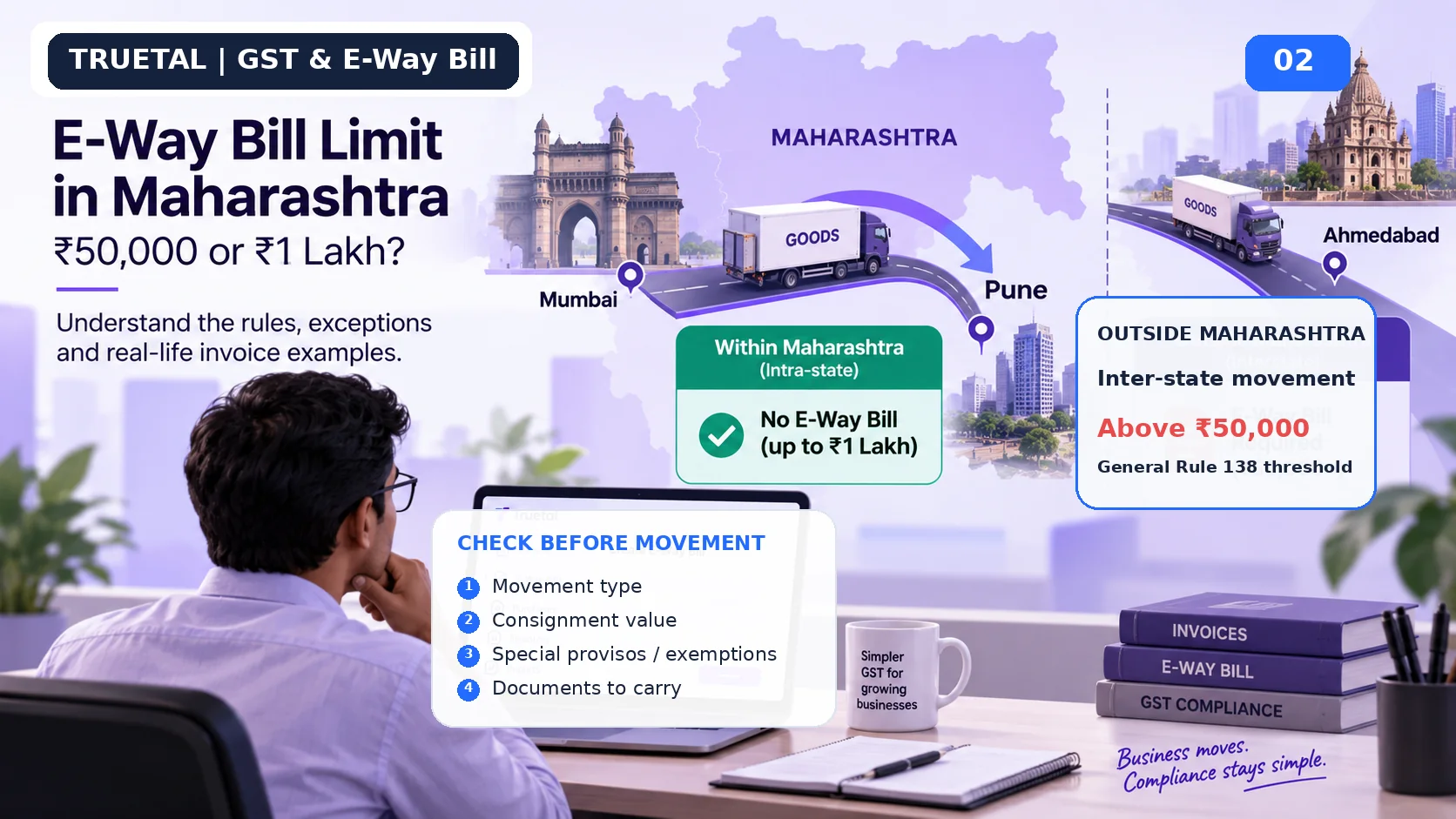
Do not stop at the headline threshold. Specified inter-State job-work and handicraft movements can require an e-way bill irrespective of consignment value. The rule also lists exemptions, and a State or Union Territory may have a different intra-State position.
For a focused threshold worksheet, use Invoice above ₹50,000: do you need an e-way bill?. Maharashtra readers should separately check the Maharashtra intra-State e-way bill limits; that State position must not be copied to another State or to an inter-State movement.
Assign the generator before dispatch
Where the registered supplier causes the movement, the supplier will ordinarily furnish the required details. Where the recipient causes movement in the relevant circumstances, responsibility may sit with the recipient. A transporter can generate or complete the record when it is assigned or the rules place the task there.
Write this responsibility into the dispatch checklist. Record the GSTIN or transporter ID, who enters Part A, who completes Part B, who checks the vehicle or transport document and who monitors validity. “Transporter will handle it” is not enough when no transporter ID or proof is attached.
A consolidated e-way bill is a transport convenience for multiple individual e-way bills; it does not replace the underlying document-level records.
Part A is not a completed movement record
Part A describes the consignment. If the vehicle number for road or the transport-document number for another mode is not entered, the portal may produce only a Part-A slip. NIC guidance states that completing Part B converts it into the e-way bill for movement.
The validity clock starts with the first Part B entry: the first vehicle entry for road or the first transport-document number for rail, air or ship. Updating Part B later for a vehicle change does not restart or recalculate the original validity.
Check the actual dispatch-from and ship-to locations. Bill-to/ship-to and bill-from/dispatch-from cases need the real transaction type and addresses, not a copy of the billing address into every field.
Calculate validity by distance and cargo type
The current rule calculates each day for the stated distance or part. The 20 km category also covers multimodal shipments with at least one ship leg. Validity begins with the first Part B entry and is not restarted by later updates.
| Movement type | Validity basis | Illustrative distance | Illustrative validity |
|---|---|---|---|
| Movement outside the ODC and qualifying ship-leg multimodal category | One day for every 200 km or part thereof. | 310 km | Two days. |
| Movement outside the ODC and qualifying ship-leg multimodal category | One day for every 200 km or part thereof. | 200 km | One day. |
| Over Dimensional Cargo, or multimodal shipment with at least one ship leg | One day for every 20 km or part thereof. | 45 km | Three days. |
| Over Dimensional Cargo, or multimodal shipment with at least one ship leg | One day for every 20 km or part thereof. | 20 km | One day. |
The “or part thereof” wording matters. A regular 201 km movement is not one day; it crosses into the next 200 km block. ODC and qualifying ship-leg multimodal movements use the 20 km basis instead. The ship condition matters: do not place every multimodal journey in the 20 km category.
NIC guidance explains the portal day calculation and says validity expires at midnight on the last day. Use the “valid up to” value returned by the actual portal record as the operational control instead of reconstructing the timestamp from memory.
Worked dispatch example
Assume a registered manufacturer sends taxable goods with a supported consignment value of ₹1,20,000 from Pune to a registered customer, and the approximate regular-road distance shown for the route is 310 km.
- Goods are moving in relation to a supply, and the central value threshold is crossed.
- The dispatch team checks the relevant State/inter-State facts and confirms no exemption applies.
- The manufacturer and transporter agree who completes each part before loading.
- The document, consignee, dispatch address, transporter ID and vehicle details are checked.
- At 310 km for regular cargo, the current distance rule gives two days because the movement uses one 200 km block plus part of the next.
- The team stores the e-way bill number, generation time, valid-up-to value and actual Part B details with the dispatch evidence.
Now change only one fact: the load is validly classified as Over Dimensional Cargo and the distance is 45 km. The special-category basis gives three days because 45 km spans three 20 km blocks or parts. The same distance basis applies to a qualifying multimodal shipment with at least one ship leg. Do not classify ordinary freight as ODC, or every multimodal movement as ship-leg multimodal, to obtain a different period.
E-invoice data does not finish the e-way-bill test
An authorised IRP can share relevant invoice data with the e-way-bill system, reducing repeat entry. That does not decide whether goods are moving, whether the consignment is exempt, who is responsible, or whether Part B is complete.
E-invoicing and e-way bills therefore need separate status fields. One authenticates covered invoice data; the other controls the prescribed movement record. Use the e-invoice applicability guide for the supplier and document test.
Handle delay before the record expires
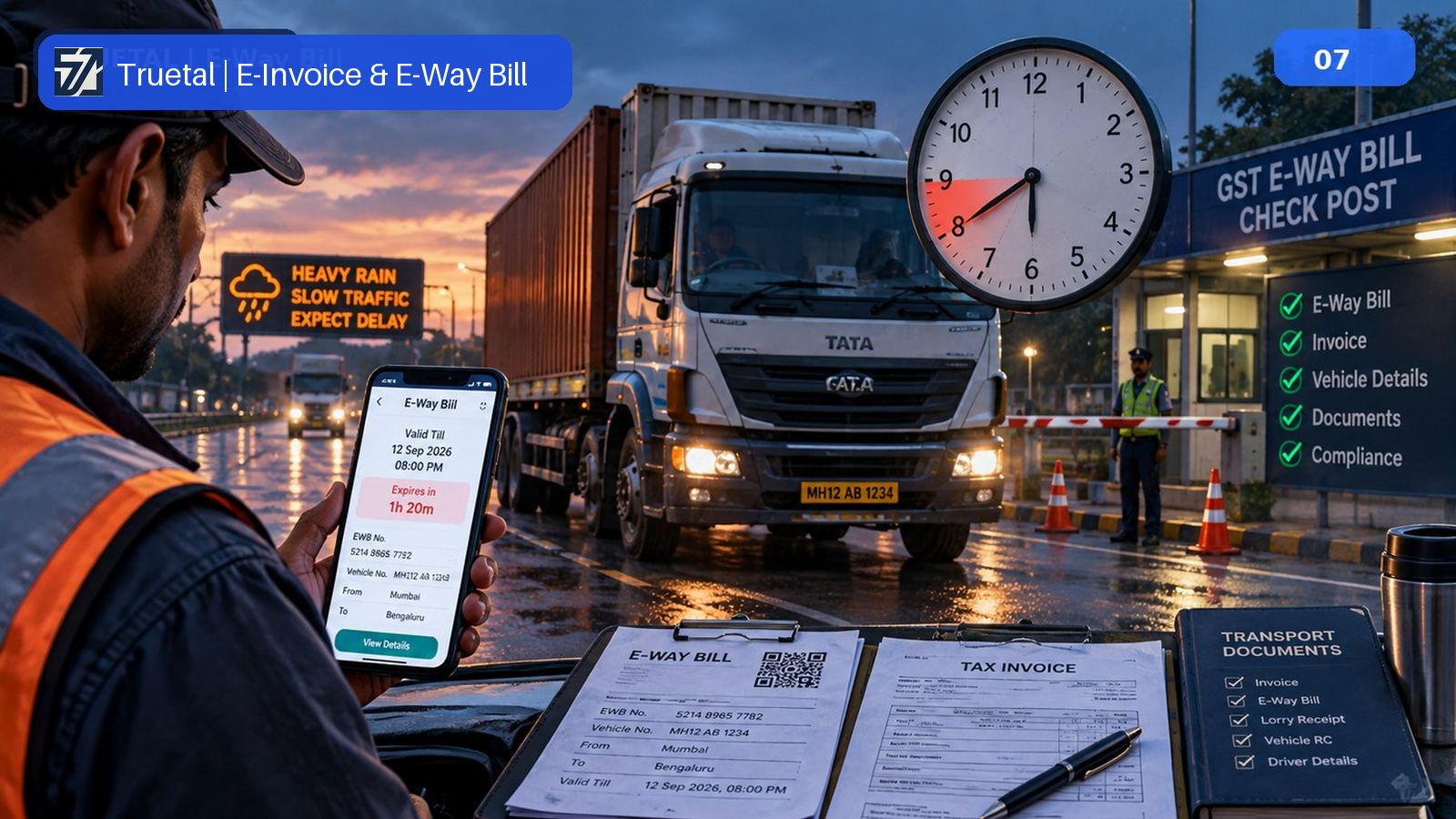
Monitor the portal's valid-up-to value, current location, remaining distance and transporter. For exceptional circumstances such as a breakdown, accident, natural calamity or trans-shipment delay, current NIC guidance provides an extension route around expiry and requires the transporter to state the reason and update the relevant movement details.
An extension is not an ordinary planning tool. If the e-way bill expires, goods should not continue moving merely because an internal spreadsheet says an extension will be requested later. Use the official route and retain the result. The separate expired e-way bill and eight-hour extension guide covers that recovery control in detail.
Dispatch checklist
- Confirm that goods are physically moving and record the reason.
- Select the correct invoice, bill of supply, delivery challan or bill of entry.
- Calculate consignment value under the rule.
- Test special provisos, exemptions and the relevant State position.
- Assign consignor, consignee and transporter responsibilities.
- Verify GSTINs, addresses, PIN codes and transaction type.
- Complete the required transport details before movement.
- Check approximate distance, cargo type and portal valid-up-to value.
- Give the person in charge the prescribed document and e-way bill number or copy.
- Monitor changes, breakdowns and delays before expiry; preserve every update.
Common mistakes
- Testing the invoice total without confirming movement of goods.
- Treating exactly ₹50,000 as automatically exceeding ₹50,000.
- Copying one State's intra-State threshold to another State.
- Calling a Part-A slip a completed e-way bill.
- Assuming a vehicle update restarts validity.
- Using the 200 km category for ODC or qualifying ship-leg multimodal movement, or applying the 20 km category to every multimodal journey.
- Believing an IRN automatically completes Part B.
- Moving goods after expiry without a valid official extension.
- Failing to keep the generated number and movement evidence with the dispatch record.
How Truetal helps—and where it stops
Truetal can keep invoice, dispatch, customer and transporter master data organised so an authorised user can prepare for the official workflow and retain the resulting evidence. It can help prevent the billing and dispatch records from drifting apart.
Live e-way-bill generation is currently coming soon, not a production capability represented by this article. Use the official NIC portal or an enabled provider for generation and extension. Truetal does not decide exemptions or replace the person responsible for checking the movement.
Frequently asked questions
Is an e-way bill required whenever an invoice exceeds ₹50,000?
Not from invoice value alone. Confirm that goods are moving, calculate consignment value under Rule 138, check special provisos and exemptions, and apply the relevant State or Union Territory rule for intra-State movement.
Who should generate the e-way bill?
Depending on who causes the movement and the registration and transport arrangement, responsibility may sit with the registered consignor, registered consignee or transporter. Assign it before dispatch and retain the actual generated record.
How long is an e-way bill valid for regular cargo?
For movement outside the ODC and qualifying ship-leg multimodal category, the current rule states one day for every 200 km or part thereof. For example, an approximate distance of 310 km gives two days.
Which e-way bill movements use the 20 km validity category?
The one-day-per-20-km-or-part category applies to Over Dimensional Cargo and to multimodal shipments in which at least one leg involves transport by ship. Do not apply it to every multimodal movement.
When does e-way bill validity start?
NIC guidance says validity starts with the first Part B entry: the first vehicle entry for road or the first transport-document number for rail, air or ship. Later Part B updates do not recalculate the original validity.
Can an expired e-way bill be extended?
The current portal guidance permits the current transporter to request extension for specified exceptional circumstances within the portal window around expiry, with the reason, current place, remaining distance and Part B details. Goods should not keep moving on an expired document.
Sources
- CBIC — current Rule 138: movement, consignment value, responsibility and exceptions
- NIC E-Way Bill System — current portal and advisories
- NIC — current e-way bill FAQs: validity, Part B and extension
- NIC API release notes — 200 km validity change from 1 January 2021
- NIC — current extend-validity API and required details