The direct answer
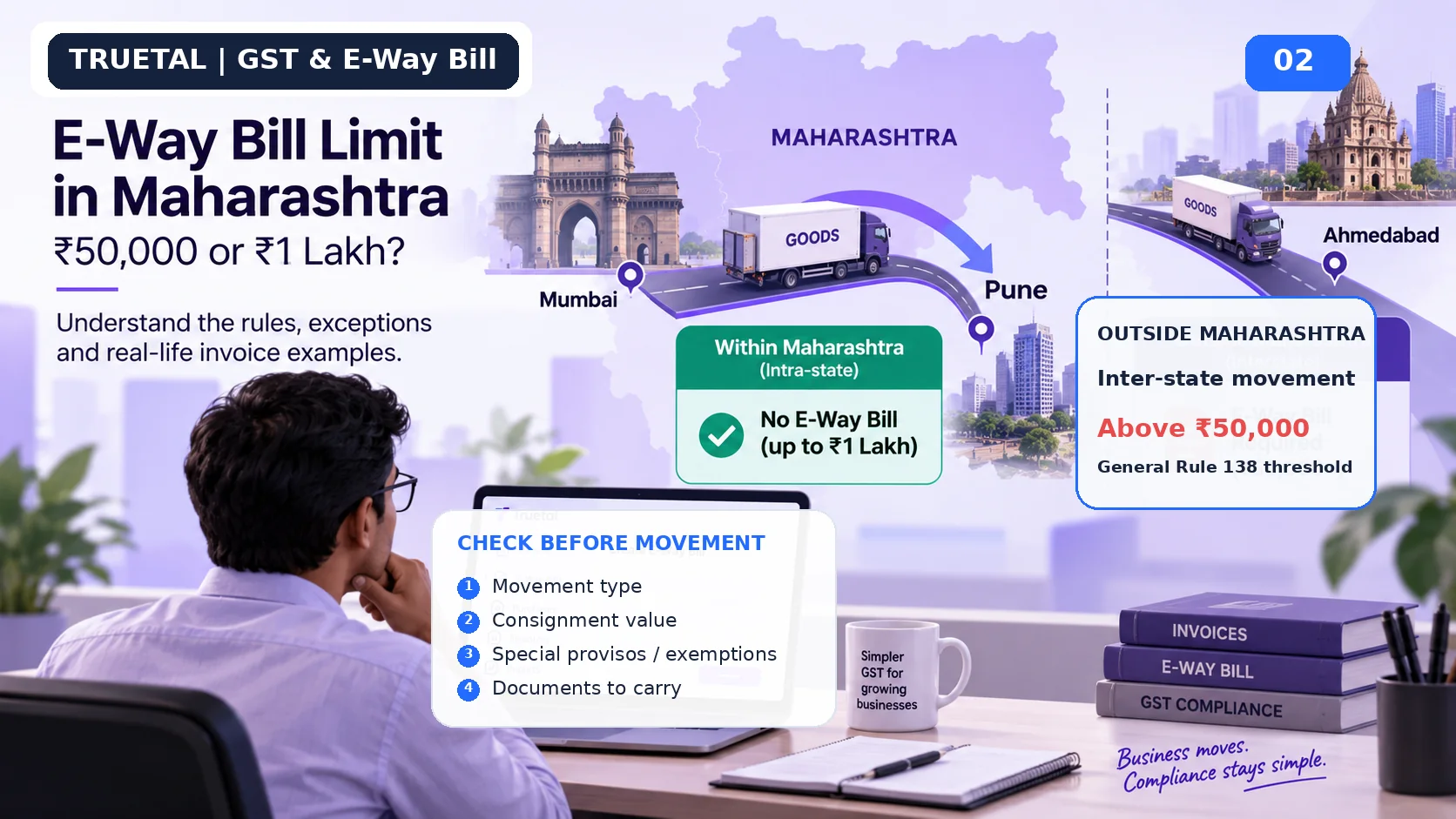
As verified on 19 October 2026, Maharashtra Notification 15E/2018 exempts qualifying movement that begins and ends within Maharashtra where consignment value does not exceed ₹1,00,000, including exactly ₹1 lakh. For interstate movement, the general Rule 138 trigger is value exceeding ₹50,000, not ₹50,000 or more. Include applicable GST and cess in consignment value, then check special provisos and exemptions. The 2024 specified-goods amendment did not replace Maharashtra’s general ₹1 lakh row.
Last reviewed: 19 October 2026.
In Plain Words
Start with the route, not the invoice amount. If the goods move entirely within Maharashtra, check Maharashtra’s state notification. If the goods cross the Maharashtra border, apply the general GST e-way bill rule and any applicable special provisos.
Then calculate the consignment value, not just the taxable value. Under Rule 138, consignment value is the value determined under section 15 and declared in the invoice, bill of supply or delivery challan, and it includes GST and cess charged in that document. Where one invoice contains both exempt and taxable goods, the value of exempt supply is excluded for this purpose under the rule’s explanation.
Finally, check the nature of movement. A sale, stock transfer, job work, return or movement for another reason can have different documentary consequences. An e-way bill is a movement document; it does not by itself decide whether the movement is revenue, inventory transfer, job work or a return in your accounts.
Why This Problem Happens
The confusion exists because most GST explainers begin with the central Rule 138 threshold of ₹50,000 and stop there. Maharashtra exercised the state-level power under Rule 138(14)(d) and issued Notification 15E/2018, effective from 1 July 2018, giving a higher exemption for qualifying intra-state movement.
That means a national “₹50,000 rule” chart is incomplete for a business dispatching goods only within Maharashtra. We rechecked the active CBIC rule, the principal State notification, its 2024 amendment and Maharashtra’s unfiltered notification index on 19 October 2026. No later general replacement of the ₹1 lakh row was identified in those records. Later named-manufacturer road-testing permissions are not a new threshold for every business.
The second source of confusion is wording. The central rule says consignment value exceeding ₹50,000. “Exceeding” is not the same as “₹50,000 or more”. A consignment of exactly ₹50,000 does not cross that general value threshold, although other provisions can still create an e-way bill requirement.
The third source is special cases. For goods sent by a principal in one State or Union territory to a job worker in another State or Union territory, Rule 138 requires an e-way bill irrespective of value. It may be generated by the principal or by the job worker, if the job worker is registered. The rule also contains an interstate handicraft proviso for specified persons. State notifications can add or change exemptions for particular goods or purposes, so the transaction type must be checked before dispatch.
Problem → Risky Behaviour → Correct Control → Result
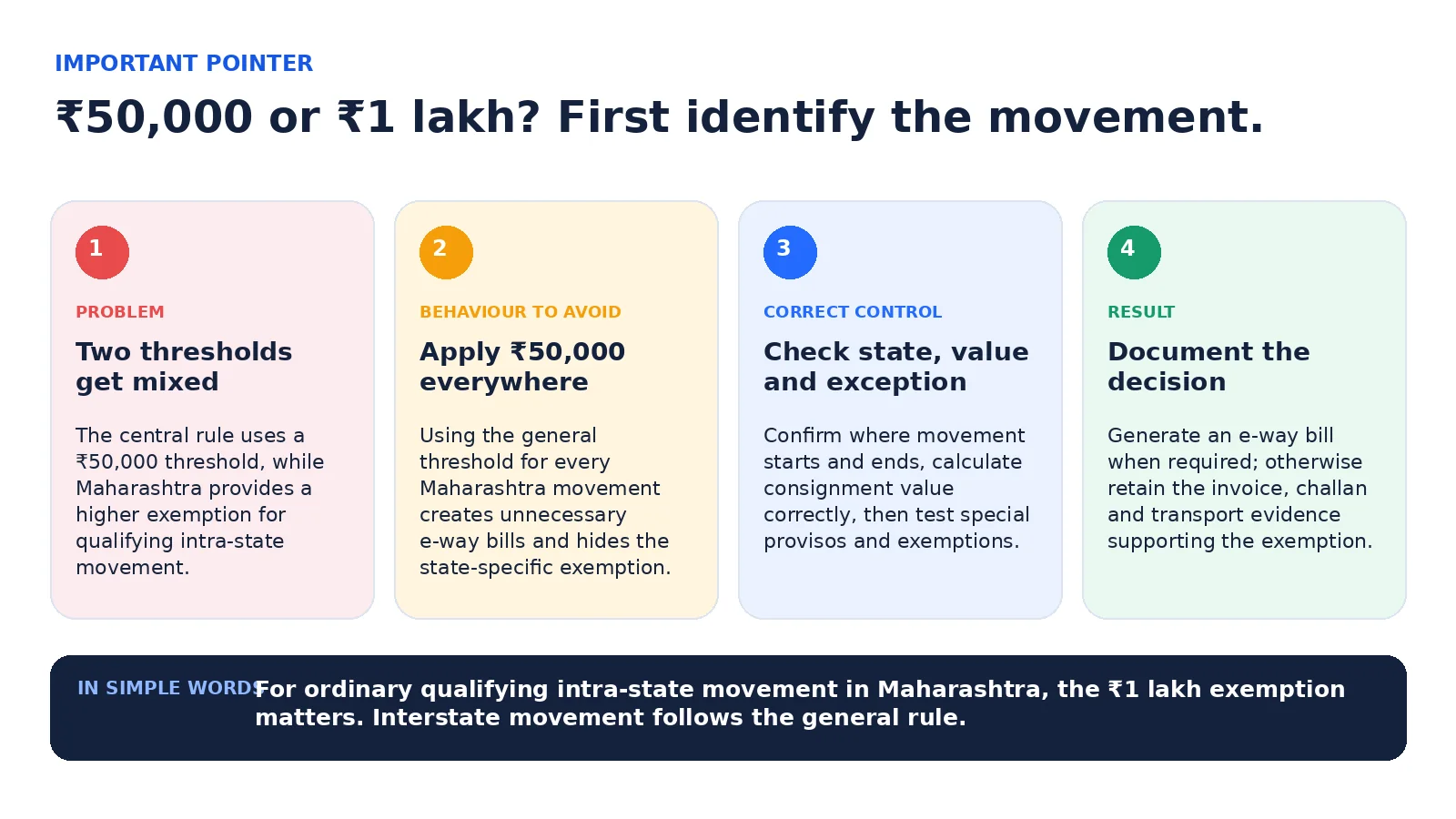
The problem is mixing a national threshold with a Maharashtra-specific exemption. The risky behaviour is using one number for every goods movement. The correct control is a four-part check: route, value, purpose and exception. The result is an e-way bill decision you can explain later with documents.
For every dispatch, keep a short internal trail:
- origin and destination;
- whether movement is intra-state or interstate;
- invoice/bill of supply/delivery challan number;
- consignment value used for the threshold test;
- reason for movement;
- e-way bill number, if generated; or
- exemption/exception relied on, if not generated.
This is far better than relying on somebody remembering “the limit is ₹1 lakh”.
Worked Example
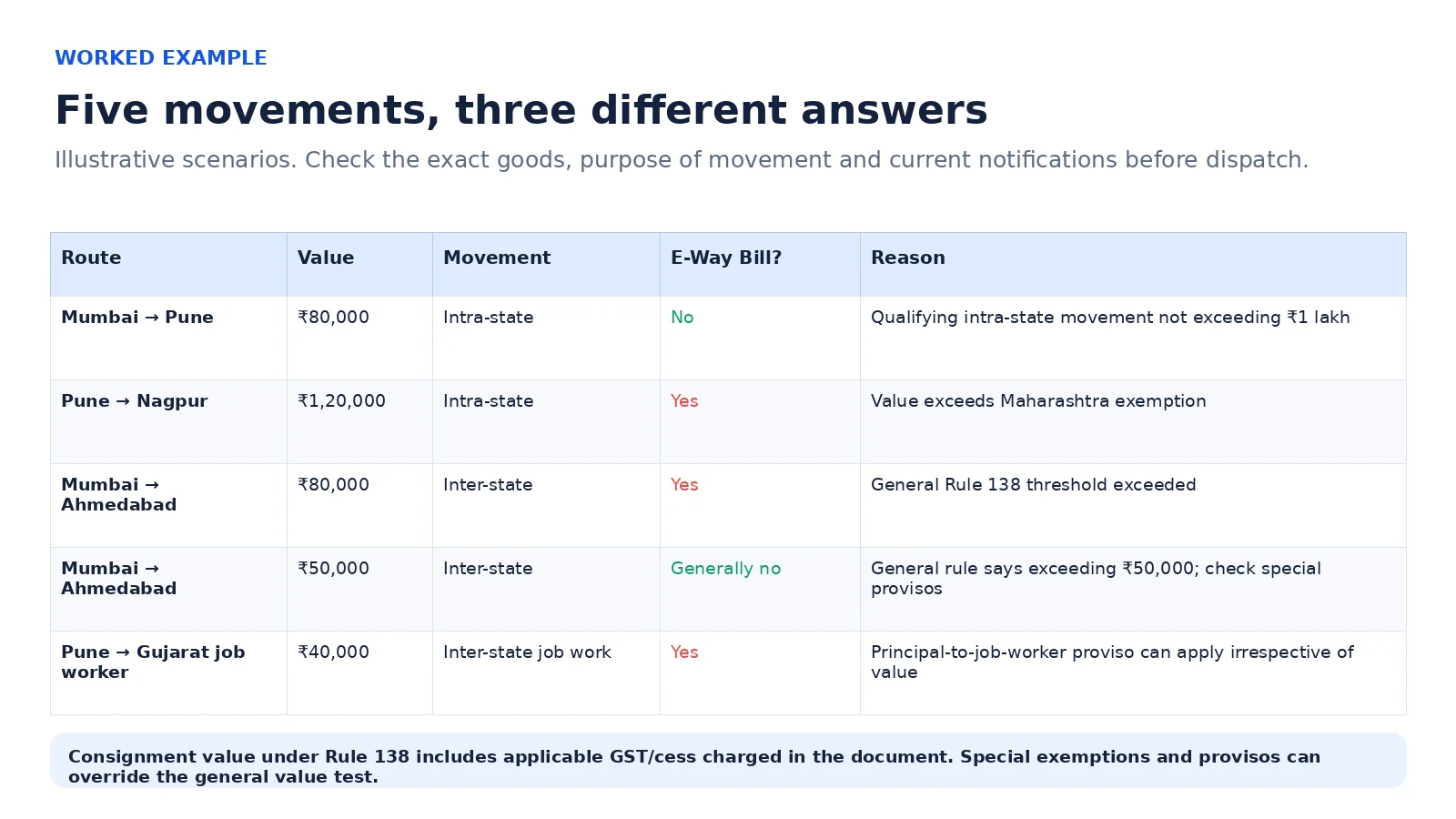
The following cases are illustrative and assume no other special exemption or requirement unless stated.
| Movement | Consignment value | General answer | Why |
| Mumbai → Pune sale | ₹80,000 | No e-way bill, if conditions are met | Movement starts and ends in Maharashtra and does not exceed ₹1 lakh |
| Pune → Nagpur sale | ₹1,00,000 | Within the general Maharashtra exemption | The State row includes value exactly at ₹1 lakh |
| Pune → Nagpur sale | ₹1,00,001 | E-way bill generally required | The general Maharashtra exemption is exceeded; check separate exemptions |
| Mumbai → Ahmedabad sale | ₹80,000 | E-way bill required | Interstate movement and general ₹50,000 threshold is exceeded |
| Mumbai → Ahmedabad sale | ₹50,000 | Generally not triggered by value alone | Rule 138 says “exceeding ₹50,000”; check special cases |
| Mumbai → Ahmedabad sale | ₹50,001 | E-way bill generally required | The general interstate value trigger is crossed; check exemptions |
| Pune principal → Gujarat job worker | ₹40,000 | E-way bill required | Interstate principal-to-job-worker proviso applies irrespective of value; the principal or registered job worker may generate it |
GST-inclusive value example. A Mumbai-to-Pune consignment has taxable goods worth ₹90,000 and illustrative GST of ₹16,200 (18%), with no exempt goods or cess. Its consignment value is ₹1,06,200, not ₹90,000. It therefore exceeds the general Maharashtra ₹1 lakh exemption, subject to any separate exemption. Verify the actual tax rate for the goods.
The exact-boundary rows matter. If software simply codes value >= 50000 → e-way bill required, it can produce the wrong result for an ordinary ₹50,000 interstate consignment. The basic value test should be value > 50000, followed by the special-case rules.
For movement that both begins and ends within Maharashtra, row 1 of Notification 15E/2018 exempts any goods where consignment value does not exceed ₹1 lakh. Separate rows provide additional any-value exemptions for specified goods and purposes.
GST and Accounting Treatment
An e-way bill decision should not be used as an accounting decision. The e-way bill answers whether movement information must be furnished for the goods. The accounting entry depends on the underlying event.
A normal customer sale may create revenue, output GST and a receivable. A stock movement within the same GST registration may be an inventory movement rather than a sale. A transfer between distinct GST registrations can have a different GST treatment. Goods sent for job work remain linked to the principal’s inventory and job-work documentation rather than being treated as ordinary sales merely because an e-way bill exists.
The supporting document also matters. Rule 138 refers to invoice, bill of supply or delivery challan while defining consignment value. Keep that source document aligned with the actual reason for movement.
Do not “fix” an e-way bill problem by changing the accounting classification or invoice value without a genuine commercial or tax reason. Bank evidence, accounting classification and GST movement compliance are separate layers.
The Four Steps at a Glance
1. Identify the movement. Does it start and end within Maharashtra, or does it cross a state border?
2. Calculate the consignment value. Use the Rule 138 definition, including applicable GST and cess charged in the document.
3. Check purpose and exceptions. Sale, job work, stock movement, return and specified goods may not follow the same route.
4. Generate or document. If an e-way bill is required, generate it before movement and keep the necessary transport details. If it is not required, retain the invoice/challan and the basis for the exemption.
Exceptions and Edge Cases
Exactly ₹50,000 interstate. The general value trigger is not crossed because the rule says “exceeding ₹50,000”. Optional generation is permitted below the threshold, and special cases can still require generation.
Exactly ₹1,00,000 within Maharashtra. Notification 15E/2018 uses “not exceeding Rs. 1 Lakh” for the general intra-state row, so qualifying movement at exactly ₹1 lakh falls within that exemption.
Interstate job work. Goods sent by a principal in one State or Union territory to a job worker in another require an e-way bill irrespective of value. The principal may generate it, or the job worker may generate it when registered.
Handicraft goods interstate. Rule 138 also contains a special proviso for certain handicraft movements by persons exempted from registration under specified clauses.
Hank, yarn, fabric and garments for job work. From 1 July 2018, Notification 15E/2018 provides an any-value exemption where these goods move up to 50 kilometres within Maharashtra for job work.
Turmeric, chilli and raisins for specified movement. The Gazette dated 1 October 2024 adds row 3 for turmeric, chilli (genus Capsicum) and raisins, at any value, transported up to 50 kilometres within Maharashtra for the notification’s stated purposes: (a) job work; and (b) storage and warehousing. Match the goods, route, distance and purpose to the exact table before relying on this exemption; it does not exempt every movement of these goods.
These special rows add exemptions; they do not remove the general ₹1 lakh row for any goods moving wholly within Maharashtra.
A journey below 50 km is not automatically exempt. Rule 138 has limited up-to-50-km provisions for the consignor-to-transporter leg for further transportation and the final transporter-to-consignee leg within the same State or Union territory. These concern furnishing or updating conveyance particulars in Part B, not a general exemption from the e-way bill itself. Do not confuse them with Maharashtra’s separate goods-specific exemption rows.
Movement where e-way bill is not required under Rule 138(14). The central rule itself lists categories where an e-way bill is not required. These should be tested separately from the value threshold.
What to Do Now
For a Maharashtra business, add a dispatch check before goods leave the premises:
- Confirm “From” and “To” state from the actual movement, not only the billing address.
- Calculate consignment value using the GST rule definition.
- Identify the reason for movement: supply, stock transfer, job work, return or another reason.
- Check Maharashtra Notification 15E/2018 and the latest amendments for intra-state movement.
- Check Rule 138 provisos for interstate special cases.
- Generate the e-way bill where required before movement.
- Keep the invoice/bill of supply/delivery challan and transport evidence even where the state exemption applies.
If your dispatch team regularly asks the same question, turn this into a system rule rather than a WhatsApp discussion every time.
Common Mistakes
Using ₹50,000 for every Maharashtra dispatch. This ignores the Maharashtra intra-state notification.
Using ₹1 lakh for interstate movement. The Maharashtra exemption is for movement that commences and terminates within the state under the notification.
Coding the general test as ₹50,000 or more. Rule 138 uses “exceeding ₹50,000”.
Checking only invoice taxable value. Consignment value includes applicable tax and cess charged in the document under the rule’s explanation.
Assuming every stock transfer is exempt. The route, registrations and reason for movement must be checked.
Assuming a delivery challan means no e-way bill. A challan may be the correct movement document, but the e-way bill requirement still has to be tested separately.
Treating old blog posts as the law. State notifications can be amended. Re-check Maharashtra’s current notification list before building permanent software logic.
How Truetal Helps
Truetal helps organise invoices, purchases, inventory and accounting records behind a dispatch. Keep the source document, actual movement details and review evidence aligned rather than changing an invoice to fit a remembered threshold.
e-Way Bill generation is coming soon in Truetal; it does not generate e-way bills today. Use the official e-way bill portal where generation is required. A software record or this guide is not an official e-way bill or a case-specific tax opinion.
FAQ
What is the e-way bill limit in Maharashtra in 2026?
For qualifying movement that begins and ends within Maharashtra, Notification 15E/2018 exempts any goods with consignment value not exceeding ₹1,00,000. For interstate movement, the general Rule 138 value trigger is exceeding ₹50,000. Special provisos and exemptions must still be checked.
Is an e-way bill required at exactly ₹1 lakh within Maharashtra?
Qualifying intra-state movement at exactly ₹1,00,000 falls within the notification’s not-exceeding exemption. At ₹1,00,001 that general exemption no longer applies; check whether a separate goods-specific exemption applies before deciding.
Is an e-way bill required at exactly ₹50,000 for interstate movement?
The general value trigger is not crossed at exactly ₹50,000 because Rule 138 uses exceeding. At ₹50,001 it is crossed. Special cases, including interstate principal-to-job-worker movement, can require an e-way bill irrespective of value.
Does the e-way bill value include GST?
Yes. Rule 138 includes GST and cess charged in the invoice, bill of supply or delivery challan in consignment value. Where an invoice contains both exempt and taxable goods, the exempt goods’ value is excluded as prescribed. Do not compare only the taxable value with the threshold.
Is there a general exemption for every movement below 50 km?
No. The limited up-to-50-km consignor-to-transporter and transporter-to-consignee provisions concern conveyance particulars in Part B, not a blanket exemption from generating an e-way bill. Maharashtra also has separate, narrowly specified goods-and-purpose exemptions; their exact conditions must be met.
Is an e-way bill required for interstate job work below ₹50,000?
Where a principal in one State or Union territory sends goods to a job worker in another, Rule 138 requires an e-way bill irrespective of consignment value. It may be generated by the principal or by the job worker, if registered. Check intra-state Maharashtra job-work exemptions separately.
The Takeaway
For Maharashtra, do not memorise one e-way bill number. Memorise the decision sequence.
Within Maharashtra: qualifying general intra-state movement not exceeding ₹1 lakh can use the Maharashtra exemption. Across a state border: the general threshold is value exceeding ₹50,000, followed by special provisos and exemptions. In every case, the actual goods, reason for movement and current notifications still matter.
Sources
- CBIC — active Rule 138, including valuation and special provisos (checked 19 October 2026)
- Maharashtra State Tax — Notification 15E/2018, dated 29 June 2018; applies from 1 July 2018
- Maharashtra State Tax — specified-goods amendment, Gazette dated 1 October 2024
- Maharashtra GST — current unfiltered notification index (checked 19 October 2026)
- NIC E-Way Bill System — official FAQs