
The direct answer
GST e-invoicing generally applies when a registered supplier's PAN-wide aggregate turnover exceeded ₹5 crore in any relevant financial year from 2017-18 onward, unless a notified entity exemption applies. The current ₹5 crore mandate took effect on 1 August 2023. A lower turnover this year does not, by itself, switch the requirement off.
After the turnover test, check the supplier's entity class, the document and the transaction. Covered outward B2B and export documents are not the same as every invoice. Taxpayers with AATO of ₹10 crore or more also need the separate 30-day IRP reporting control from 1 April 2025.
Reviewed against primary sources on 20 October 2026. Notifications can change the threshold, exempt classes and scope. This is an evidence framework, not a legal determination for a particular GSTIN.
Use four tests, not one turnover checkbox
Pass through every test. Crossing the turnover threshold alone does not remove the need to check the notified entity class and actual document or transaction.
| Test | Question | Evidence | Do not assume |
|---|---|---|---|
| Turnover history | Did aggregate turnover exceed ₹5 crore in any relevant financial year from 2017-18 onward? | PAN-wide year-wise turnover working and GST-return support. | Current-year turnover alone decides applicability. |
| Entity class | Is the supplier within a notified exempt class? | Legal identity, registration facts and the current notification or clarification. | Portal enablement proves that an exemption does or does not apply. |
| Document | Is the supplier issuing an invoice, debit note or credit note within the mandate? | Document type, supplier GSTIN and recipient or export facts. | Every PDF, bill of supply, delivery challan or B2C invoice needs an IRN. |
| Transaction | Is the outward transaction a covered B2B, SEZ, export or other notified supply? | Recipient registration, supply type, place-of-supply and export/SEZ evidence. | An e-way bill or ordinary invoice automatically satisfies e-invoice reporting. |
Keep the conclusion in a signed applicability working. Record the years checked, PAN, GSTINs included, exemption analysis, covered document map, reviewer and date. A portal status or software toggle is supporting information, not the legal analysis by itself.
Test 1: build the PAN-wide turnover history
The threshold is based on aggregate turnover, not one branch's revenue or one GSTIN's sales. Compile the turnover of all registrations under the PAN for every relevant year from FY 2017-18 onward. Reconcile the working to the available GST returns and explain acquisitions, demergers or registration changes rather than silently dropping them.
The legal wording is exceeding ₹5 crore. Do not round ₹5 crore up into “above the threshold”, and do not rewrite the rule as a current-year-only test. If the PAN crossed the notified limit in a relevant earlier year, a later fall in turnover does not itself end applicability while the same historical test remains in force.
The phrase “sticky rule” is useful shorthand, but it is not a promise that the law can never change. Reassess when a notification changes, the entity changes or a new registration joins the PAN.
Test 2: check the notified entity class
Notification 13/2020-Central Tax, as amended, contains exempt classes. These include specified insurers, banking companies or financial institutions including NBFCs, goods transport agencies, passenger-transport service suppliers and suppliers of admission to cinematograph films in multiplex screens. Later amendments also address SEZ units, government departments and local authorities.
Do not convert that summary into an automatic exemption. Identify the legal person, registration type and exact notification wording. An SEZ unit and an SEZ developer do not have the same treatment. CBIC has also clarified that the exemption for a notified entity is examined for the entity as such, rather than being confined only to one exempted line of supply.
Portal enablement is not conclusive. A GSTIN may be enabled based on system data even though the taxpayer believes an exemption applies, or may need its status reviewed. Retain the legal basis and authorised review rather than relying on a dashboard label.
Test 3: map the covered documents
E-invoicing does not mean that the government portal creates the business invoice from nothing. The supplier first creates its invoice data, reports the prescribed data to an authorised Invoice Registration Portal and receives the IRN and signed QR response for the covered document.
The usual covered supplier documents are tax invoices, debit notes and credit notes for covered transactions. A bill of supply, delivery challan or job-work challan does not become an e-invoice merely because it is stored in the same billing system. Ordinary B2C invoices are not pulled into the regular B2B/export e-invoice mandate by the turnover threshold alone; any dynamic QR obligation is a separate analysis.
Map each document series to one of four states: covered, outside current transaction scope, entity-exempt or requires professional review. Do not let a generic “e-invoice on/off” switch decide every series.
Test 4: identify the transaction
For a covered supplier, the mandate includes specified outward transactions such as supplies to registered persons, supplies to SEZ units or developers and exports, together with covered debit and credit notes. Confirm the actual recipient and supply type; a customer name containing “government” or “export” is not enough.
If the recipient GSTIN is wrong, fix the source data through the permitted process. Do not obtain an IRN for one transaction type and then edit the PDF to make it look like another. The IRP request, signed response, invoice output and GST reporting should describe the same transaction.
Apply the 30-day IRP control separately
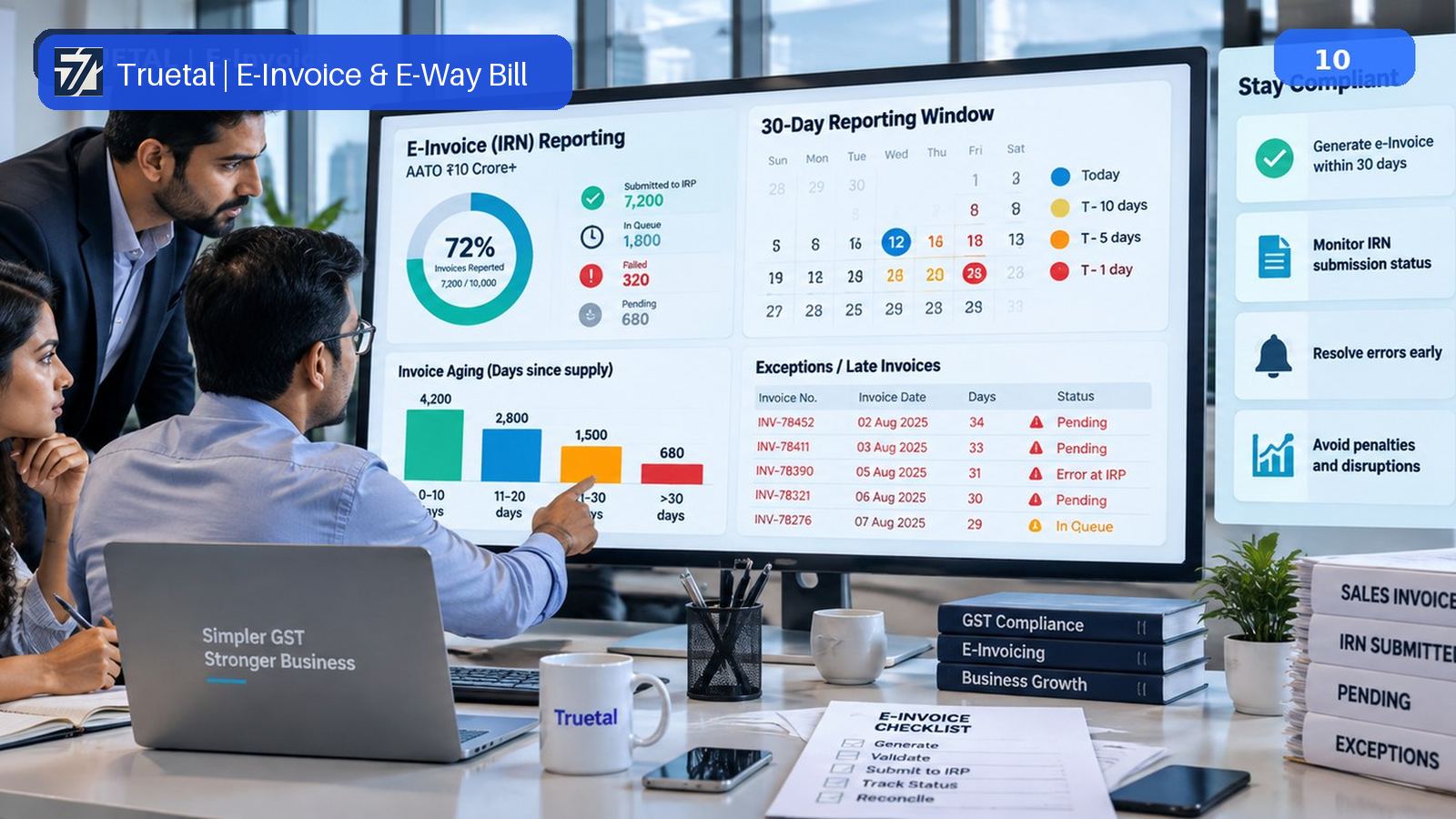
From 1 April 2025, the authorised IRP guidance restricts taxpayers with AATO of ₹10 crore or more from reporting eligible e-invoice documents more than 30 days after the document date. This is an additional reporting-time control; it does not replace the ₹5 crore applicability test.
Store the document date, readiness status, submission timestamp, acknowledgement, IRN, signed QR, error and retry history. Escalate a document before the limit instead of changing its date. For the detailed control, see the 30-day e-invoice reporting rule guide.
E-invoice and e-way bill are different decisions
E-invoice reporting is tied to the notified supplier, document and outward transaction. An e-way bill is tied to movement of goods, consignment value, exceptions, State-specific intra-State provisions and transport details. Services can fall within e-invoicing but do not create an e-way bill because no goods move. A stock transfer can require an e-way bill even though there is no sales invoice.
IRP data may support or populate parts of the e-way-bill workflow, but data transfer does not prove that an e-way bill is required, complete or valid for the actual movement. Use the separate e-way bill threshold, generator and validity guide.
Worked examples
These examples are illustrative and assume the current threshold and no unmentioned facts.
Earlier threshold crossing: A PAN had aggregate turnover of ₹6.2 crore in FY 2020-21 and ₹3.8 crore in the current year. The lower current figure does not end the analysis. Check the entity exemption and covered documents because one relevant earlier year exceeded ₹5 crore.
Exactly ₹5 crore: A supported PAN-wide working shows aggregate turnover of exactly ₹5 crore and no relevant year above it. The notification's “exceeding” language matters; do not round the amount or apply “exceeding ₹5 crore” shorthand without checking the actual figure and current text.
Goods movement: A covered manufacturer issues a B2B tax invoice for goods. It applies the e-invoice test to the supplier document and separately applies the e-way-bill test to the consignment and movement. One result does not automatically decide the other.
Exempt entity: A taxpayer above the threshold believes it is within a notified exempt class. It records the exact legal entity and notification basis, obtains an authorised review and retains that evidence. It does not rely only on a portal status message.
Readiness checklist
- Prepare PAN-wide turnover by financial year from FY 2017-18.
- Identify every GSTIN and explain additions or structural changes.
- Test the exact legal entity against the current exemptions.
- Map invoice, debit-note and credit-note series by transaction type.
- Validate supplier, recipient, place-of-supply, item, HSN and tax data before reporting.
- Store the exact IRP request and signed response with the source document.
- Apply the 30-day control where the AATO condition is met.
- Reconcile IRNs and cancellations to the underlying document and GST records.
- Apply the e-way-bill test separately for movement of goods.
- Revisit the working after a notification or entity change.
Common mistakes
- Checking only the current year's turnover or one GSTIN.
- Treating exactly ₹5 crore as automatically above ₹5 crore.
- Assuming portal enablement is the legal conclusion.
- Confusing an invoice PDF with an IRP-authenticated document.
- Reporting every B2C invoice through the regular mandate.
- Treating an e-invoice as proof that an e-way bill is unnecessary.
- Editing the displayed invoice after the IRP response so the records no longer agree.
- Missing the separate 30-day reporting control for AATO of ₹10 crore or more.
How Truetal helps—and where it stops
Truetal can help prepare consistent invoice data and retain source records for the e-invoice workflow on the applicable setup. The taxpayer must confirm applicability, exemptions and the authorised IRP or provider route actually enabled for the business.
Truetal is not represented here as making a legal eligibility decision or completing every government-portal action automatically. E-way-bill generation is not currently a live Truetal capability, and direct GST-return filing is not offered.
Frequently asked questions
What is the current turnover threshold for GST e-invoicing?
The notified test applies where aggregate turnover exceeded ₹5 crore in any relevant preceding financial year from 2017-18 onward, subject to the notified exemptions and document or transaction scope. The current mandate at this level took effect on 1 August 2023.
Is e-invoice turnover checked PAN-wise or GSTIN-wise?
Aggregate turnover is assessed across GSTINs under the same PAN. Keep a PAN-wide, year-wise working rather than testing one registration or only the current financial year.
If turnover falls below ₹5 crore now, can e-invoicing stop?
A lower current year does not by itself switch the mandate off where a relevant preceding year crossed the notified threshold. Recheck the current notification, entity exemption and document scope before changing the process.
Are B2C invoices covered by the regular e-invoice mandate?
The standard mandate discussed here covers specified supplier documents for covered outward transactions such as B2B and exports; ordinary B2C invoices are not treated as covered merely because the supplier crossed the threshold. Dynamic QR requirements are a separate test.
Does generating an e-invoice remove the need for an e-way bill?
No. E-invoicing authenticates covered document data through an authorised IRP, while the e-way-bill rules test movement of goods, consignment value, exceptions, State provisions and transport details. Apply both tests independently.
Sources
- Government notification 10/2023-Central Tax — ₹5 crore threshold from 1 August 2023
- GST-authorised IRP — e-invoice mandate, turnover history and IRN process
- Government notification 13/2020-Central Tax — notified class and exemptions
- Government notification 61/2020-Central Tax — SEZ-unit exclusion
- Government notification 70/2020-Central Tax — preceding-year history and exports
- CBIC — CGST Act aggregate-turnover definition
- Government notification 23/2021-Central Tax — government departments and local authorities
- CBIC Circular 186/18/2022-GST — entity-wide e-invoice exemption clarification
- GST-authorised IRP — 30-day reporting limit for AATO ₹10 crore and above
- CBIC — current Rule 48 on issuing an invoice and obtaining an IRN