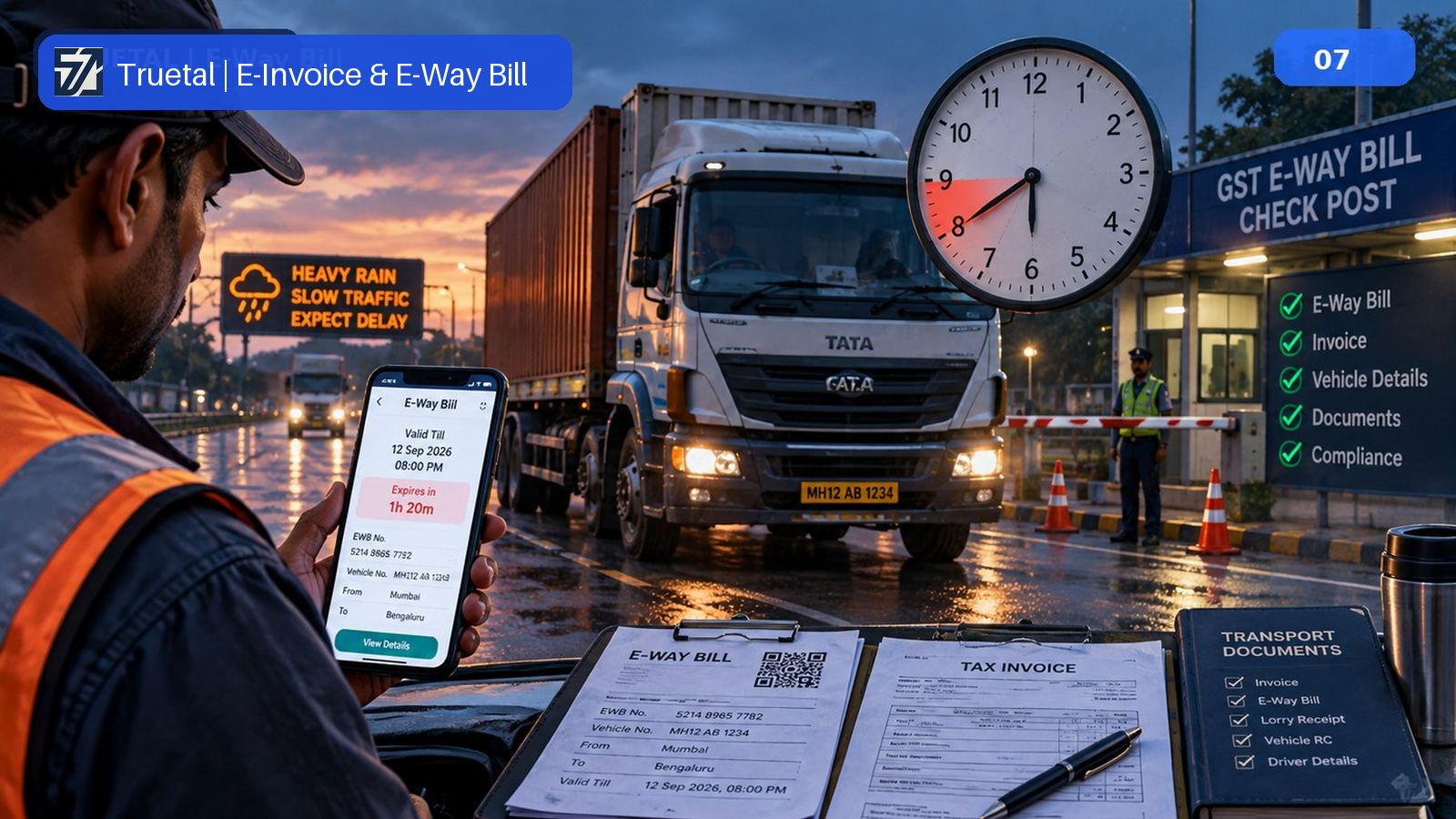
A truck can be perfectly genuine and still face a breakdown, flood, road closure or transshipment delay. The danger starts when the e-way bill validity expires and the vehicle continues casually without the proper extension trail.
The Short Answer
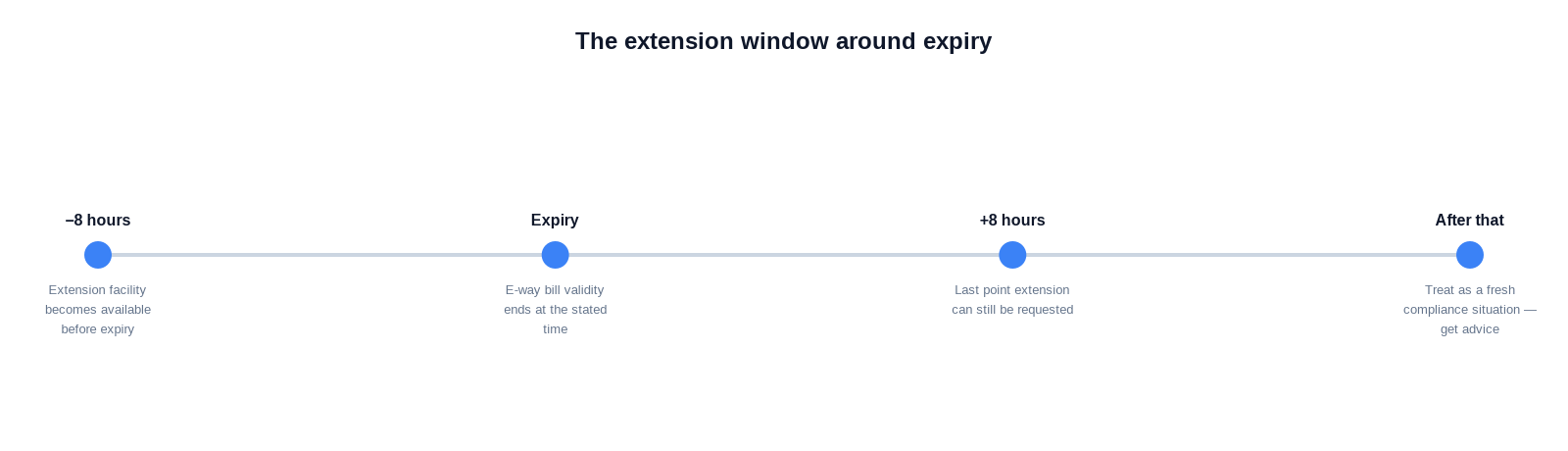
Goods should not keep moving on an expired e-way bill. The current transporter can use the extension facility for genuine exceptional circumstances in the permitted window - up to eight hours before and within eight hours after expiry - with current location, remaining distance and updated Part-B details.
In Plain Words
The extension facility is an operational safeguard, not a reason to ignore expiry. Keep the current vehicle location, remaining distance, updated transport details and evidence of the exceptional circumstance. The value of the evidence is highest when it is created on the same day.
The eight-hour extension window
The official E-Way Bill system allows validity to be extended from eight hours before expiry until eight hours after expiry. For example, if an e-way bill is valid until 11:59 PM, the extension window begins at approximately 4:00 PM that day and remains available until approximately 8:00 AM the following day. Do not treat the post-expiry portion as extra travel time — it is a limited portal window for requesting an extension because the consignment could not reach its destination for a genuine reason.
The current transporter carrying the consignment normally makes the extension request. If no transporter has been assigned, the generator may be able to extend it. The portal requires the present location, remaining distance, transport details, reason code, and explanatory remarks.
When extension is appropriate
The E-Way Bill system recognises reasons including natural calamity, law-and-order situation, transshipment, accident, and other genuine circumstances described in the remarks. Select the reason that actually occurred — do not choose a convenient dropdown value and then create documents to match it later.
How to extend the e-way bill
- Sign in to the E-Way Bill portal.
- Open the Extend Validity facility and enter the e-way bill number.
- Confirm whether the consignment is in movement or in transit, and enter its current place, state and PIN code.
- Provide vehicle or transport-document details for the mode of transport.
- Enter the approximate remaining distance, select the genuine reason, and write clear remarks.
- Submit and retain the extended e-way bill.
The extension is calculated for the remaining journey — Part A details cannot simply be rewritten through this process. If a road vehicle broke down and goods were transferred to a replacement vehicle, update the new vehicle details and keep the breakdown and transshipment records together.
Evidence to collect on the same day
The portal entry is only one part of the audit trail. Keep contemporaneous evidence: the original tax invoice and e-way bill, the extended e-way bill and acknowledgement, vehicle/driver/transporter details, timestamped photographs, a repair or towing receipt where relevant, and any weather alert or road-closure notice. Ask the driver or transporter for written confirmation immediately — a note created weeks later carries far less evidentiary value.
What if the eight-hour window has already closed?
Do not assume a fresh e-way bill automatically cures the period during which the consignment lacked valid coverage. Pause the vehicle at a safe location, preserve the full delay timeline and evidence, and get case-specific advice before generating or using another document. If an officer has already intercepted or detained the goods, do not alter records or create a backdated explanation — respond to the notice within the stated time with genuine documents.
Worked example: an e-way bill that expires at midnight
Scenario: A truck carrying goods on an e-way bill valid until 11:59 PM breaks down at 6:30 PM, about 90 km short of the destination. A replacement vehicle will take three hours to arrive.
- Stop and record the facts. Note the time, place, remaining distance and cause. Take timestamped photos and get the tow or repair note.
- Open the extension window. It runs from about eight hours before expiry (around 4:00 PM) to about eight hours after (around 8:00 AM the next day). The breakdown at 6:30 PM falls inside it.
- Request the extension on the portal as the current transporter: current location, remaining distance, updated vehicle details and the reason that actually occurred (vehicle breakdown), with clear remarks.
- Update Part-B with the replacement vehicle once the goods are transferred, and keep the transshipment record with the breakdown evidence.
- File the evidence the same day: invoice, original and extended e-way bill, driver statement, photos, repair receipt.
Result: The consignment moves under a valid, extended e-way bill, and the audit file explains the delay with same-day evidence instead of a note written weeks later.
Key takeaway: When an e-way bill is close to expiry, action and evidence matter more than a later explanation.
Illustrative example. Actual treatment may depend on the facts and rules applicable on the transaction date.
The Key Steps at a Glance
Read the four steps in order — each one depends on the one before it.
- 1Stop movement and establish the current status
- 2The official 8-hour-before / 8-hour-after window
- 3Acceptable exceptional circumstances
- 4What can and cannot be changed during extension
What to do now
- Build a dispatch control that calculates validity against the actual route and flags any e-way bill approaching its 8-hour pre-expiry window.
- Nominate one person accountable for monitoring every active e-way bill until delivery.
- Keep transporter contact details attached to every dispatch record so an extension can be requested without delay.
Common mistakes
- Continuing to move goods after expiry without attempting the extension.
- Choosing a convenient reason code rather than the one that actually occurred.
- Waiting until after the 8-hour post-expiry window to act.
The Takeaway
When an e-way bill is near expiry, action and evidence matter more than a later explanation. Capture the reason while it is happening.
How Truetal Helps
Truetal can keep the invoice, dispatch and transporter records together so the responsible user can review validity and act on the official portal.
Questions People Search For
- E way bill expired what to do
- Eway bill extension 8 hours
- Expired eway bill in transit
Visual Checklist
E-Way Bill system FAQ. E-way bill requirements and consequences depend on the goods, movement, documents and facts of the case — this is general compliance information, not case-specific advice.