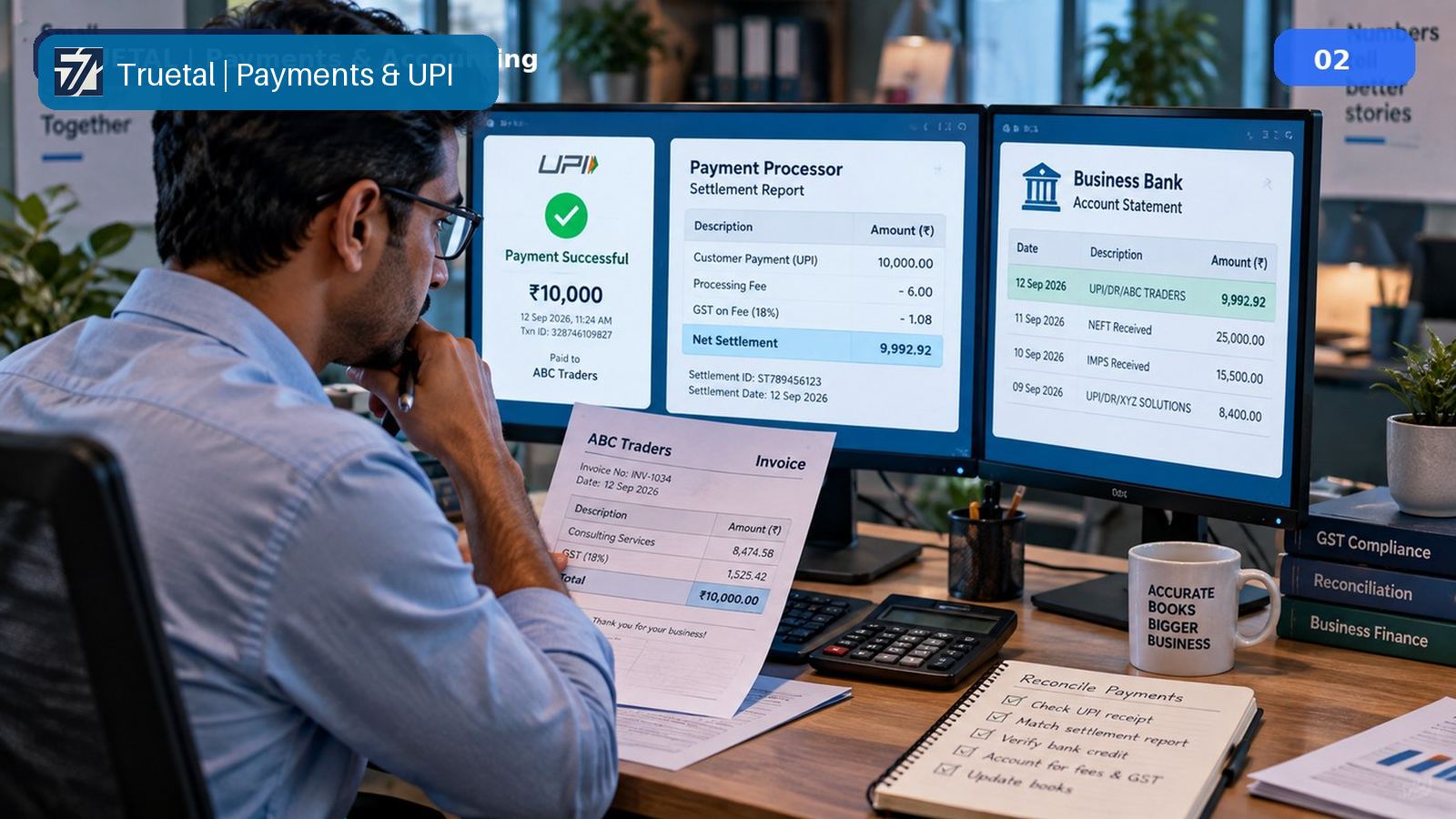

A customer pays you ₹10,000 by UPI. The sale is ₹10,000, but the payment processor may charge the merchant a small service fee. The common confusion is whether GST suddenly applies to the customer's full payment or only to that fee.
The Short Answer
The customer payment itself is not the GST base for the payment service. The GST question is on the MDR/service fee charged in the payment ecosystem. A registered merchant should reconcile the payment processor tax invoice separately from the sales invoice and assess input tax credit (ITC) eligibility under normal GST conditions.
In Plain Words
Think of MDR as a fee charged for using the payment rail. The customer's ₹10,000 is still the customer's payment for your sale; the fee is a separate cost of collecting that money. GST, where charged, follows the service fee - not the customer's entire payment amount.
What actually changed in September 2026
Under the framework the government notified this month, UPI stays completely free for person-to-person transfers and for the large majority — officially, 96% — of merchant transactions. A small MDR now applies only to specified merchant categories on transactions above ₹2,000. Most small-ticket retail UPI payments a typical Indian SME accepts are unaffected. If your business sits in one of the specified categories and processes larger-ticket UPI payments, your payment aggregator will start showing an MDR line on its own settlement statement and tax invoice to you.
This is a payment-industry fee change, not a GST rate change. Nothing about how you invoice your customer changes.
MDR is a payment-service charge, not GST on the sale value
Keep two invoices mentally separate:
- Your sales invoice to the customer — taxable value + your GST, exactly as before. UPI is just the payment rail; it has no bearing on this invoice.
- Your payment processor's invoice to you — the MDR fee + GST on that fee, charged by the bank/aggregator for handling the transaction.
The government has been explicit on this point: GST is levied on the service charge (MDR), never on the underlying UPI payment amount itself. Treating MDR as if it were GST on the sale — or worse, backing it out of your reported sales figure — misstates both your revenue and your GST liability.
Worked settlement example: ₹10,000 UPI sale
| Step | Amount | What happens |
| Customer pays via UPI | ₹10,000 | Full sale value, matches your tax invoice |
| Processor deducts MDR (illustrative) | ₹6 | A payment-service fee, not GST |
| GST on MDR (illustrative, 18%) | ₹1.08 | Tax on the fee, charged by the processor |
| Net amount credited to your bank | ₹9,992.92 | Sale value minus fee minus GST-on-fee |
Your sales invoice still shows ₹10,000 as the taxable value with your normal GST. The ₹6 MDR and ₹1.08 GST-on-fee are a separate transaction between you and your payment processor — do not net them against your reported sale.
How to book MDR and GST in your accounts
- Debit your bank/clearing account for the gross ₹10,000 receivable against the customer invoice.
- When the processor's settlement and tax invoice arrive, book the MDR as a bank-charges/payment-processing expense, and the GST on it separately to your GST Input Credit account (subject to normal ITC eligibility conditions — see below).
- The net figure that actually lands in your bank account is simply gross receivable minus these two ledger entries. Never adjust the sale amount itself to make the bank credit "balance."
When ITC may be available
The GST charged on your payment processor's MDR invoice is, like any other business expense, potentially eligible for input tax credit under the normal conditions in Section 16 of the CGST Act — a valid tax invoice from the processor, the service actually received, and the return-filing conditions met. Retain the processor's monthly settlement statement and its tax invoice; that document, not your bank statement, is your evidence for claiming this ITC.
The Key Steps at a Glance
Read the four steps in order — each one depends on the one before it.
- 1What changed in the September 2026 UPI framework
- 2MDR is a payment-service charge, not GST on the sale value
- 3Worked settlement example: Rs 10,000 UPI sale
- 4How to book MDR and GST in accounts
What to do now
- Confirm with your payment aggregator whether your business category is one of the specified MDR categories, and above what transaction size.
- Ask your processor to itemise MDR and GST-on-MDR separately on its settlement statement, if it doesn't already.
- Set up a dedicated ledger account for payment-processing fees so MDR never gets buried inside "bank charges" or, worse, netted against sales.
- Reconcile gross sale → fee → GST-on-fee → net bank credit every settlement cycle, not just at month-end.
Common mistakes
- Reducing the reported sale value by the MDR amount — this understates turnover and can misstate your GST-1 figures.
- Assuming GST applies to the customer's UPI payment itself — it does not; UPI payment collection is not a taxable supply by you.
- Losing the processor's tax invoice and trying to claim ITC from the bank statement alone, which is not valid supporting documentation.
- Treating every UPI transaction as MDR-bearing — most consumer and small-ticket merchant UPI payments remain fee-free under the current framework.
The Takeaway
The simplest rule is: keep the sale, the collection fee and GST on that fee as three separate things. That one separation prevents most UPI-settlement confusion.
How Truetal Helps
Truetal's bank reconciliation engine already separates a customer's gross UPI settlement from processor deductions during matching, so your sales invoice and your processor's fee never get blended into one number. When MDR-linked deductions appear on a statement, they're flagged for classification rather than silently netted against revenue.
Questions People Search For
- UPI MDR GST 2026
- GST on UPI charges
- UPI merchant charges accounting
Sources
PIB press releases on the September 2026 UPI MDR framework; Reuters market coverage of the fee shift. This article covers the current, notified position as of the "last reviewed" date above — payment-industry fee schedules can be revised, so confirm your own applicable rate with your payment aggregator.