Freelancers often receive three different numbers for the same year: invoice value, bank receipts and taxable income. None is automatically wrong. GST, accounting and income tax answer different questions, and the job is to reconcile them without pretending they are identical.
Income-tax transition note, reviewed 10 October 2026: FY 2025-26 / AY 2026-27 filing remains under the Income-tax Act, 1961. For Tax Year 2026-27 beginning 1 April 2026, use the Income-tax Act, 2025, its equivalent presumptive provisions and the forms notified for that tax year.
The direct answer
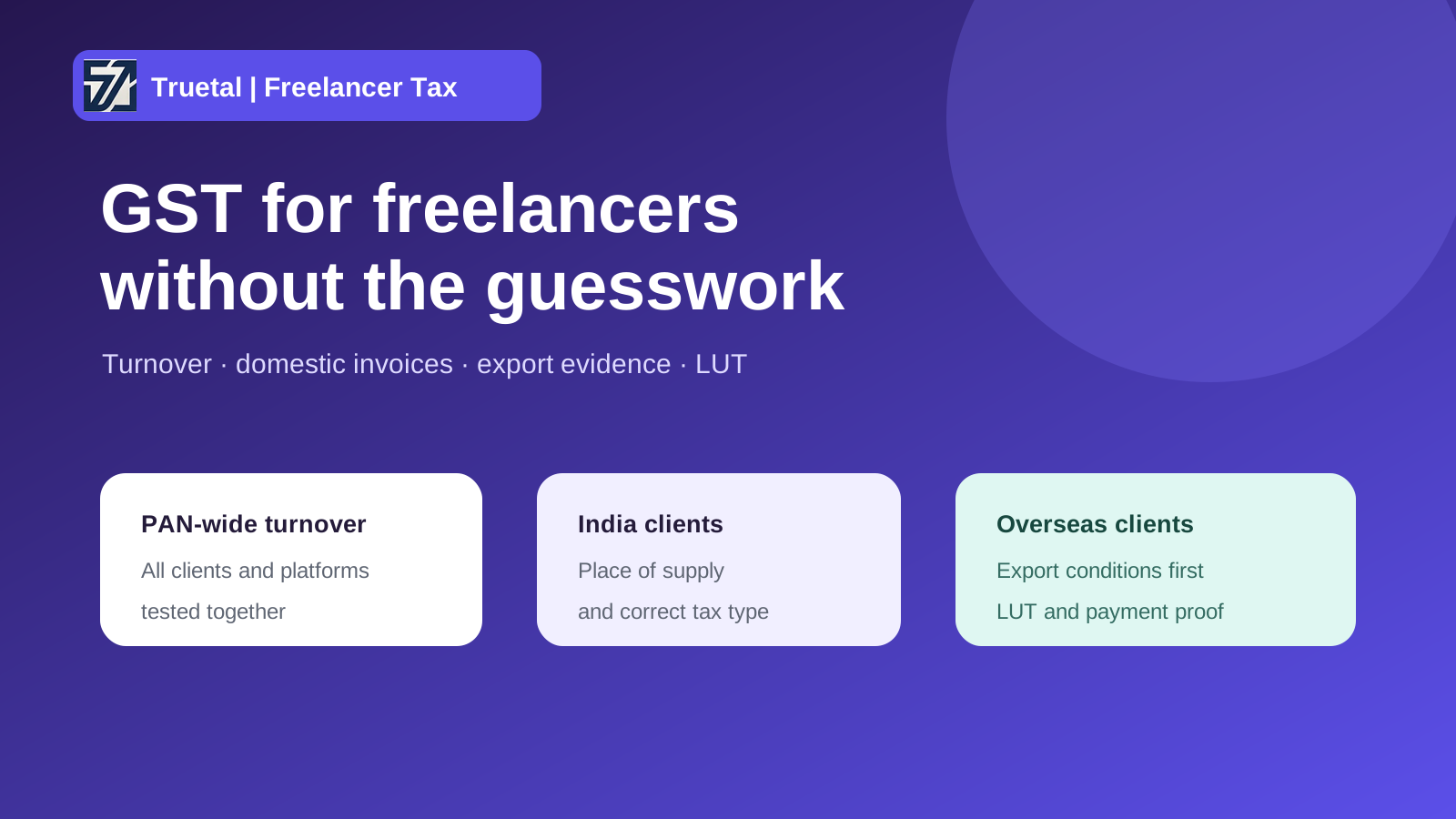
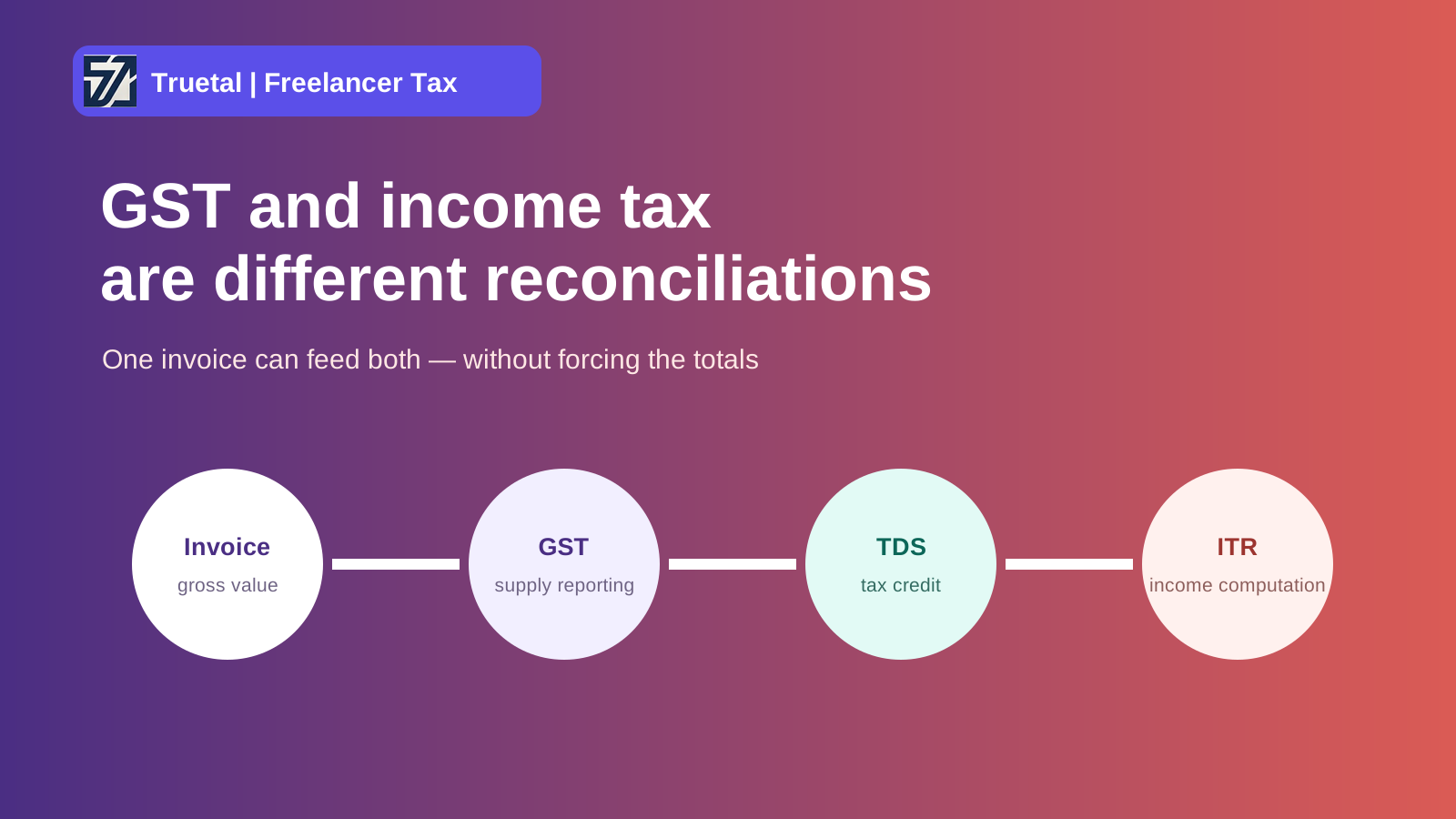
GST is a transaction tax built around supplies, registration, place of supply, invoices and returns. Income tax applies to taxable income after the permitted computation. TDS is tax credit collected through the payment chain, not a separate deduction from revenue. A reliable freelancer file connects all three systems to the same contracts and receipts while preserving their differences.
Build the compliance year from source records: contract → invoice → credit note/advance → bank receipt → fee or exchange difference → expense → GST return → TDS/AIS → advance tax → ITR.
Why the numbers differ
An invoice raised in March may be collected in April. A foreign receipt may arrive net of bank charges. A client may deduct TDS. GST turnover can include zero-rated exports. Income-tax gross receipts and accounting revenue can need cut-off adjustments. AIS can contain duplicated or misreported entries.
Reconciliation explains these differences; it should not erase them by changing every source to the bank-credit number.
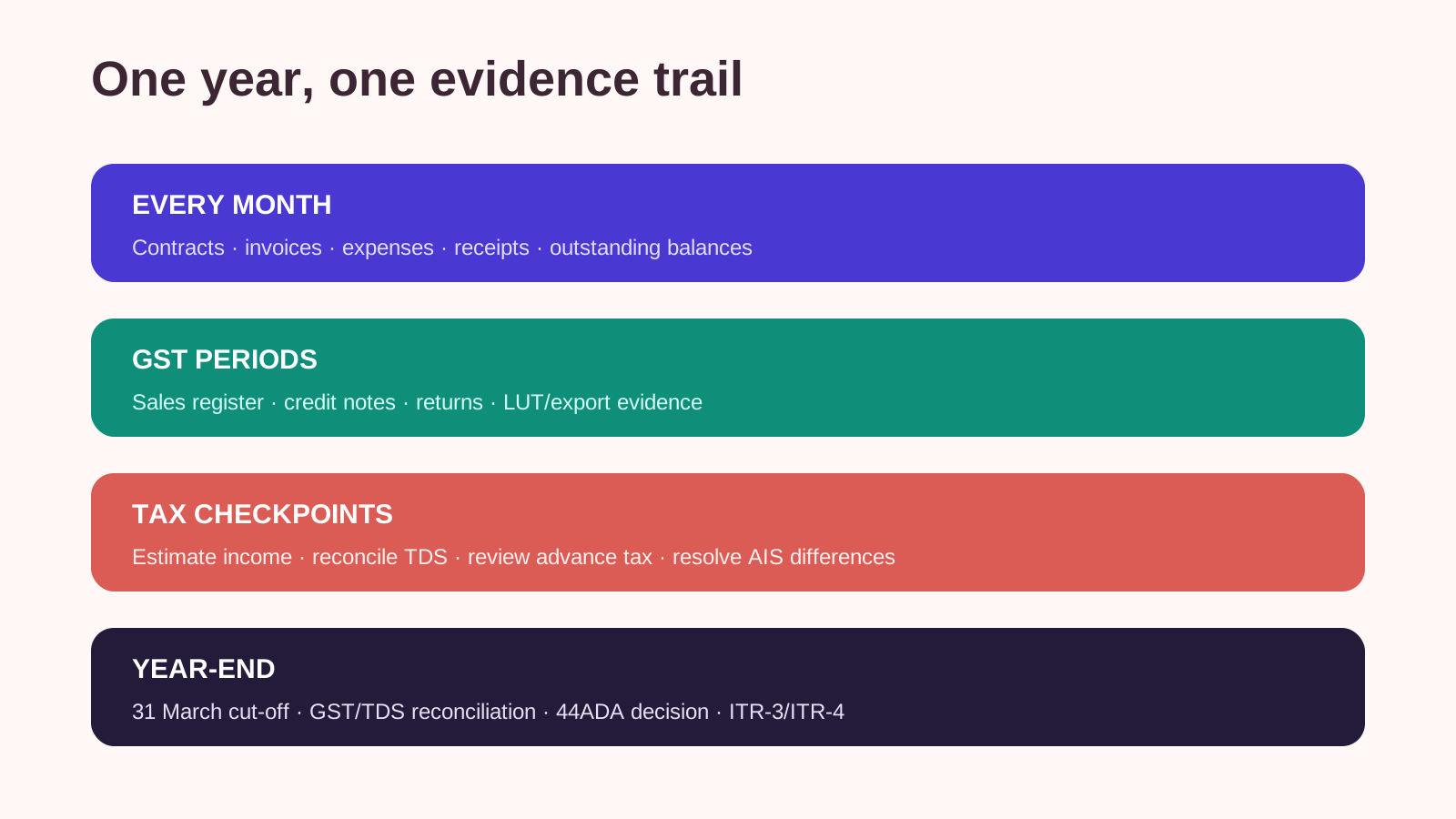
Quarterly and annual compliance map
Every month
- issue sequential invoices and preserve contracts;
- record expenses with business purpose and payment evidence;
- match receipts to invoices, including TDS and bank fees;
- update outstanding client balances;
- preserve export/LUT evidence where relevant; and
- review whether turnover is approaching GST or presumptive-tax limits.
Each GST period
Registered freelancers should reconcile the sales register with outward-supply reporting and the applicable payment return, review credit notes and advances, and preserve filing acknowledgements. A nil business month does not automatically remove a registered person’s return obligations.
Each income-tax checkpoint
Estimate annual professional income, consider the applicable advance-tax timetable, reconcile TDS credits and review regime/form choices. A Section 44ADA taxpayer follows the special advance-tax rule described by the Income Tax Department; a regular-books taxpayer may follow the ordinary instalment framework.
At year-end
Close invoices and expenses to 31 March, explain April collections relating to March, reconcile GST turnover, the applicable Form 168 or legacy Form 26AS/AIS statement and TDS certificate, review assets and outstanding balances, then decide Section 44ADA and ITR eligibility from final facts.
Worked example
Ravi invoices an Indian client ₹1,18,000, including ₹18,000 GST. The client deducts ₹10,000 TDS from the professional fee base and pays the balance through bank transfer.
Ravi should not record only the net receipt as revenue. His records preserve the gross customer receivable, output GST, net bank receipt and a separate TDS-receivable amount. He then matches the credit with Form 168 for Tax Year 2026-27 onward, or the applicable legacy Form 26AS statement, and follows up with the client if it is missing. The exact entry, transition test and certificate trail are covered in Customer-Deducted TDS Entry: Form 168 and 26AS.
One master reconciliation
Use a table with these columns:
| Source | What it proves | Common difference |
| Contract/invoice | Service, customer, value and date | Advance, credit note, foreign currency |
| Sales register | Accounting/GST source list | Cut-off or cancellation |
| Bank | Cash actually received | TDS, fee, exchange difference |
| GST returns | Supply reported for GST | Timing or amendment |
| Form 168 or legacy Form 26AS/TDS certificate | Tax deducted and reported | Client reporting error |
| AIS | Department information feed | Duplicate or wrong information |
| ITR working | Final income computation | Presumptive versus actual profit |
Close every material difference with a note and evidence. Do not “make totals match” by deleting a genuine invoice or creating unsupported income.
Expenses, GST ITC and income-tax deduction
Business use is the starting point, but GST ITC and income-tax deduction have separate conditions. A laptop, software subscription, coworking fee or travel cost may need invoice, payment and business-purpose evidence. Personal use must be separated. A GST credit can be restricted even where an income-tax expense is allowed, and vice versa.
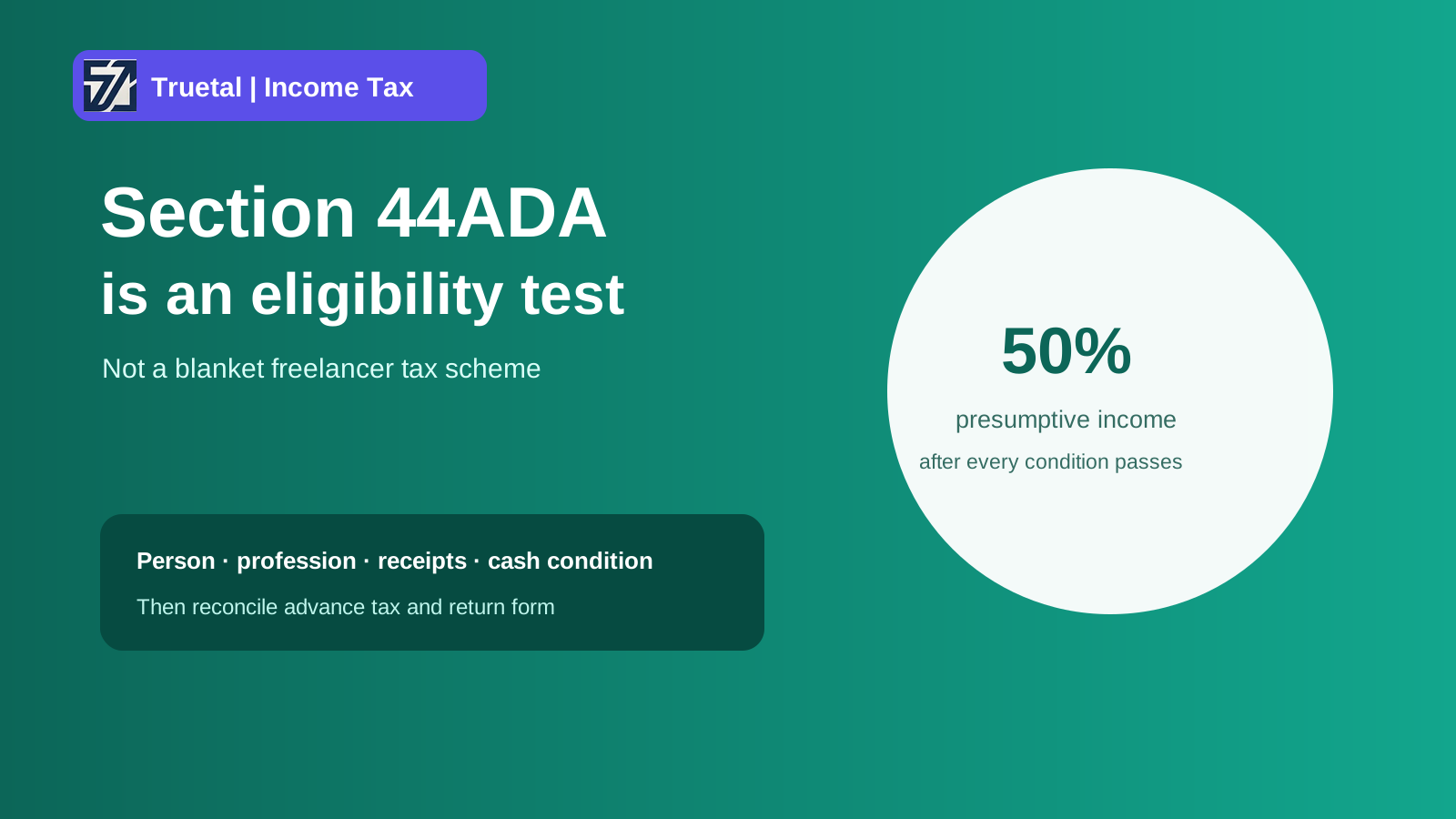
If Section 44ADA is used, professional expenses are deemed allowed in the presumptive computation and are not deducted again. The underlying records can still matter for GST, cash control and future scrutiny.
Common mistakes
- Posting net bank receipts as revenue after TDS or platform fees.
- Treating TDS as an expense instead of a tax credit to reconcile.
- Assuming GST turnover and income-tax receipts must always be identical.
- Claiming an expense or ITC without separating personal use.
- Waiting until the ITR deadline to discover client TDS errors.
- Selecting ITR-4 before reviewing all income and exclusions.
- Forgetting the annual LUT or export evidence.
How professional support helps
Accounting services for freelancers can maintain the monthly evidence trail; freelancer ITR filing can then use the reconciled year-end file instead of rebuilding twelve months from bank statements.
FAQ
Is TDS deducted by my client an expense?
No. TDS is generally tax paid to your credit through the payer. Record the gross income and reconcile the deduction with the certificate and annual statement applicable to the period. For Tax Year 2026-27 onward, use Form 168 and the applicable new-law certificate; use Form 26AS for the relevant legacy period. See the dedicated TDS receivable and annual-statement guide for the entry and transition test.
Should GST turnover equal bank receipts?
Not necessarily. Timing, advances, TDS, bank fees, exchange differences, credit notes and unpaid invoices can create valid differences. Reconcile them item by item.
Can I claim the same freelancer expense under GST and income tax?
The same source invoice may be relevant to both, but each law has separate eligibility conditions. Business purpose alone does not automatically establish GST ITC.
Does Section 44ADA remove the need for bookkeeping?
It can simplify the income computation and specified books requirement for an eligible profession, but records remain important for gross receipts, GST, TDS, banking and commercial control.
When should a freelancer start year-end reconciliation?
Monthly is best. At minimum, begin before 31 March so missing invoices, TDS errors, export evidence and advance-tax issues can be addressed while evidence is available.
The takeaway
Do not run GST, TDS and income tax as three unrelated annual emergencies. Maintain one source-linked set of records, reconcile the legitimate differences and let each tax computation use the facts it actually requires.
Sources
- CBIC — Central Goods and Services Tax Act, sections 22, 24 and 25
- CBIC — Notification 10/2017-Integrated Tax (inter-State services registration exemption)
- CBIC — Integrated Goods and Services Tax Act, including export of services
- GST Portal — Furnishing a Letter of Undertaking (FORM GST RFD-11)
- Income Tax Department — Return-filing transition FAQs for the Income-tax Act, 2025
- Income Tax Department — Objective and scope of the Income-tax Act, 2025 FAQs
- Income Tax Department — ITR-4 (Sugam) online FAQs for AY 2026-27
- Income Tax Department — Identify the applicable ITR
- Income Tax Department — Income-tax return utilities and form descriptions
- Income Tax Department — Form 10-IEA user manual
- Income Tax Department — TDS transition FAQ from 1 April 2026
- Income Tax Department — Form 168 (earlier Form 26AS)