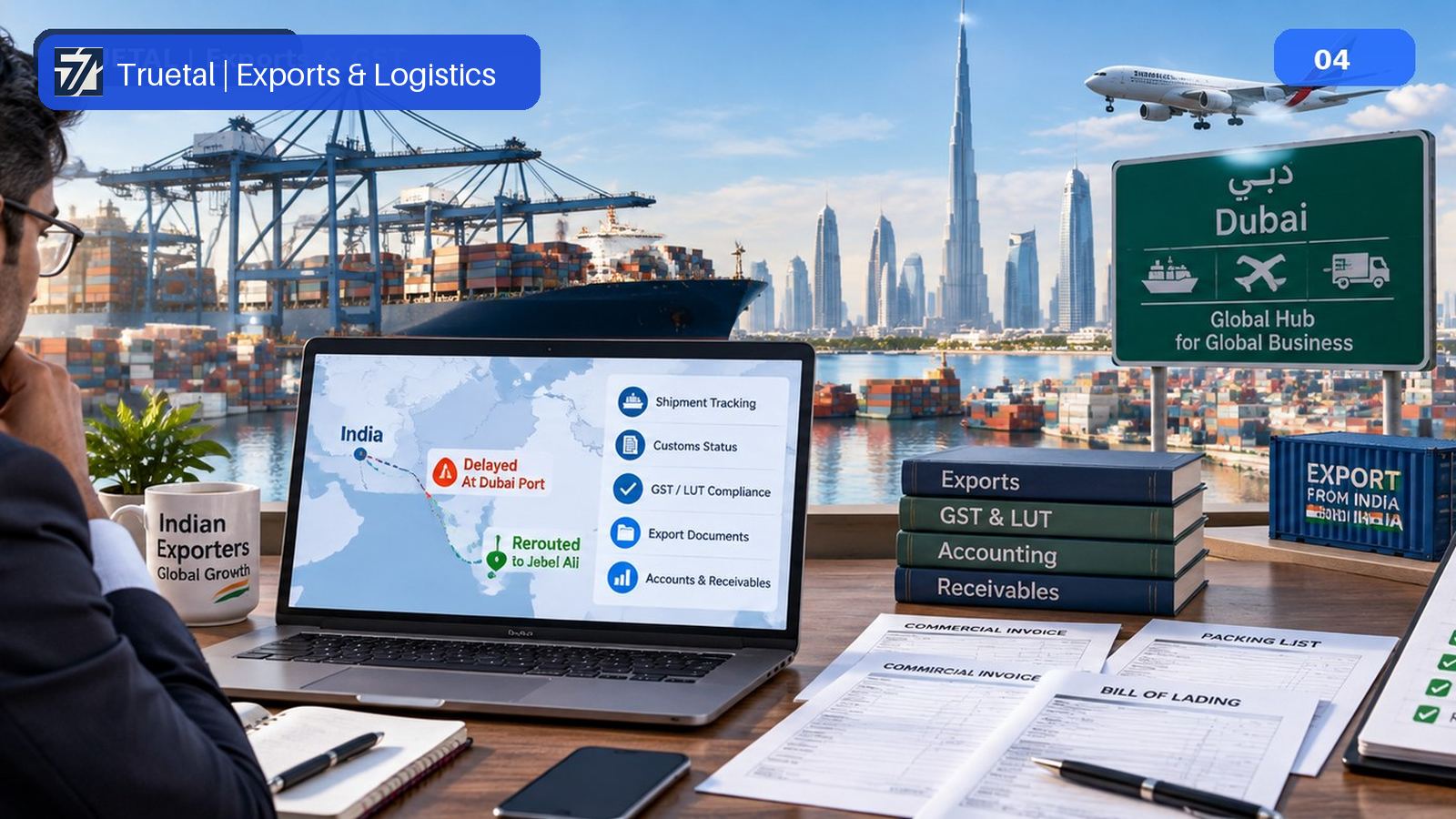
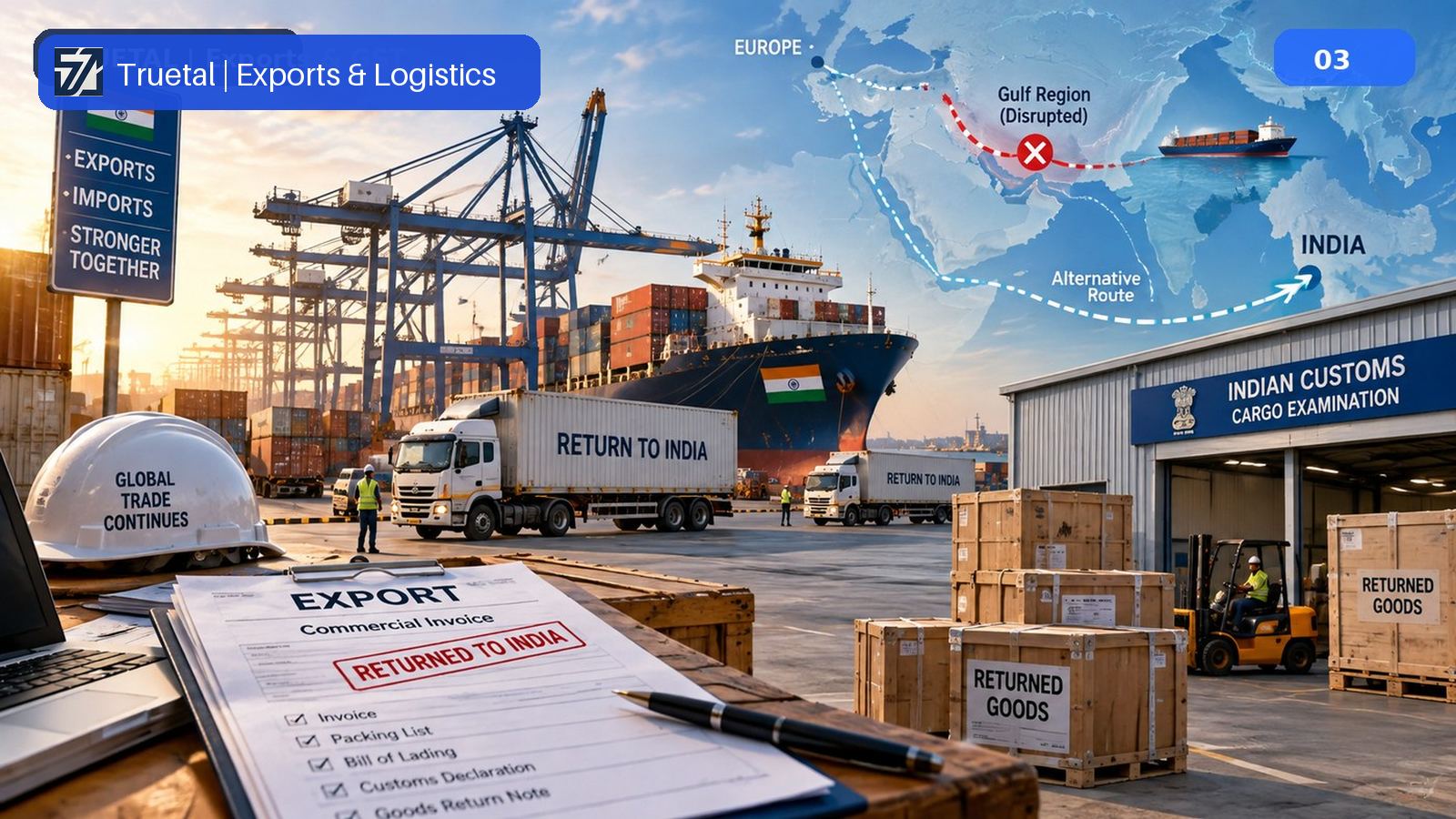
An export shipment leaves India, gets caught in a Gulf shipping disruption and eventually comes back. The accounting team now has three different questions at once: did the export legally complete, what should happen to stock and receivables, and what evidence will GST/customs teams expect?
The Short Answer
Treat the case as a document-chain problem: determine whether export completion evidence exists, preserve shipping and customs records, reverse or reclassify accounting only after establishing the legal status of the movement, and ensure any refund/incentive claim matches the final customs outcome.
In Plain Words
Do not start with a journal entry. Start with the legal/document status of the movement: shipping bill, customs records, proof of export, refund/incentive status and actual physical return. Only then decide whether stock, export receivable and related claims need reversal or reclassification.
First question: did the export legally complete?
Check your shipping bill status, bill of lading, and any export general manifest filing. If customs already registered the export as complete — meaning the shipping bill shows an out-of-charge / let-export-order status — the legal export event has happened, even if the vessel is later diverted or the goods physically return. If the shipping bill never reached that status, the goods never legally left as an export in the first place, and you're dealing with a cancelled or aborted shipment, not a returned one.
LUT / zero-rated invoice does not eliminate documentation requirements
An export invoice raised under LUT is zero-rated, but LUT status alone proves nothing about what actually happened to the goods. Whichever outcome applies, you still need:
- The original export invoice and LUT reference.
- Shipping bill, bill of lading, and any customs correspondence about the diversion or return.
- Bank realisation status for the export proceeds (were they ever received?).
Returned cargo: customs, shipping bill and incentive trail
If goods are physically returning to an Indian port after a legally completed export, this is now a re-import event with its own customs process — separate from, and additional to, the original export documentation. If you had claimed or were in process of claiming any export incentive or refund tied to that shipment, that claim needs to be reassessed against the fact that the goods came back; do not let an incentive claim and a physical return sit unreconciled in parallel.
E-way bill / domestic movement after re-entry
Once goods clear customs back into India, their onward domestic movement (to your warehouse, for inspection, for rework) needs its own e-way bill under the normal domestic movement rules — this is unrelated to the original export documentation and should not be skipped just because the goods "already have" export paperwork.
Accounting treatment: inventory, receivable and FX reversal
The accounting entries differ by scenario:
- Export never completed (aborted shipment): reverse the export invoice and the associated foreign-currency receivable; restore the goods to inventory at their original cost once customs/shipping records confirm no legal export occurred.
- Export completed, goods returned afterward: do not reverse the original export invoice — it was a real, legally completed transaction. Instead, book the re-import as its own event (inventory received back, any customs duty on re-import, and a separate assessment of whether the export receivable was realised or needs its own resolution).
The distinction matters because reversing a legally completed export transaction that shouldn't be reversed creates a mismatch between your books and your GST/customs filings that can be very difficult to unwind later.
Control checklist for auditors and GST refund files
- Shipping bill status (out-of-charge or not) — the single most important document.
- Any refund or LUT-linked ITC claim already filed for this shipment, and its current status.
- Bank realisation certificate or equivalent proof of (non-)receipt of export proceeds.
- A written record of why the accounting treatment you chose matches the shipping-bill status you found — this is what an auditor or GST officer will ask for first.
Worked example: a container that leaves, is diverted, and comes back
Scenario: You export goods worth ₹20,00,000 under LUT. The vessel sails, is diverted because of a regional shipping disruption, and the cargo is eventually brought back to an Indian port.
- Check the shipping bill first. Suppose it shows an out-of-charge / let-export status. The export legally completed before the goods turned back.
- Do not reverse the export invoice. It was a real, completed export. Keep the invoice, LUT reference and shipping bill together.
- Book the return separately. Record the goods received back into stock as their own event (with any customs duty on re-import), and assess separately whether the export receivable was realised or needs its own resolution.
- Stop any refund or incentive claim from running in parallel with the physical return until it has been reassessed against the return.
- Raise a domestic e-way bill for the onward movement from the port to your warehouse.
Result: The books follow the customs record, not the fact that the boxes are physically back. If the shipping bill had never reached out-of-charge status, the answer flips: reverse the export invoice and receivable and restore stock at original cost.
Key takeaway: A returned export is a document-status problem first and an accounting-entry problem second.
Illustrative example. Actual treatment may depend on the facts and rules applicable on the transaction date.
The Key Steps at a Glance
Read the four steps in order — each one depends on the one before it.
- 1First question: did the export legally complete?
- 2LUT / zero-rated invoice does not eliminate documentation requirements
- 3Returned cargo: customs, shipping bill and incentive trail
- 4E-way bill / domestic movement after re-entry
What to do now
- Pull the shipping bill and bill of lading for every disrupted shipment before making any accounting entry.
- Classify each one as "never completed" or "completed then returned" using the shipping bill status alone — not the fact that goods are physically back in India.
- Flag any shipment with an already-filed refund/incentive claim for separate reassessment.
Common mistakes
- Reversing an export invoice for a shipment that had already legally completed, based only on "the goods came back."
- Treating a diverted-but-still-en-route shipment the same as one that has actually returned to India.
- Skipping the domestic e-way bill for re-imported goods because they "already have" export paperwork.
The Takeaway
Returned export cargo is a document-status problem first and an accounting-entry problem second. Let the customs/shipping evidence drive the books.
How Truetal Helps
Truetal's export documentation tracking keeps shipping bill status, LUT reference and invoice linked in one place, so a disruption doesn't leave you guessing which accounting treatment applies.
Questions People Search For
- Export goods returned India GST LUT
- Strait of Hormuz export cargo GST
- Returned export cargo accounting
Sources
Reuters reporting on Gulf shipping disruption (September 2026); CBIC accounts and records rules. This is a fast-moving operational situation — verify your specific shipment's status directly with your shipping line and customs broker.