Section 44ADA can simplify income computation for an eligible professional, but “freelancer” is not itself a profession listed in the section. Eligibility turns on who earns the income, the actual professional activity and the receipt limits—not the way the person describes the engagement.
Transition note, reviewed 10 October 2026: income earned in FY 2025-26 and filed for AY 2026-27 remains governed by the Income-tax Act, 1961. For income from Tax Year 2026-27 beginning 1 April 2026, the Income-tax Act, 2025 and its equivalent provisions apply. This guide retains “Section 44ADA” because it is the familiar search and AY 2026-27 filing term; verify the operative provision and notified form for the tax year being prepared.
The direct answer
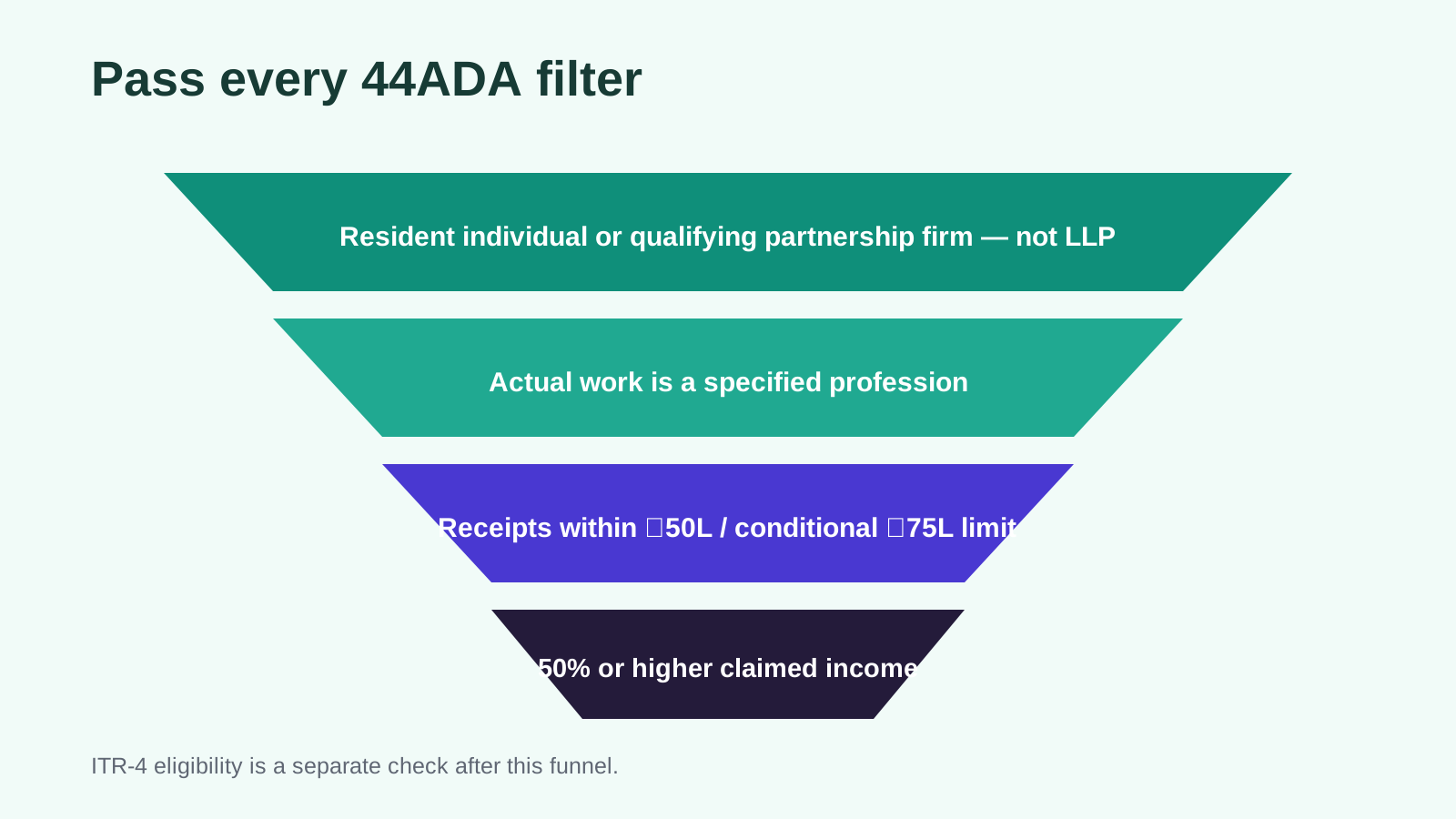
The Income Tax Department states that Section 44ADA may be used by a resident individual or resident partnership firm other than an LLP carrying on a specified profession. The ordinary gross-receipts limit is ₹50 lakh. It can extend to ₹75 lakh where cash receipts do not exceed 5% of total gross receipts.
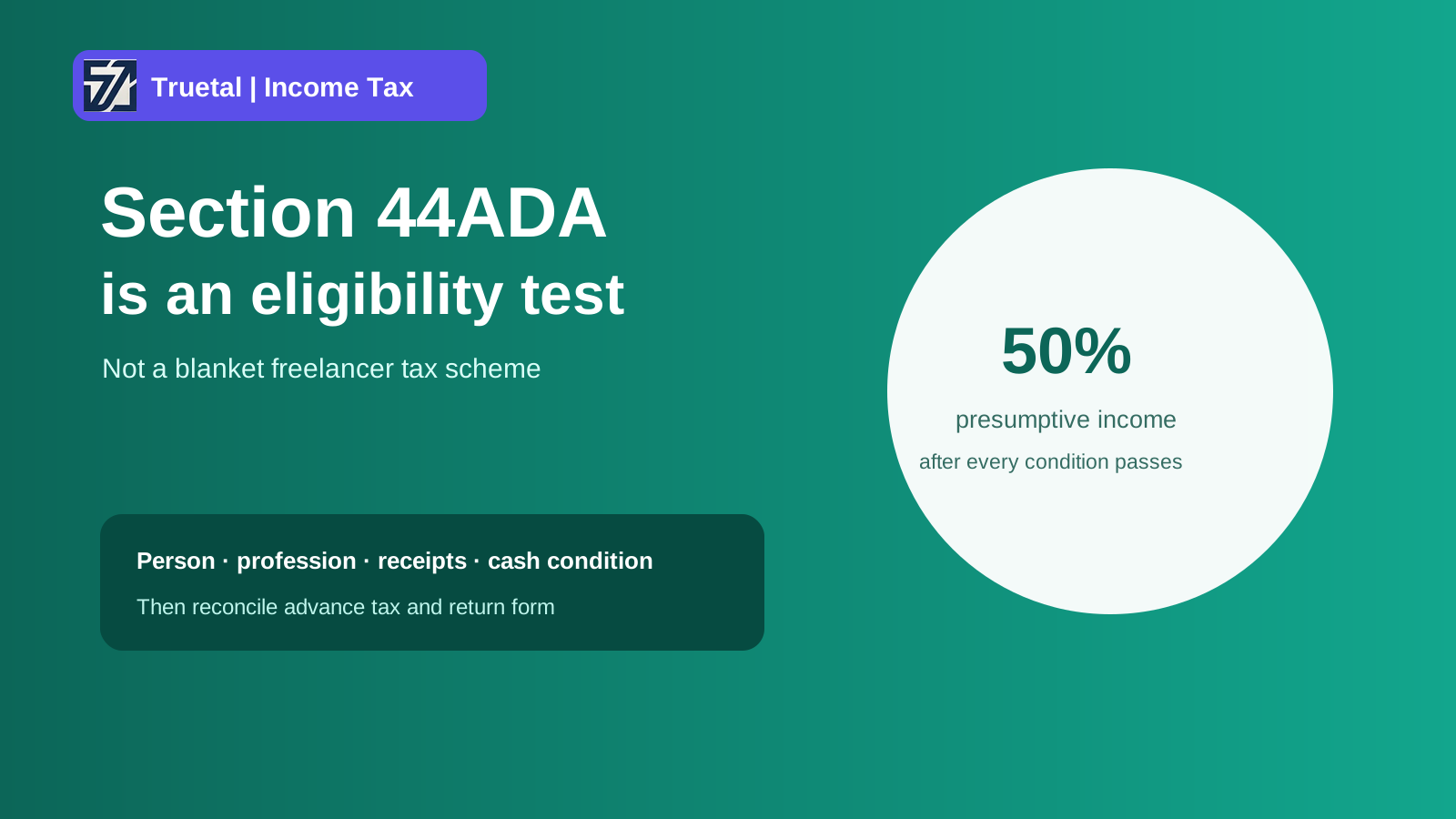
Presumptive income is normally 50% of eligible professional gross receipts, or a higher amount actually claimed to have been earned. After choosing the scheme, separate professional expense deductions are treated as already allowed; it is not “50% tax.” Tax is computed on total taxable income after the applicable return computation.
Which freelance professions may qualify?
Specified professions include legal, medical, engineering, architecture, accountancy, technical consultancy and interior decoration, plus other notified professions. A software or technology engagement may require a careful analysis of what the person actually does before calling it technical consultancy. Marketing, content creation, general business consulting and commission work should not be forced into Section 44ADA merely because they are skilled services.
Entity form matters too. A resident individual or qualifying partnership firm may be eligible; an LLP cannot use Section 44ADA. Residence and the actual source records should be checked for the relevant year.
The ₹50 lakh and ₹75 lakh receipt limits
The enhanced ₹75 lakh limit applies only when cash receipts do not exceed 5% of total gross receipts. Test the permitted modes and timing against the current provision rather than assuming every non-cash-looking wallet or settlement meets the condition.
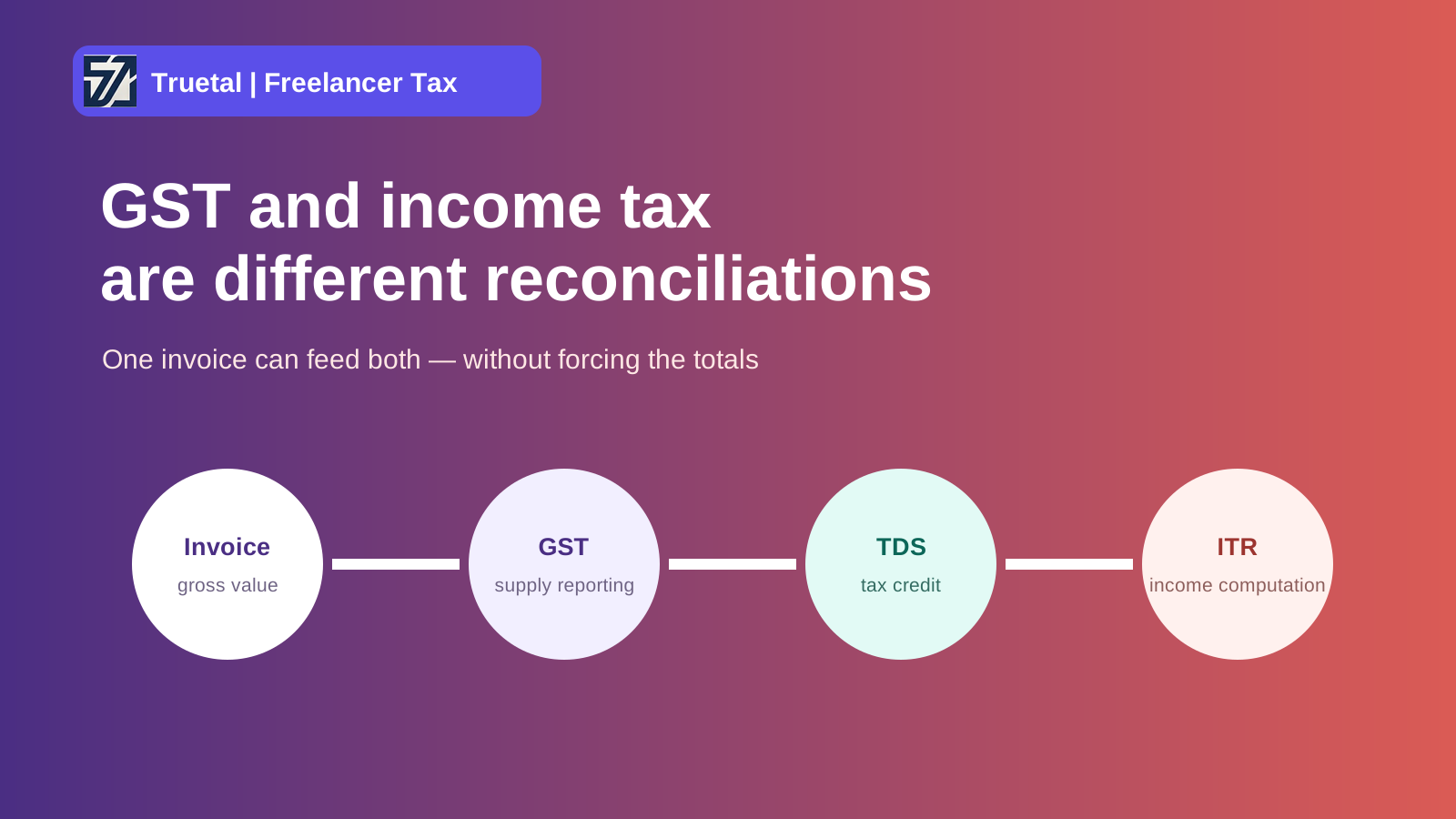
Gross receipts are not profit and not bank balance. Build the number from invoices, advances, credit notes and year-end cut-off, then reconcile it with Form 26AS, AIS, TDS certificates, GST turnover where applicable and bank receipts. Differences may be valid, but they need explanations.
Worked example
Arjun is a resident independent architect with ₹48 lakh of professional receipts, all received through bank transfers. If the other conditions are satisfied, he can consider Section 44ADA. A 50% presumptive computation would produce ₹24 lakh of professional income before considering the rest of his return.
Assume his actual office, software, travel and subcontractor expenses total ₹15 lakh. Section 44ADA does not permit him to declare ₹24 lakh and then deduct those ₹15 lakh again. The presumptive computation already treats eligible professional deductions as allowed.
Now change the facts: Arjun’s activity is commission-based property broking rather than architecture. The same receipt amount does not prove eligibility because the actual profession differs. The correct response is to classify the activity first, not to copy the earlier calculation.
Records still worth keeping
The simplified computation should not become evidence-free accounting. Keep:
- contracts and client invoices;
- the gross-receipts reconciliation;
- bank statements and payment-gateway settlements;
- TDS certificates, Form 26AS and AIS comparison;
- GST returns and sales register where registered;
- major expense and asset records;
- cash-receipt working for the 5% condition;
- advance-tax calculations and challans; and
- the written basis for treating the activity as a specified profession.
The Income Tax Department says an eligible specified professional declaring income at the presumptive rate is not required to maintain books under Section 44AA for that profession. Other laws, GST, commercial needs, lender requirements and the need to prove receipts can still make disciplined records essential.
Advance tax and return choice
The Department’s ITR-4 guidance states that a person using Section 44ADA pays 100% of advance tax by 15 March, subject to the applicable rules. Missing the date can create interest consequences.
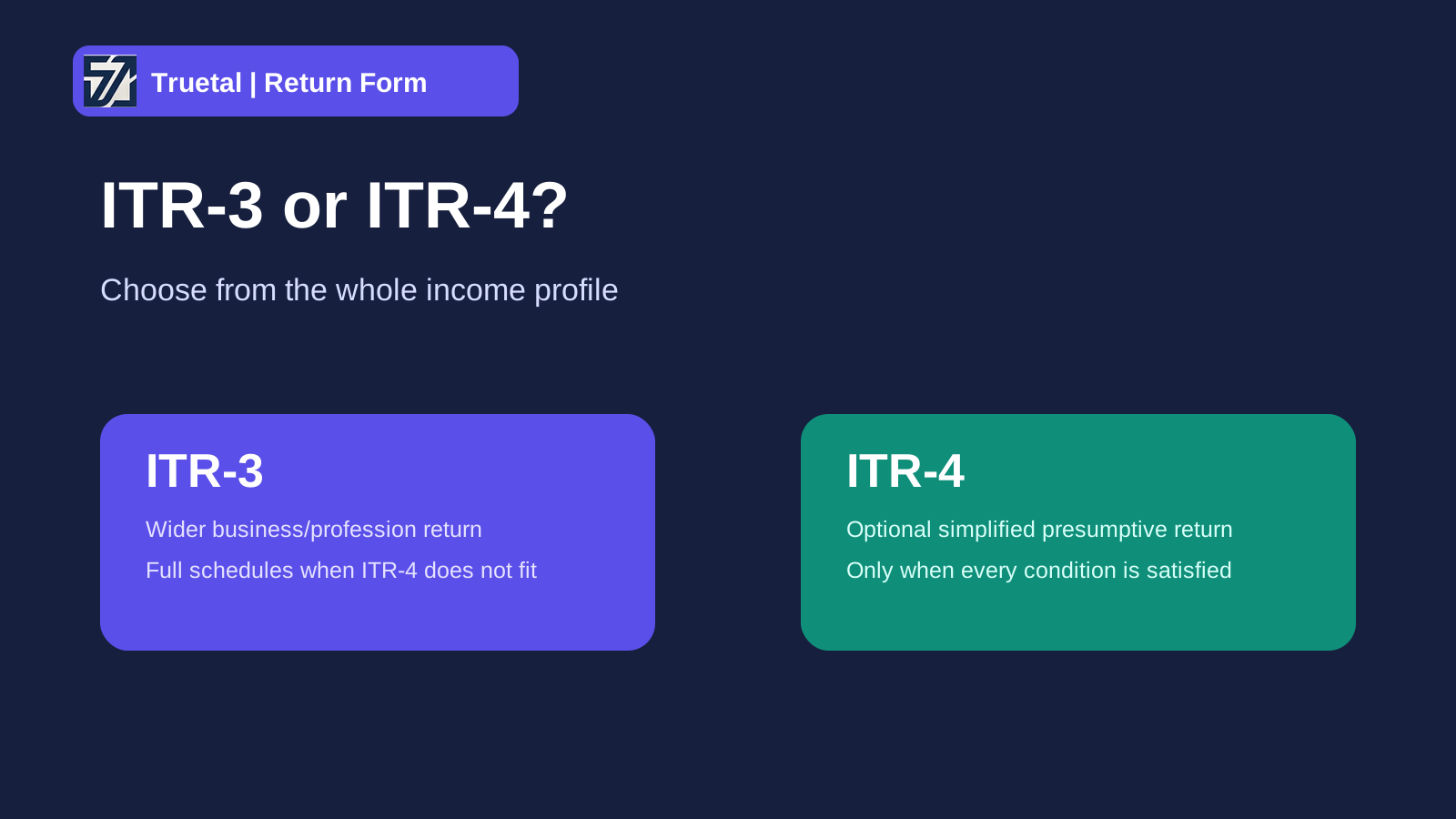
Section 44ADA eligibility does not automatically guarantee ITR-4 eligibility. ITR-4 has its own residence, total-income, income-type and exclusion conditions. Where those fail, ITR-3 may be required even though professional income is computed presumptively.
Common mistakes
- Calling every self-employed activity a specified profession.
- Reading “50% income” as a 50% tax rate.
- Deducting professional expenses again after using the presumptive figure.
- Using ₹75 lakh without testing the 5% cash-receipt condition.
- Treating GST turnover, AIS and bank credits as automatically identical.
- Assuming Section 44ADA always means ITR-4.
- Discarding records that support receipts, TDS, GST and the profession classification.
How professional support helps
ITR record-preparation support for freelancers starts with an organised receipt and evidence pack, not an automatic form selection. Truetal can help organise accounting records and unresolved differences. Profession analysis, presumptive eligibility, the ITR decision and any advance-tax working remain with the taxpayer or a separately engaged qualified tax professional.
FAQ
Can every freelancer use Section 44ADA?
No. The taxpayer must meet the residence and entity conditions and carry on a specified profession. “Freelancer” by itself is not a listed profession.
Is tax charged on 50% of receipts under Section 44ADA?
Section 44ADA generally treats 50% of eligible professional gross receipts, or a higher claimed amount, as professional income. The final tax applies to total taxable income under the applicable regime and slabs; it is not a flat 50% tax.
When does the ₹75 lakh limit apply?
It applies where the statutory cash-receipt condition is satisfied—cash receipts must not exceed 5% of total gross receipts—along with all other eligibility conditions.
Can I deduct laptop, rent and travel after declaring 50%?
Not separately against the Section 44ADA professional income. Eligible professional deductions are deemed to have been allowed in the presumptive computation.
Does Section 44ADA mean I must file ITR-4?
No. ITR-4 is optional and has additional eligibility and exclusion conditions. An individual with professional income who cannot use ITR-4 may need ITR-3.
The takeaway
Use Section 44ADA only after four checks: eligible taxpayer, specified profession, receipt threshold and cash condition. Then reconcile receipts, understand the deemed-expense effect and select the return form from the complete income profile.
Sources
- Income Tax Department — Return-filing transition FAQs for the Income-tax Act, 2025
- Income Tax Department — Objective and scope of the Income-tax Act, 2025 FAQs
- Income Tax Department — ITR-4 (Sugam) online FAQs for AY 2026-27
- Income Tax Department — Identify the applicable ITR
- Income Tax Department — Income-tax return utilities and form descriptions
- Income Tax Department — Form 10-IEA user manual