A freelancer should not choose an income-tax return merely because a colleague filed the same form. ITR selection follows the taxpayer’s residence, entity, professional-income method, total income and every other source or exclusion in the notified form.
Transition note, reviewed 10 October 2026: the ITR for FY 2025-26 / AY 2026-27 is filed under the Income-tax Act, 1961. Income from Tax Year 2026-27 falls under the Income-tax Act, 2025. Use the forms and validations notified for the return period; do not carry old section numbering into a later tax year without checking the equivalent provision.
The direct answer
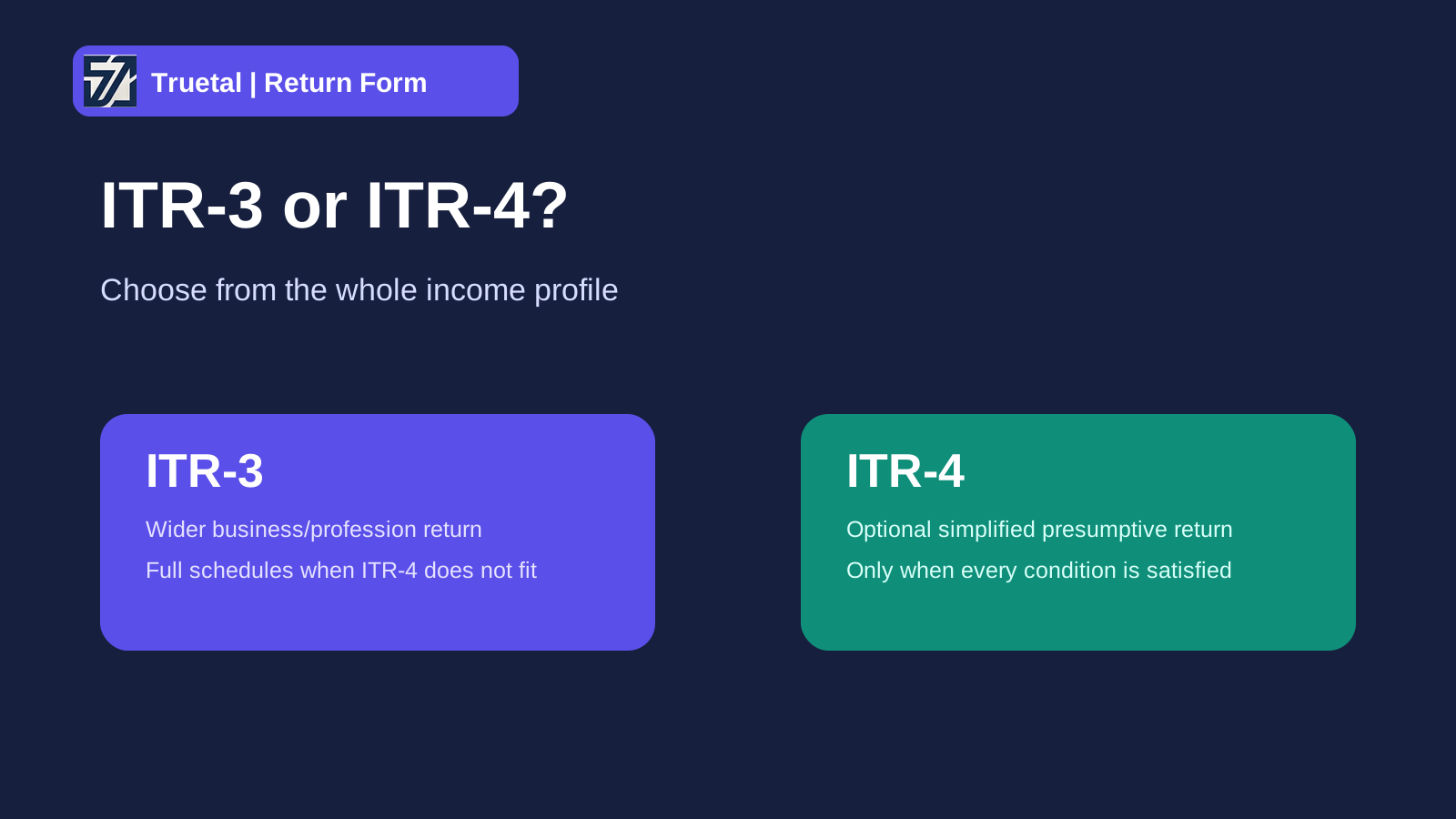
For AY 2026-27, the Income Tax Department describes ITR-3 as the return for individuals and HUFs with profits and gains from business or profession. ITR-4 is the simplified, optional return for eligible resident individuals, HUFs and firms other than LLPs using presumptive sections such as 44ADA, subject to its total-income and other conditions.
A freelancer eligible for Section 44ADA may still need ITR-3 because of another income source, an exclusion, non-resident status, total income above the ITR-4 limit, a loss position or another fact. Start with the entire return, not only freelance receipts.
When ITR-4 may fit
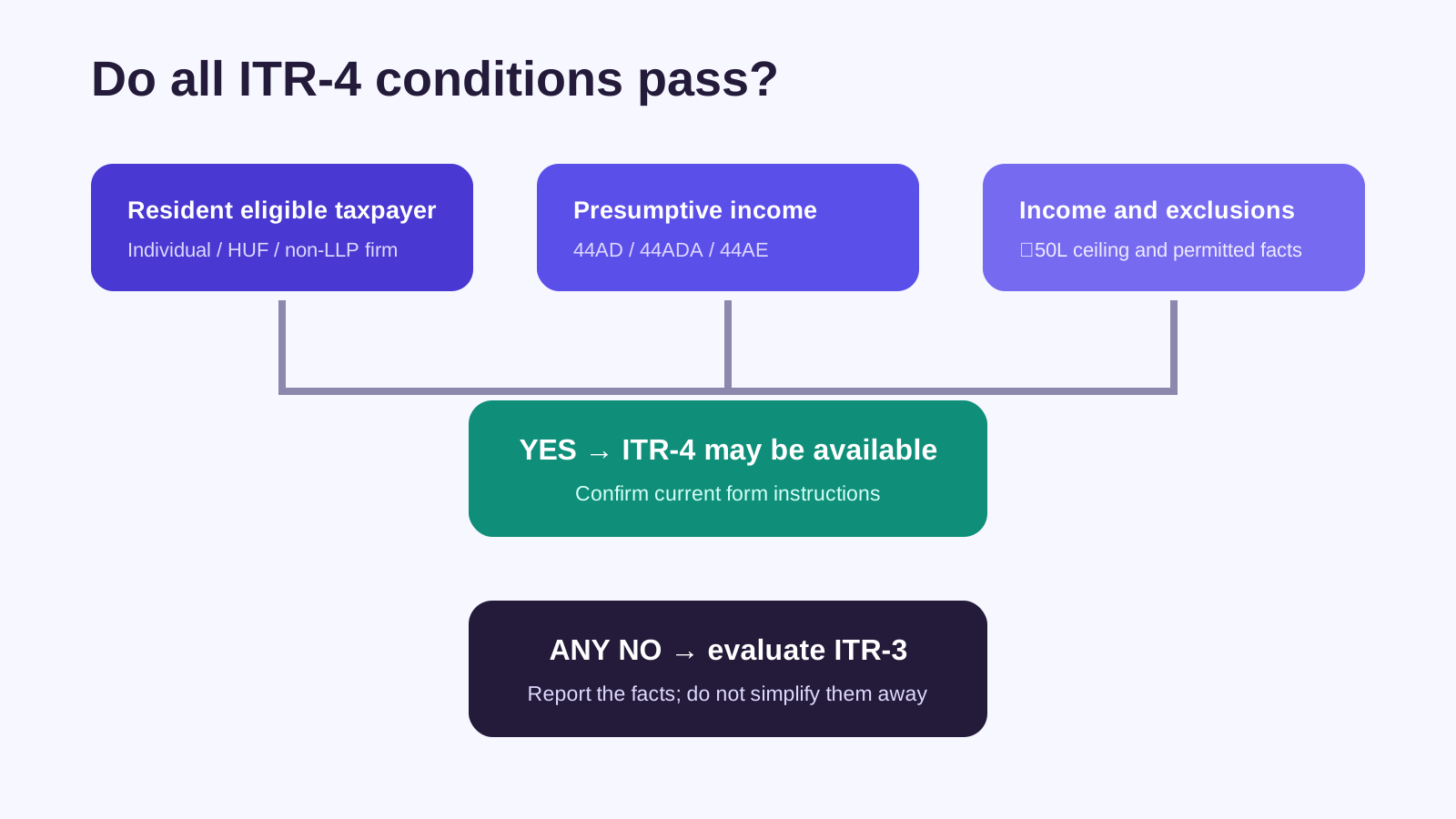
The Department’s current ITR-4 guidance includes resident taxpayers with total income up to ₹50 lakh and eligible presumptive business/professional income. It also lists permitted accompanying income and specific exclusions. The notified form and validations for the assessment year are controlling.
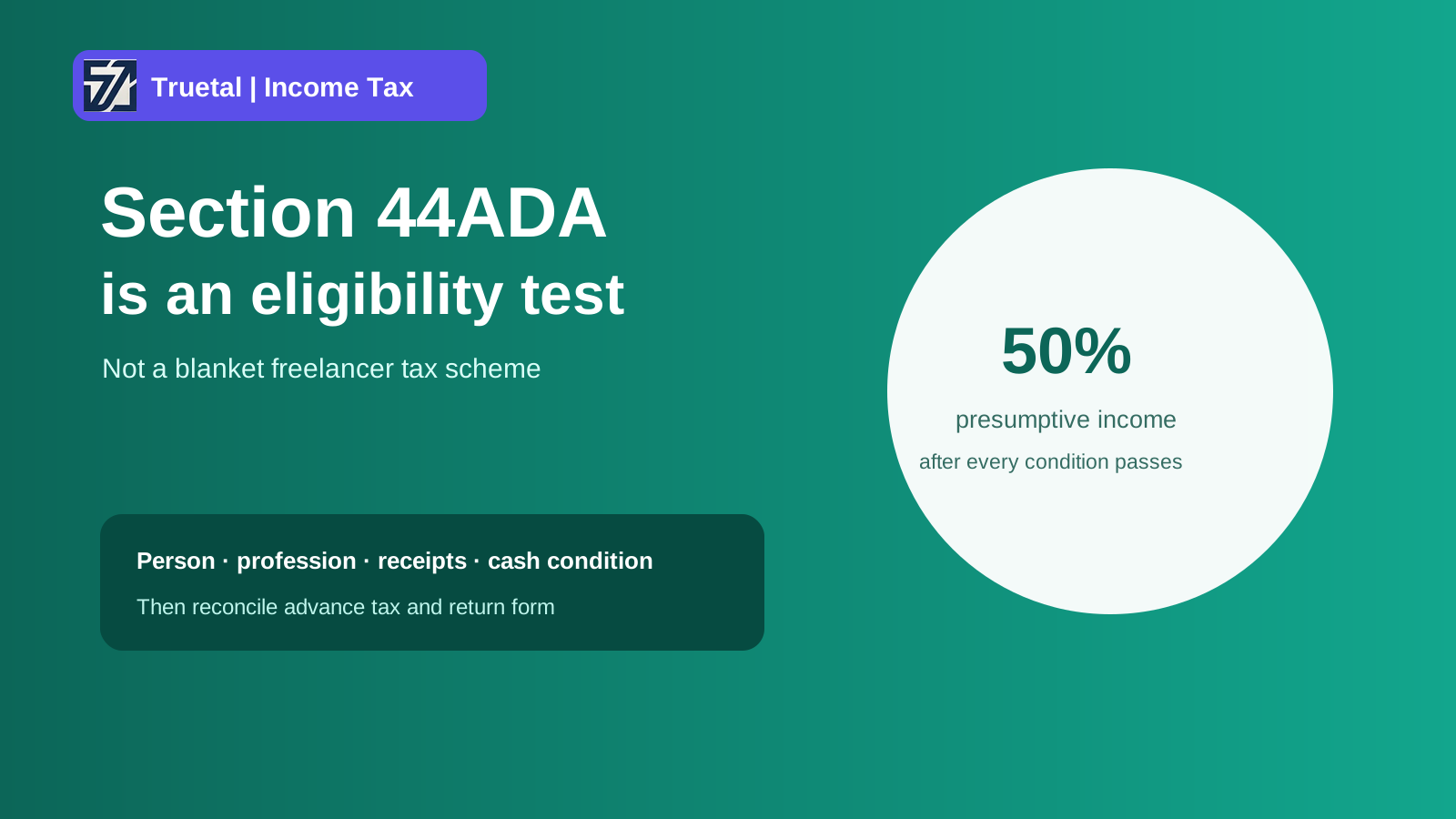
ITR-4 is not compulsory merely because a person uses Section 44ADA. It is a convenience form when all conditions line up.
When ITR-3 becomes relevant
ITR-3 is the broader individual/HUF return for business or professional income. It may be needed when the freelancer keeps regular books and reports actual profit, cannot use ITR-4, has income or losses outside ITR-4’s permitted set, or otherwise falls within the notified ITR-3 scope.
The form decision can also affect schedules and disclosures. Capital gains, foreign assets/income, brought-forward losses, directorship or unlisted-equity holdings and other facts require careful review against current instructions rather than a remembered checklist.
Worked example
Nisha is a resident technical consultant. Her gross professional receipts are ₹36 lakh and she is eligible to compute income under Section 44ADA. Her total income is within the ITR-4 limit and she has only permitted interest income. Subject to the remaining current conditions, ITR-4 may be available.
Now add a brought-forward professional loss that she needs to carry forward or set off. That fact can make ITR-4 unavailable. The professional receipts and Section 44ADA discussion have not changed, but the complete return profile has; ITR-3 may now be the applicable form.
In a second variation, Nisha is non-resident. ITR-4’s resident condition fails. Again, the answer changes before looking at the simplicity of the form.
A reliable form-selection checklist
- Confirm taxpayer type and residential status.
- List every head of income, not just freelance revenue.
- Decide whether professional income uses eligible presumptive computation or regular books.
- Calculate total income against the ITR-4 ceiling.
- Check capital gains, house properties, foreign income/assets and special-rate income.
- Check current-year and brought-forward losses.
- Review directorship, unlisted shares and every other notified exclusion.
- Confirm the assessment year and latest form validations.
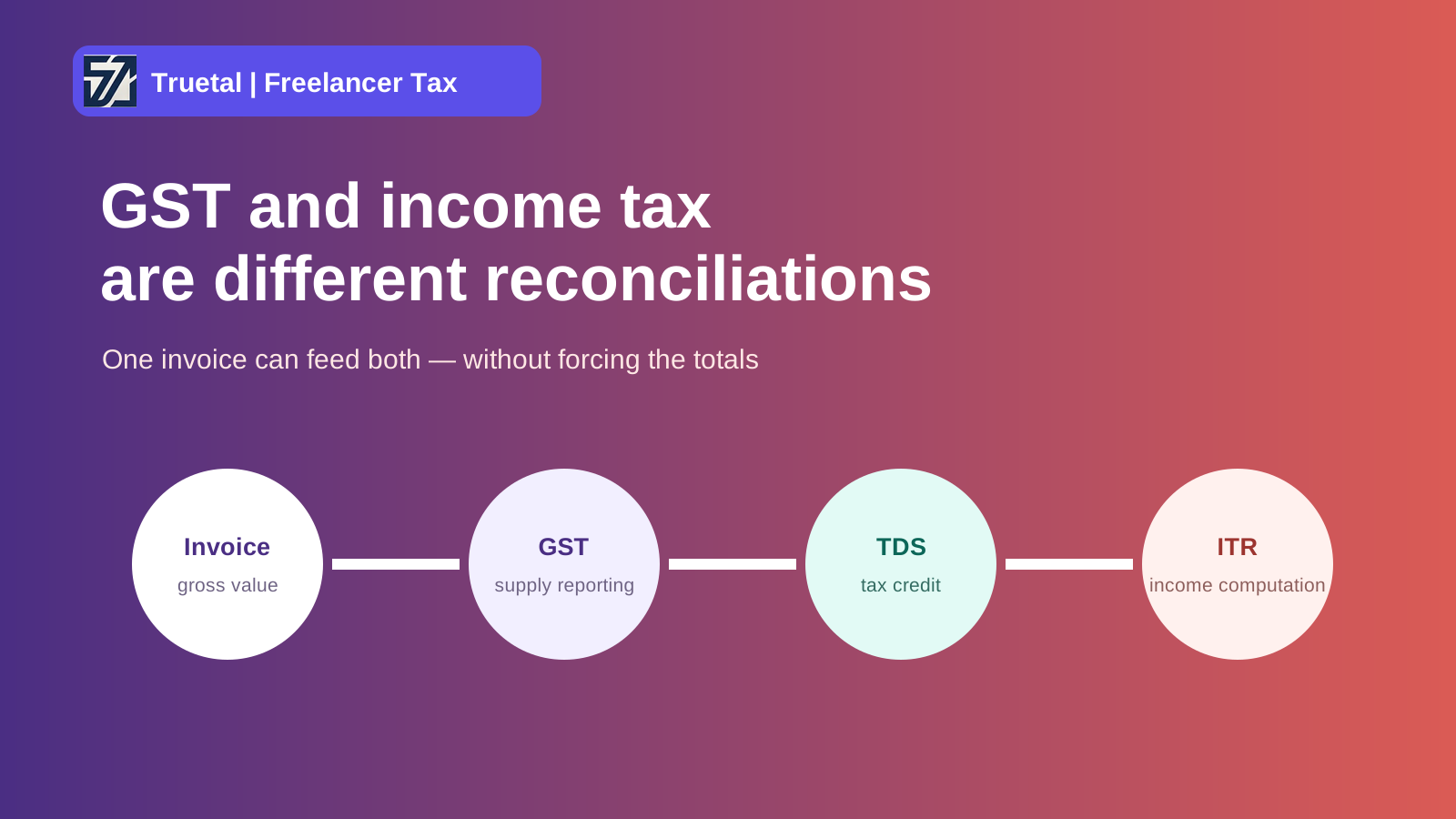
- Reconcile TDS, AIS, Form 26AS, GST turnover and receipts before filing.
- Save the form-selection working with the filed acknowledgement.
New versus old tax regime
The new regime is the default. The Income Tax Department’s Form 10-IEA guidance says taxpayers with business or professional income who want to opt out to the old regime must follow the prescribed Form 10-IEA process and timing. Their ability to move between regimes is more restricted than for taxpayers without business/professional income.
Return form and tax regime are separate decisions. ITR-3 is not synonymous with the old regime, and ITR-4 is not synonymous with the new regime.
Common mistakes
- Choosing ITR-4 because receipts are below ₹50 lakh while ignoring total income.
- Treating Section 44ADA eligibility as automatic ITR-4 eligibility.
- Forgetting residence, losses, capital gains or foreign assets.
- Filing ITR-1 for professional income because TDS appears under a salary-like label.
- Selecting a tax regime without checking Form 10-IEA timing for professional income.
- Copying last year’s form when facts or notified validations changed.
How professional support helps
Freelancer ITR record-preparation support can organise receipt summaries, accounting evidence and an exception list for review. The taxpayer or separately engaged tax professional decides the form, prepares the final tax computation and return, and confirms submission and verification. An accounting pack is not a form-selection opinion or proof of filing.
FAQ
Is ITR-4 mandatory if I use Section 44ADA?
No. ITR-4 is an optional simplified return available only when all its conditions are satisfied.
Can a freelancer file ITR-1?
ITR-1 is not the return for profits and gains from business or profession. A freelancer with professional income normally evaluates ITR-3 or, where every condition is met, ITR-4.
What is the main difference between ITR-3 and ITR-4?
ITR-3 is the wider individual/HUF business-profession return. ITR-4 is a simpler optional form for specified resident taxpayers using eligible presumptive computation and meeting its other limits.
Can I use ITR-4 if my professional receipts are below ₹50 lakh but total income exceeds ₹50 lakh?
No. The current ITR-4 total-income ceiling is a separate condition from the Section 44ADA gross-receipts limit.
Does the old or new tax regime decide whether I file ITR-3 or ITR-4?
No. Form eligibility and tax-regime choice are separate. Business/professional taxpayers choosing the old regime must also review the Form 10-IEA requirements.
The takeaway
ITR-4 is the shorter form, not the default freelancer form. Test it against the complete taxpayer and income profile. If one condition fails, use the form that correctly reports the facts—often ITR-3—rather than simplifying away a required schedule.
Sources
- Income Tax Department — Return-filing transition FAQs for the Income-tax Act, 2025
- Income Tax Department — Objective and scope of the Income-tax Act, 2025 FAQs
- Income Tax Department — ITR-4 (Sugam) online FAQs for AY 2026-27
- Income Tax Department — Identify the applicable ITR
- Income Tax Department — Income-tax return utilities and form descriptions
- Income Tax Department — Form 10-IEA user manual