Section 43B(h) is not only a tax-law topic; it is a vendor-master and ageing-report topic. If you do not know whether a vendor is micro/small, the acceptance date, agreed payment term and actual payment date, year-end review becomes guesswork.
The Short Answer
Build a vendor-wise year-end ageing report for micro and small enterprises. The Income Tax Department explains that payments beyond the MSMED Act time limit fall under section 43B(h) and the usual return-filing-date relaxation does not apply to that clause.
In Plain Words
The report should calculate the due date from vendor status, acceptance date and agreement terms rather than from invoice date alone. Year-end review then becomes a sortable risk list showing which micro/small-enterprise balances may need special tax treatment.
Why "registered MSME" matters first
This rule applies specifically to vendors registered as Micro or Small enterprises under the MSME Act (Medium enterprises are treated differently). Confirm a vendor's actual registration status — don't assume based on their apparent size — since the disallowance only applies to genuinely covered vendors.
The 45-day clock
The MSME Act requires payment within any agreed period, but caps that agreed period at 45 days from acceptance of goods/services. If no period is agreed, a shorter statutory default applies. Payment beyond this window is what triggers both the MSME Act's own interest consequence and, separately, the Section 43B(h) tax disallowance.
What gets disallowed, and for how long
If payment isn't made within the required period and remains unpaid by the time the income tax return is filed for that year, the expense is disallowed for that financial year entirely — it isn't lost forever, but it can only be claimed as a deduction in the year the payment is actually made, not the year it was originally incurred.
Practical implication: track MSME vendor payments separately
Because the deadline here is tax-consequential, not just a commercial courtesy, track payment due dates for registered MSME vendors distinctly from your general payables aging — the stakes for missing this specific deadline are different.
Worked example
A registered small-enterprise vendor delivers goods in January, with a 30-day agreed payment term. If payment isn't made by the due date in February, and remains unpaid when the income tax return for that financial year is filed, the expense is disallowed for that year — even though the goods were genuinely received and the liability is real. Paying the vendor the following year allows the deduction to be claimed in that later year instead.
Illustrative example. Actual treatment may depend on the facts and rules applicable on the transaction date.
The year-end payables report to run
Before the financial year ends, run one report that lists every open payable to a micro or small enterprise supplier:
- Supplier, MSME registration status and the date you checked it
- Invoice date, amount and the date the 45-day clock started
- Days outstanding and the due date under the payment terms
- Amount already paid and amount still open
- Whether the balance will be cleared before year end
Action: sort by days outstanding, pay or renegotiate what can still be settled inside the allowed time, and flag the balance that will cross the limit so the tax team knows a disallowance may arise.
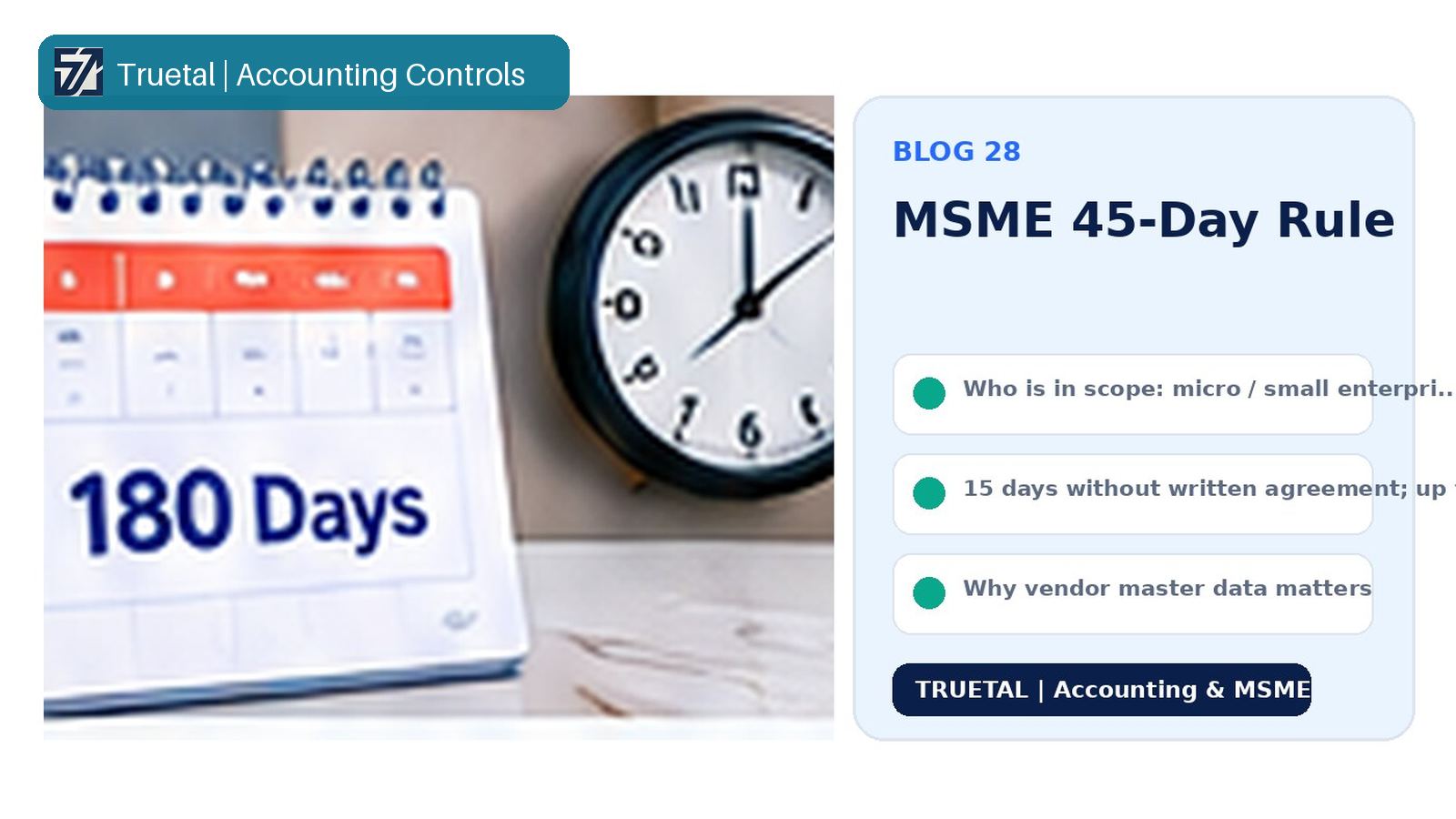
The Key Steps at a Glance
Read the four steps in order — each one depends on the one before it.
- 1Who is in scope: micro / small enterprise status
- 215 days without written agreement; up to 45 days with agreement
- 3Why vendor master data matters
- 4Year-end ageing and disallowance report
What to do now
- Confirm which of your vendors are registered Micro or Small enterprises under the MSME Act.
- Track their payment due dates (capped at 45 days) distinctly from general payables.
- Prioritize settling any overdue MSME vendor payment before your income tax return is filed for the year.
Common mistakes
- Not knowing which vendors are actually MSME-registered, missing the rule's applicability entirely.
- Treating the 45-day window as advisory rather than tax-consequential.
- Paying late but assuming the expense is simply "late," not realizing it's disallowed for that year specifically.
The Takeaway
For 43B(h), data quality is the tax control. Vendor status, acceptance date, agreement terms and payment date must all be connected.
How Truetal Helps
Truetal tags registered MSME vendors and tracks their payment status against the 45-day window separately, flagging any unpaid balance before your return-filing deadline.
Questions People Search For
- MSME 45 days 43B h accounting year end
- Section 43B h payment due date
- MSME vendor payment 45 days tax disallowance
Income Tax Department, Section 43B; MSME Development Act, 2006. Confirm your vendor's current registration status and the applicable payment period before relying on this.