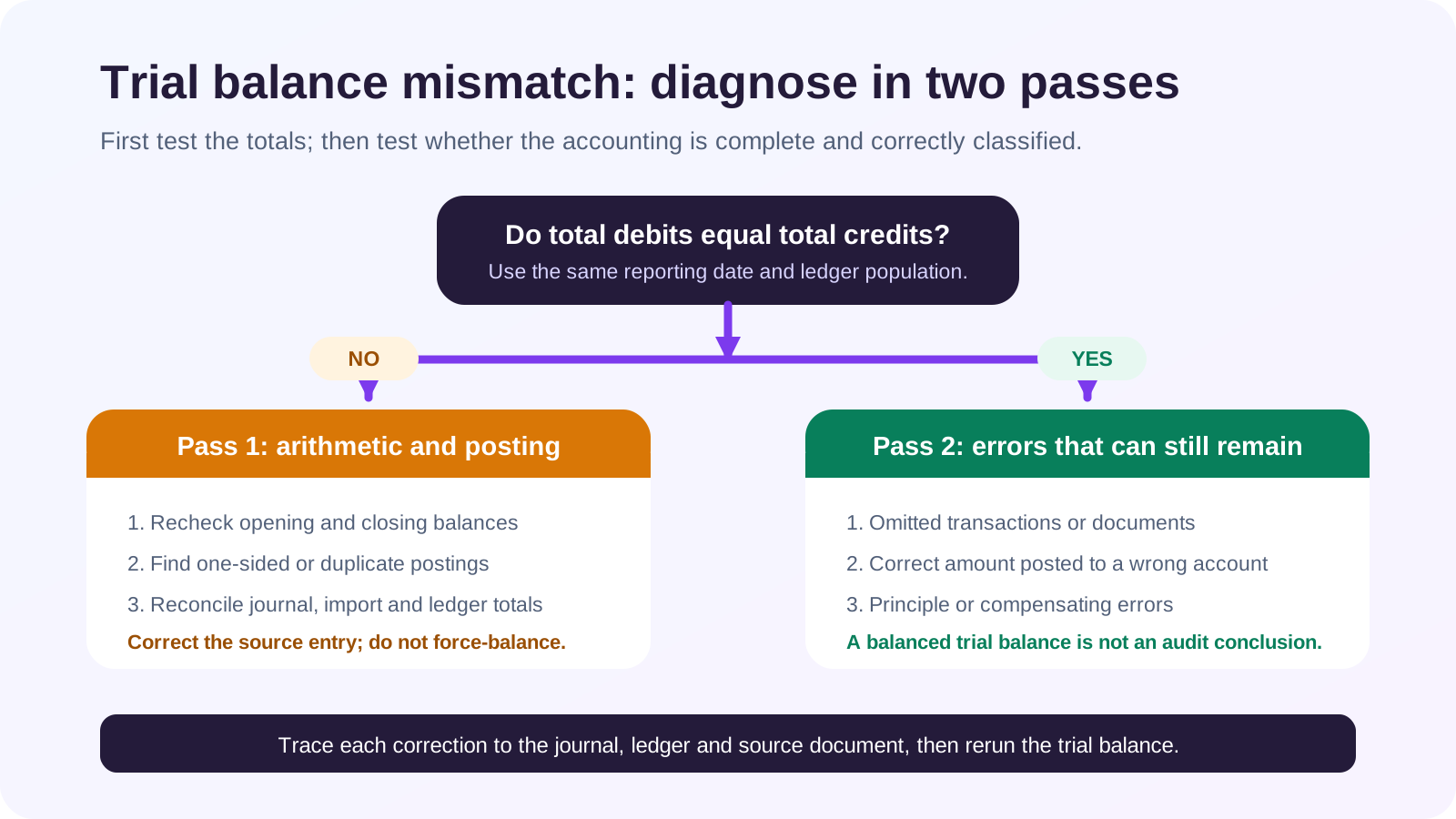
If a trial balance does not match, first confirm the report date and opening balances, then trace the difference to the source entry, import or ledger mapping. Do not force the totals to agree with an unexplained suspense journal. Correct the underlying transaction and rerun the report. Also remember the reverse: a balanced trial balance proves arithmetical equality, not that every transaction, amount and classification is correct.
Accounting-control caution, reviewed 15 October 2026: freeze the affected period before investigating, preserve the original report and involve the accountant where filed returns, audited balances or opening migrations may change. A balancing correction without source evidence can make later reports less reliable.
The direct answer
Every complete double-entry posting has equal debits and credits. A difference means that one side did not reach the report, an opening balance is incomplete, the report scope differs between sides, or data was altered outside the controlled posting path. Find when the difference first appeared, identify the exact source and repair it there.
If debit and credit totals agree, continue reviewing. Omitted transactions, posting to the wrong account, equal-and-opposite errors, duplicated complete journals and errors of principle can all leave the trial balance perfectly balanced.
First isolate the mismatch
Run the trial balance at progressively earlier dates until you find the first day or import batch where the difference appears. Then compare opening balance plus period movement with closing balance for the affected ledger.
| Signal | What it may indicate | What to inspect |
| Difference existed on the first day | Incomplete opening migration | Opening-balance import, equity/control offset and migration report |
| Difference begins on one transaction date | One-sided or partially failed posting | Source voucher, API/import log and audit trail |
| Difference equals one known document | Missing counterpart or excluded ledger | Invoice, payment, journal lines and report filters |
| Difference is divisible by 9 | Possible digit transposition | Source amount and keyed amount; treat this only as a clue |
| Trial balance agrees but a control account does not | Complete entry posted to wrong party/account | Customer/vendor ageing, bank reconciliation and ledger mapping |
| Only one period/view disagrees | Date, branch, currency or scope inconsistency | Report parameters and posting date/time |
Worked example: incomplete opening receivable
A business migrates opening balances on 1 April. Assets and expenses total ₹8,40,000 debit, while liabilities, income and equity total ₹8,25,000 credit. The trial balance difference is ₹15,000.
The customer-ageing import shows one customer opening balance of ₹15,000 that entered Accounts Receivable, but the migration did not create the corresponding opening-equity/control credit. Posting ₹15,000 to “Miscellaneous Expense” would balance the report while corrupting profit.
The correct response is to return to the approved opening-balance working, confirm the customer amount and intended counterpart, repair the migration entry with evidence, and rerun both the trial balance and customer ageing. The corrected control account should equal its supporting schedule.
Now assume the trial balance already agreed, but that same customer amount was posted to another customer. Debits and credits would still balance. The ageing and source-document review—not the total alone—would reveal the error.
Source-entry review sequence
- Save the mismatched trial balance with date, time and filters.
- Confirm the financial year, report period, branch/entity scope and currency basis.
- Compare total opening debits and credits before reviewing current-period activity.
- Find the earliest date on which the difference appears.
- Expand the affected ledger and inspect its source vouchers.
- Compare journal total with invoice, payment, bank, purchase or migration evidence.
- Check failed imports, deleted source records, duplicate integrations and manual database changes.
- Correct or reverse through the controlled source workflow; do not overwrite history silently.
- Rerun the general ledger, trial balance and the relevant supporting schedule.
- Document the cause, reviewer and final zero-difference proof.
Supporting schedules that should agree
- Accounts Receivable control to customer ageing.
- Accounts Payable control to vendor ageing.
- Each bank ledger to its reconciled bank statement.
- Inventory/control value to the approved stock valuation schedule.
- GST input/output ledgers to the transaction and return workings.
- TDS receivable/payable to certificates, statements and challans.
- Fixed assets to the asset register and depreciation schedule.
- Loans and advances to lender/party confirmations.
- Opening balances to the signed migration or prior-year closing pack.
Errors a balanced trial balance does not reveal
Complete omission. A transaction never entered the books, so neither side appears.
Wrong account, same side. Office equipment is debited to repairs expense; the trial balance still agrees, but profit and assets are wrong.
Wrong amount on both sides. An invoice for ₹54,000 is posted as ₹45,000 on both sides.
Compensating errors. Two unrelated errors happen to offset each other.
Duplicate complete entry. Both debit and credit are duplicated, preserving equality while doubling the transaction.
Wrong customer, vendor or period. The control totals may remain equal even though ageing, tax period or party balance is wrong.
Common mistakes
- Posting the difference to suspense without an owner, evidence or clearance date.
- Looking only at current-month turnover when the opening balance caused the issue.
- Editing ledger totals instead of the invoice, payment or journal that generated them.
- Ignoring report filters and comparing different entities or dates.
- Deleting a source record without reversing its accounting entry.
- Treating a balanced trial balance as proof that GST, receivables, inventory and profit are correct.
- Correcting a filed or locked period without approval and an audit trail.
How Truetal helps
Truetal’s accounting reports show the trial balance as closing ledger balances, with opening and period movement, group/ledger views, source drill-down and review items. This can shorten the path from a difference to its originating record. It does not certify that a balanced ledger is correctly classified or that every external transaction was recorded; the user and accountant must complete those controls.
FAQ
Why does my trial balance not match?
Common causes include incomplete opening balances, a one-sided failed import, an excluded ledger, inconsistent report scope or a source record whose counterpart did not post. Find the first date of difference and trace its source.
Should I use a suspense account to make the trial balance agree?
Not as an unexplained plug. A temporary suspense process may exist under a controlled accounting policy, but every item needs evidence, an owner and a prompt resolution to the correct source or account.
Can a trial balance be balanced and still be wrong?
Yes. Complete omissions, wrong-account postings, equal errors on both sides, compensating errors and duplicate complete journals can all preserve debit-credit equality.
What should I check after the totals agree?
Agree control accounts to supporting schedules, review unusual balances and source documents, reconcile banks and tax ledgers, and test cut-off, classification and duplicate risk.
The takeaway
Balance is the start of review, not the finish. Repair a mismatch at its source, prove the control schedules, and retain the audit trail explaining what changed and why.