
“Audit trail” is used for several different things. A screen that lists logins is an activity log. A report that links a ledger line to an invoice is source traceability. The Companies (Accounts) Rules use a more specific edit-log requirement for companies using accounting software to maintain books.
Confusing these meanings can lead a business to buy the wrong product or make a compliance claim the evidence does not support.
The short answer
For company books, Rule 3(1) needs careful professional review of the accounting software and every part of the bookkeeping environment. The relevant requirement concerns recording an audit trail for each transaction, creating an edit log for changes with their dates, and ensuring the trail cannot be disabled. Auditor reporting under Rule 11(g) adds a separate examination and reporting dimension.
Do not treat a vendor's “has audit logs” badge as proof. Ask what records are covered, whether changes and deletions are captured, who can disable or alter the log, how long it is retained, and how the auditor can inspect it.
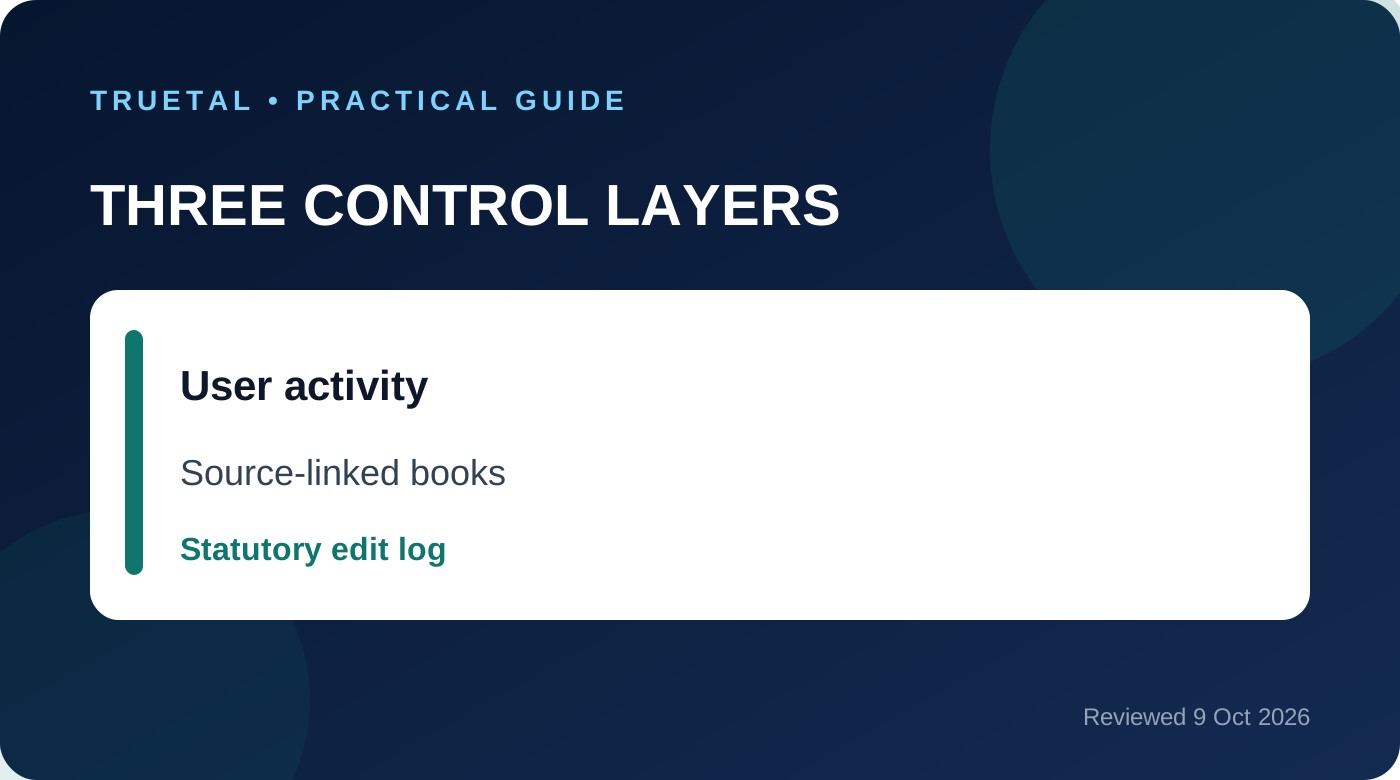
Three controls that should not be confused
| Control | Main question | What it does not prove by itself |
| User activity log | Who logged in or clicked an action? | The accounting value before and after a change |
| Source-linked ledger | Which invoice, payment or journal produced this line? | That every edit is captured and the log cannot be disabled |
| Statutory edit log/audit trail | What changed in books, when, and can the trail be disabled or tampered with? | Correct accounting or auditor acceptance without testing |
All three are useful. They solve different problems.
Worked example: correcting a supplier bill
Suppose a user records supplier invoice PB-118 with taxable value ₹1,00,000 and GST ₹18,000. The next day, the source invoice is reviewed and the taxable value should have been ₹90,000 with GST ₹16,200.
A weak system simply replaces the old values. The final bill looks correct, but nobody can see that ₹11,800 disappeared from the payable and purchase records.
A controlled workflow should answer:
- Who created PB-118 and when?
- What were the original values?
- Who made or approved the correction?
- When did the change occur?
- What reason and source document support it?
- Which ledger and tax records changed?
- Was the period already protected or filed?
- Can an administrator erase or disable this history?
Source traceability can link the corrected ledger to PB-118. A correction reason can explain the business event. A period lock can stop an unauthorised change after filing. But whether the complete software environment satisfies the MCA requirement is a broader, evidence-based conclusion—not a marketing shortcut.
What to verify with a software provider
Coverage
List every system that maintains or changes the books: core accounting, billing that posts entries, purchase/bill tools, bank posting, payroll journals, integrations, imports and direct database utilities. An audit trail in one module may not cover changes made elsewhere.
Events captured
Test creation, modification and deletion/cancellation. Check masters as well as transactions when they affect books. Review before/after values, user, timestamp and reference.
Ability to disable or alter
Ask whether any owner, administrator, support engineer or database operator can turn off logging or modify the audit records. Document configuration changes and downtime.
Retention and availability
Confirm how long the trail remains available, what happens after migration, whether backups preserve it and what export or read access the auditor receives.
Time and identity
Check time-zone consistency, unique user accounts and shared credentials. A perfect timestamp attached to “admin” is weak evidence when five people use the same login.
Change management
Retain version, update and configuration evidence. A feature may exist but not operate throughout the year because it was disabled, misconfigured or bypassed.
Evidence checklist for management and the auditor
- Software inventory and modules used for books.
- Version and configuration records.
- User/role list and access review.
- Samples of created, changed, cancelled and reversed transactions.
- Before/after values, timestamps and user identity.
- Evidence that logging operated throughout the period.
- Tests of whether the trail can be disabled or altered.
- Backup, retention and migration procedures.
- Source documents and approval reasons for sampled changes.
- Reconciliation from source transaction to ledger and financial report.
- Exceptions, downtime and remediation documented honestly.
Use the ICAI implementation guide and your statutory auditor to design and test the work. Applicability and reporting conclusions depend on the entity and its actual systems.
Common mistakes
- Calling a login history a complete accounting edit log.
- Assuming “cloud software” automatically means tamper-proof.
- Testing only sales invoices and ignoring masters, journals, imports or integrations.
- Letting staff share one user account.
- Deleting wrong entries when a cancellation or reversal should preserve history.
- Failing to retain logs through data migration or year-end rollover.
- Claiming MCA compliance because a feature exists, without testing operation for the full period.
- Treating an audit trail as proof that the accounting itself is correct.
How Truetal helps—and the boundary
Truetal uses source-linked accounting records so ledger and report figures can be traced to supported invoices, bills, payments, bank records or journals. Relevant workflows retain audit events, and filed periods are protected from silent changes.
That is useful operational evidence, but this article does not represent that Truetal has been independently validated as satisfying every requirement of Rule 3(1) or auditor reporting under Rule 11(g). A company considering Truetal for statutory books should have its auditor review the exact deployment, modules, integrations, access, retention and full-year operation before reaching a compliance conclusion.
FAQ
Is an audit trail mandatory for every Indian small business?
The Companies (Accounts) Rules requirement discussed here applies to companies using accounting software for their books. Other entity types can still benefit from change history and may have other record-keeping duties. Confirm your entity's position professionally.
Is a source link the same as an edit log?
No. A source link explains where a ledger line came from. An edit log records changes to relevant book records over time. A good control environment may need both.
Can administrators be allowed to delete audit logs?
That would undermine the statutory requirement that the audit trail cannot be disabled. Review the actual technical privileges, not only the user interface.
Does an audit trail prevent fraud or mistakes?
It improves visibility and accountability but does not guarantee correct entries or prevent collusion. Reviews, reconciliations, approvals and access controls remain necessary.
What should I ask for in a demo?
Ask the provider to create, modify, cancel and reverse representative transactions; show before/after data and user/time; trace each result into the ledger; and explain disablement, retention, export, backup and migration behavior.
The takeaway
Auditability is not one checkbox. Keep the source, preserve the change, identify the actor, protect the period and prove the control operated. Then let the responsible professional assess compliance from evidence rather than a product label.