A service belongs to March but the vendor sends the invoice in April. Two clocks are running: the accounting period for the expense and the GST conditions for ITC. Mixing those clocks is why year-end provisions and April invoices often produce messy reversals.
The Short Answer
Financial-statement expense recognition and GST input tax credit (ITC) timing are related but not identical. Accrue the expense in the period in which it belongs when accounting criteria are met; claim GST input tax credit (ITC) only when statutory conditions and documentation are satisfied. Reconcile the provision when the actual invoice arrives.
In Plain Words
Accrue the March expense when accounting recognition criteria are met, but do not invent GST credit without the required document/conditions. When the April invoice arrives, reverse the estimate, book the actual vendor invoice and separately handle the estimate-versus-actual difference.
Why the delivery date governs, not the invoice date
Accrual accounting exists specifically to match expenses to the period the underlying economic activity occurred, independent of when cash changes hands or paperwork is issued. A vendor's own invoicing timeline is an administrative fact about them, not a determination of when your liability actually arose.
The practical sequence
- March — the service is actually delivered, or the expense is genuinely incurred.
- April — the vendor's invoice physically arrives.
- At FY close — accrue the expense in March, based on the known or reasonably estimated amount, even without the final invoice in hand yet.
Estimating when the final invoice isn't available at close
If the vendor's invoice hasn't arrived by the time your books need to close for the year, accrue a reasonable estimate based on the contract, prior invoices, or known rate — then true up the difference, if any, once the actual invoice arrives.
Why this matters for tax and audit
Recognizing the expense in the wrong year can misstate that year's profit, and by extension the tax computed on it — a genuine year-end cutoff error, not a cosmetic bookkeeping detail. Auditors specifically test for exactly this kind of cutoff issue around financial year-ends.
Worked example
A consultant delivers advisory services throughout March but doesn't invoice until 10 April. At 31 March year-end close, accrue the estimated March fee as an expense (with a corresponding accrued-liability entry), even though the actual invoice hasn't arrived. When the April invoice does arrive, reconcile it against the accrual — adjusting for any difference between the estimate and the actual billed amount.
Illustrative example. Actual treatment may depend on the facts and rules applicable on the transaction date.
The Key Steps at a Glance
Read the four steps in order — each one depends on the one before it.
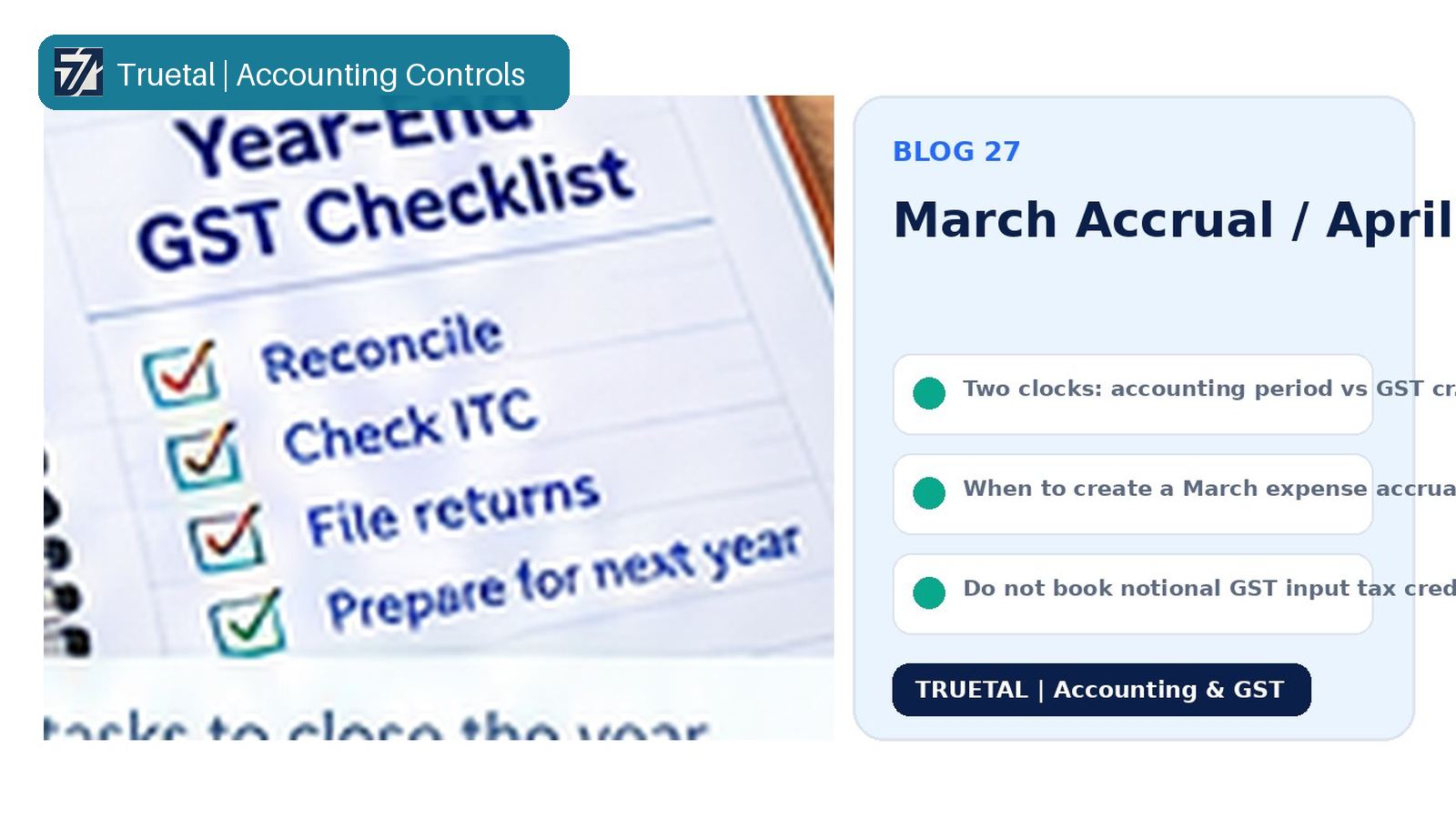
- 1Two clocks: accounting period vs GST credit
- 2When to create a March expense accrual
- 3Do not book notional GST ITC without the required document / conditions
- 4April invoice: reverse provision and book actual vendor invoice
What to do now
- Identify any service delivered before year-end whose invoice hasn't yet arrived.
- Accrue a reasonable estimate for each, rather than waiting for the invoice to record the expense.
- True up the estimate against the actual invoice once it arrives.
Common mistakes
- Recognizing an expense only when the invoice is physically received, regardless of when the service was delivered.
- Not reviewing for unbilled, undelivered-invoice services specifically at year-end close.
- Failing to true up an accrual estimate once the actual invoice arrives, leaving a small permanent discrepancy.
The Takeaway
Year-end accounting and GST ITC timing can land in different periods. Manage the bridge deliberately instead of forcing them into one date.
How Truetal Helps
Truetal flags open purchase orders and recurring vendor relationships with no invoice yet received as your financial year-end approaches, so accrual estimates aren't missed.
Questions People Search For
- March expense April invoice which financial year GST
- Accrual expense invoice next year GST ITC
- Year end expense provision GST
ICAI Accounting Standards on accrual-basis recognition.