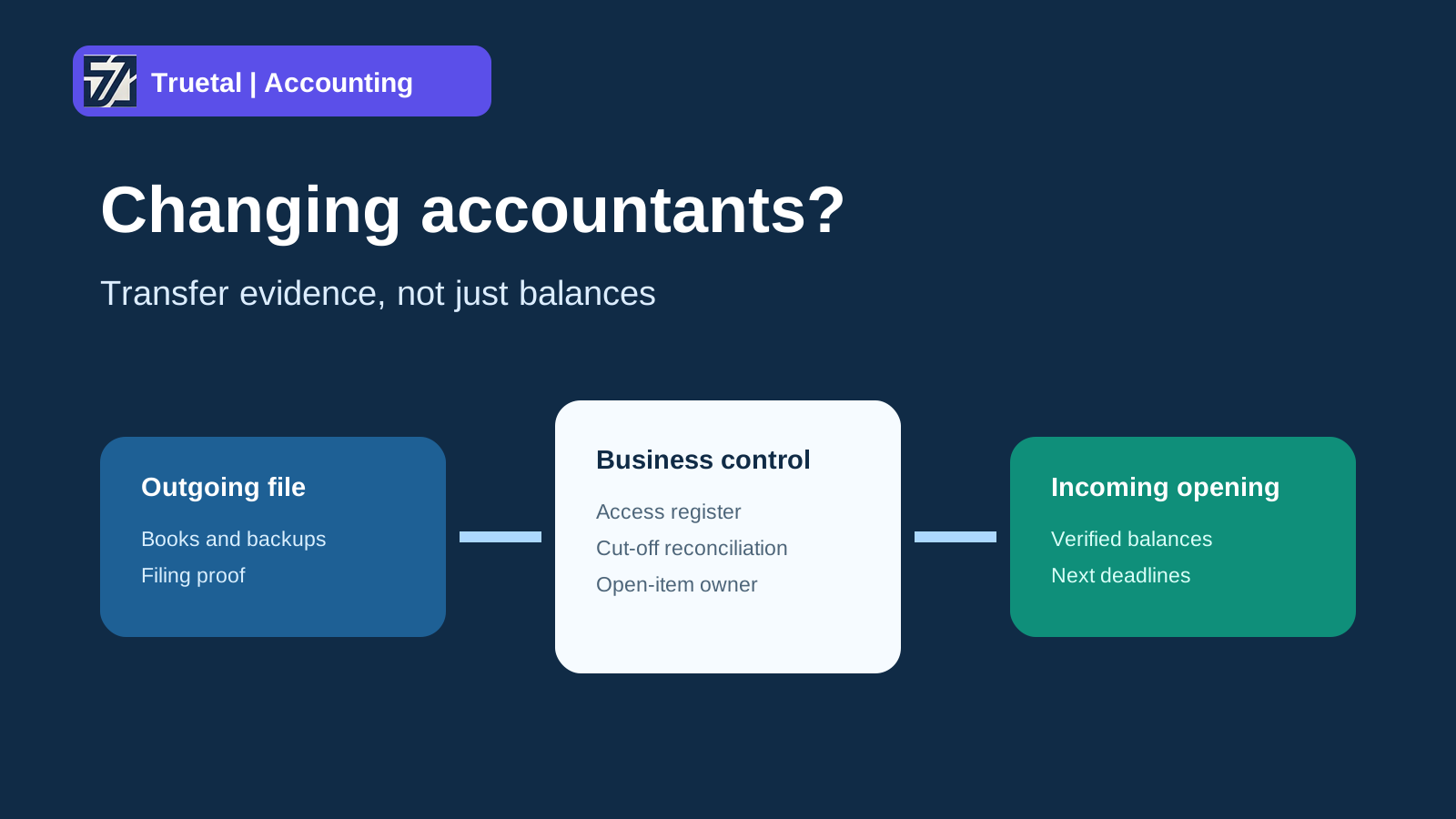
Changing an accountant should not mean starting the books again. The objective is to transfer source records, system access, reconciliations, open items and filing proof to a named cut-off date—without sharing personal passwords or leaving both advisers able to act indefinitely.
The direct answer
Agree a written handover date and responsibility matrix. Export the complete accounting data in both usable and human-readable formats, take control of statutory portal access, collect filed acknowledgements and working papers, reconcile balances to the cut-off, and record every unresolved item with an owner and due date.
Do not wait until the last filing day. A clean handover requires cooperation from the business, outgoing accountant and incoming accountant.
Step 1: define the cut-off and scope
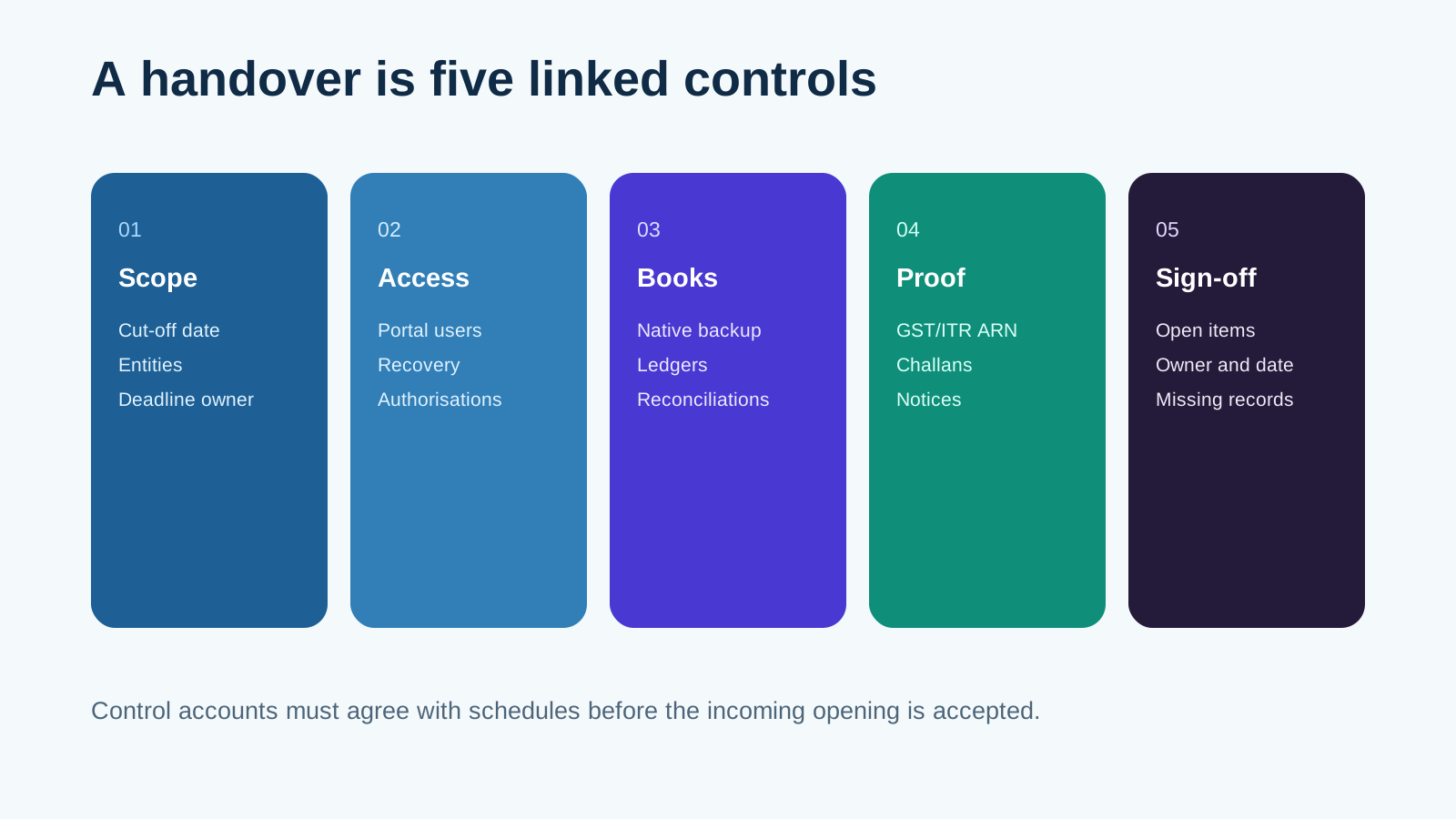
Write down the last date the outgoing accountant will post entries, prepare returns, answer notices and communicate with authorities. Identify which GSTINs, PANs, branches, bank accounts, payrolls and entities are included.
List deadlines falling within the transition window. The responsibility for a return should never be implied by who happens to possess the login.
Step 2: recover business-controlled access
The business should control its official email, mobile number and authorised signatory details. Review access to:
- GST Portal and e-way bill/e-invoice systems where applicable;
- Income Tax e-Filing portal and authorised representatives;
- accounting software and backups;
- bank feeds or statement portals;
- payroll, PF and ESIC systems where applicable;
- invoicing, payment gateway and marketplace portals; and
- business email or document storage used for finance.
Use each portal’s proper user/authorisation mechanism. Do not ask the outgoing adviser to email personal passwords or OTPs. Remove or change access only after exact users and dependencies are identified so an active filing is not accidentally blocked.
Step 3: transfer books and source records
Ask for the native accounting backup/export plus PDF or spreadsheet reports. A trial balance alone is not a handover.
The pack should include ledgers, journals, customer and supplier masters, open invoices, receivables/payables ageing, bank books, bank reconciliations, fixed assets, inventory where relevant, payroll, loans, advances, expenses and tax ledgers. Link material balances to invoices, statements, contracts or schedules.
Step 4: collect GST and income-tax proof
For GST, collect registration certificates, LUTs, filed return acknowledgements, electronic ledgers, sales/purchase extracts, GSTR-2B reconciliation, ITC positions, notices, replies, orders and refund or amendment files.
For income tax, collect filed ITR acknowledgements and computation, audit reports where applicable, Form 26AS/AIS reconciliation, TDS returns and certificates, challans, advance-tax working, notices/replies and carried-forward loss or depreciation schedules.
Portal screenshots are not a substitute for downloadable acknowledgements and workings. Keep the exact period and ARN/acknowledgement reference.
Worked example
A trading business changes accountants on 30 September. The outgoing trial balance shows ₹18 lakh of customer receivables, but the ageing report totals ₹17.4 lakh. One ₹60,000 receipt was posted directly to sales instead of the customer ledger.
If the new accountant imports only the trial balance, the customer remains incorrectly outstanding and revenue is duplicated. The handover checklist catches the control difference, links the bank receipt to the invoice, records the correction and produces a signed closing ageing equal to the control account.
The same principle applies to GST: a net ITC figure without invoice-level unmatched items is not enough to continue the next month’s reconciliation.
The handover pack
- Engagement scope, cut-off date and deadline owner.
- Portal/access register with business-controlled recovery details.
- Native software backup plus ledger and report exports.
- Signed trial balance and opening-balance mapping.
- Customer/vendor ageing and unresolved allocations.
- Bank statements and reconciliation to the cut-off.
- Inventory and fixed-asset schedules where relevant.
- GST registrations, return proof, reconciliations and notices.
- Income-tax returns, TDS, challans, audits and notices.
- Payroll/statutory files where in scope.
- Open-item register with amount, evidence, owner and deadline.
- Final handover acknowledgement listing anything not received.
Common mistakes
- Changing passwords before identifying automated feeds or active submissions.
- Accepting only PDFs when the new accountant needs transaction-level data.
- Accepting only a software backup without readable control reports.
- Importing opening balances that do not agree with ageing, bank or tax schedules.
- Losing prior filing acknowledgements after portal access changes.
- Allowing the same unresolved issue to be assumed by both advisers—or neither.
- Sharing personal OTPs instead of using authorised access.
How professional support helps
Accounting services for small businesses can review the cut-off and opening controls, while bookkeeping services can continue the monthly source-record and reconciliation rhythm after the migration.
FAQ
Can my old accountant refuse to give me my accounting data?
Contractual and professional issues depend on the engagement and facts. Start with a written inventory of business records, access and deliverables, resolve legitimate fee or scope disputes properly, and obtain professional/legal help where needed.
Is a trial balance enough for an accountant handover?
No. It gives control totals but not the transaction detail, ageing, reconciliations, source documents, tax evidence and open issues needed to continue reliable books.
Should I share GST or income-tax portal passwords?
Use official authorised-user or representative mechanisms wherever available and keep recovery details controlled by the business. Do not routinely share personal passwords or OTPs.
What date should be used for the handover?
Choose a clear cut-off after completing or documenting the period’s postings and reconciliations. State who owns every filing and correction around that date.
How do I know the opening balances are reliable?
Agree each material control account to supporting schedules: bank to reconciliation, receivables/payables to ageing, GST/TDS to returns and ledgers, and assets/inventory to their registers.
The takeaway
A good accountant handover transfers more than balances. It transfers control: who can act, what was filed, how each balance is supported and who owns every unfinished item.
When a handover exposes missing months
A change of accountant does not itself repair historical records. If the transfer reveals unentered or unreconciled periods, use the five-phase accounting backlog recovery plan to scope evidence, reconstruction, approval and unresolved items. Keep the adviser transition and any catch-up engagement separately owned.