
The direct answer
To clear an accounting backlog, separate the historical period from today's work, preserve the original books, collect the missing evidence and reconstruct one period at a time. Reconcile bank activity to source documents, not directly to assumed sales or expenses. Review tax differences separately, then approve supported closing balances before carrying them forward. Completion means a traceable close and an owned exceptions list—not merely that every bank row has a category.
As of 20 October 2026: this is an operational reconstruction method, not a tax-amnesty scheme, statutory filing instruction or promise to finish any backlog in a fixed number of days. A qualified adviser must assess historical tax positions, corrections and deadlines for the actual entity and period.
A five-phase backlog recovery plan
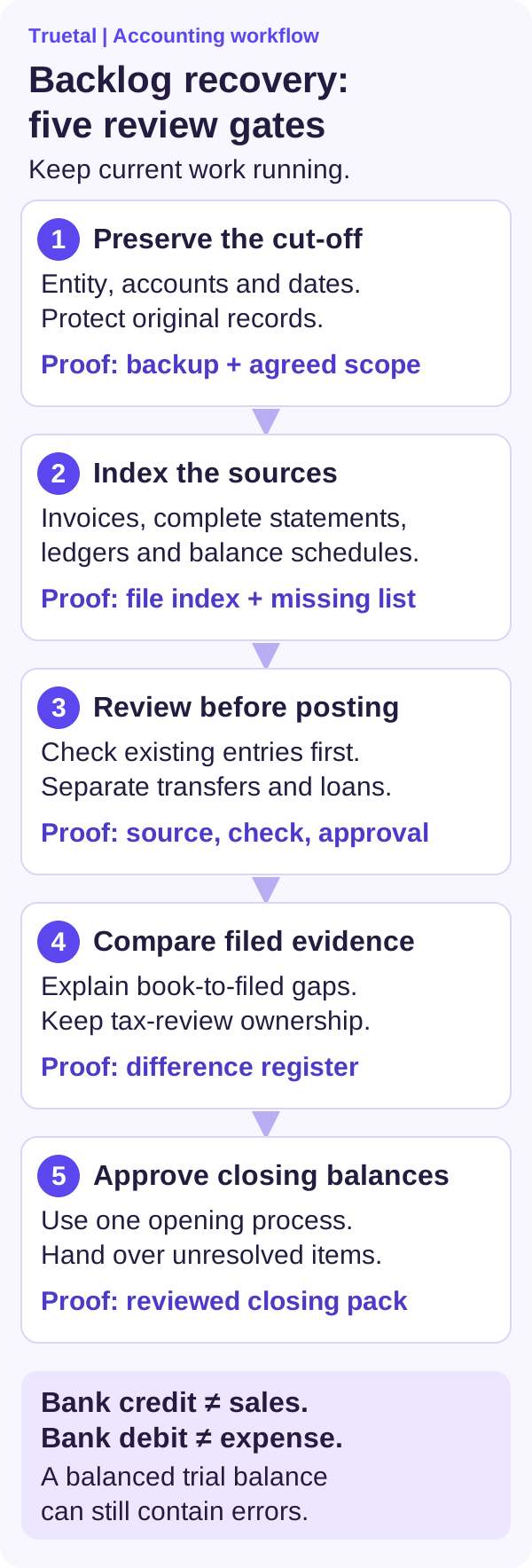
Five evidence-led phases for reconstructing historical books while preserving original records, review decisions and open items.
Phase 1: Set the cut-off and preserve the books
Define the historical period, entity, accounts and current-work owner. Preserve the original books and filed evidence before corrections. Keep current transactions running separately and respect protected periods.
Phase 2: Collect and index source evidence
Collect complete bank statements, invoices, supplier/customer records, opening schedules and applicable tax evidence through secure access. Label dates and accounts, identify missing files and assign each evidence request.
Phase 3: Reconstruct and reconcile entries
Check for existing records before posting. Match bank movements to evidence, distinguish receipts from revenue and payments from expenses, pair transfers, review duplicates and retain unresolved classifications for a named reviewer.
Phase 4: Review books against filed evidence
Compare the relevant book schedules with filed returns, acknowledgements and portal ledgers. Explain differences without overwriting history. Refer tax positions and any statutory correction route to the responsible qualified adviser.
Phase 5: Approve balances and hand over open items
Approve supported closing balances and choose one controlled carry-forward or opening process. Do not duplicate balances already in the ledger. Retain reviewer approval, reconciliation proof and a dated exceptions register before handing over current work.
Decide what is actually unfinished
“Six months pending” can describe different problems: documents never entered, entered records not reconciled, unsupported opening balances, returns filed against different workings, or reports that no reviewer has accepted. These need different scopes. Do not quote or start a full rebuild before identifying which condition applies.
Prepare a period-control sheet. Give each month a source-completeness status, posting status, bank-reconciliation status, tax-review status, reviewer and next action. “Not received”, “in review” and “approved with listed exceptions” are more useful than a single green “done” label.
For an illustrative business recovering April–September records, keep October's ordinary invoicing and document collection running. Assign one owner to current work and another to the backlog queue, even if the same accountant performs both in separate sessions. Otherwise the clean-up moves forward while a new backlog grows behind it.
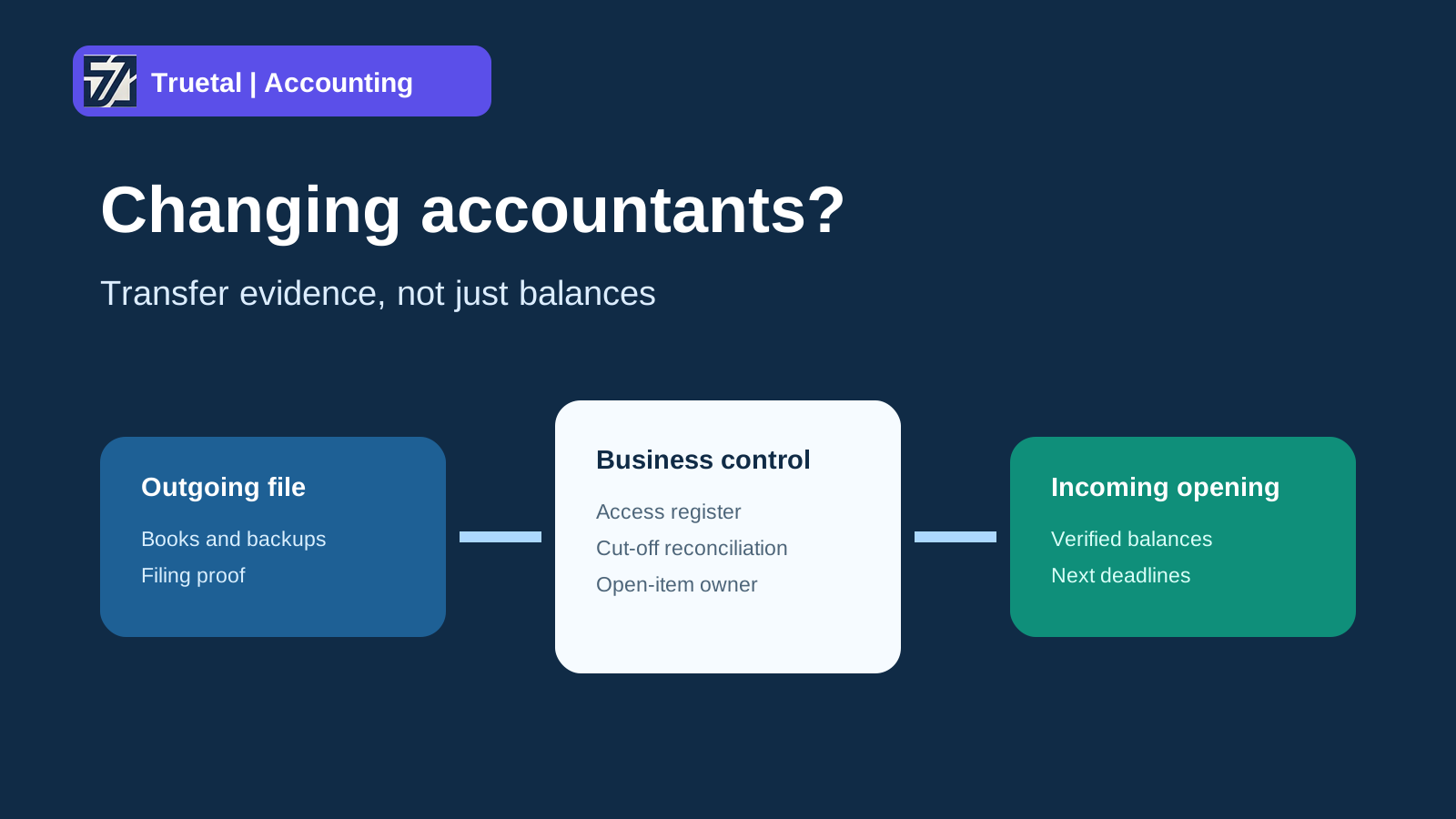
If the problem is a change of adviser rather than missing months, use the handover checklist when changing accountants. This guide owns the reconstruction sequence; that checklist owns the transfer of access, records and unfinished responsibilities.
Build an evidence index before importing anything
Keep a read-only original export or backup, then work from an identified copy. Record which entity, bank account, GST registration and dates each file covers. Include the opening and closing statement pages so a missing date range does not disappear inside an apparently complete spreadsheet.
| Evidence group | Collect through an agreed secure channel | Review it against |
| Existing books | Native backup/export, journal detail, trial balance and ledger reports | Last accepted closing balances and later changes |
| Sales and collections | Invoices, credit notes, customer statements and payment settlements | Customer balances and gross-to-net receipts |
| Purchases and payments | Supplier invoices, credit notes, statements and payment evidence | Supplier balances, duplicates and missing documents |
| Bank and cash | Complete statements for every business account, cash book and supporting vouchers | Account identity, opening balance, closing balance and transfers |
| Other balance-sheet items | Loan schedules, asset records, inventory counts and owner explanations | Principal versus interest, assets versus expenses and business versus personal items |
| Tax evidence, where applicable | Filed returns, acknowledgements, challans, portal ledgers and the workings used | The correct registration, year, period and remaining differences |
Tax-portal records are comparison evidence, not a replacement for purchase invoices or a complete accounting ledger. GSTR-2B does not contain every possible business expense. A bank statement does not contain unpaid invoices, non-bank adjustments or the full reason for each movement.
Mark gaps explicitly: missing invoice, unknown counterparty, unclear business purpose, unavailable earlier balance or disputed amount. Assign the person who can answer and a review date. Do not invent a voucher or mark a tax credit eligible merely to reduce the missing-record count.
Use a review matrix, not credit-equals-sales rules
For every proposed entry, keep the source reference, original date, amount, existing-entry search result, proposed treatment, reviewer and status. Search for the original invoice or payment before creating a new record. A receipt linked to an already recorded invoice should settle that receivable, not create another sale.
Here is a deliberately small, hypothetical sample from a backlog. These are eight bank movements, not eight new invoices. Amounts are illustrative; no GST rate, tax-credit eligibility or real customer result is implied.
| Bank movement | Evidence found | Review outcome |
| ₹1,18,000 received | Existing customer invoice, counterparty and payment reference agree | Match the receipt to the outstanding invoice; do not post sales again or match on amount alone |
| ₹50,000 received | Owner funding explanation, supporting trail and entity-specific documents | Review the capital or other funding classification and required approvals; this is not automatically revenue |
| ₹75,000 received | Lender's disbursement record and loan agreement | Review the borrowing liability, not sales |
| ₹20,000 received | Matching debit in another account of the same business | Pair the own-account transfer; do not create income or duplicate cash |
| ₹35,000 paid | Supplier invoice already recorded and payment reference matches | Settle the payable; do not book the expense a second time |
| ₹12,500 paid | Loan schedule supports ₹10,000 principal and ₹2,500 interest | Split the liability repayment and interest after review |
| ₹600 paid | Bank's charge advice supports the debit | Review the charge and any separately evidenced tax treatment |
| ₹4,800 paid | Narration only; purpose and document missing | Keep an owned exception; do not silently label it a deductible expense |
The receipt for ₹1,18,000 and the supplier payment for ₹35,000 illustrate why importing bank rows as new invoices overstates activity. The loan instalment also shows why one bank debit can require more than one accounting component. An equal bank total is not proof of correct classification.
For the detailed matching method, see bank reconciliation workflows. ICAI's cash-and-bank guidance highlights authorisation, reconciliation and examination of old outstanding items. Its financial-statement framework distinguishes accrual recognition from cash movement; it is conceptual guidance, not a substitute for the entity's applicable accounting requirements.
Keep book corrections and tax decisions separate
Build a bridge from the corrected accounting records to the filed evidence for each relevant period. A difference could arise from timing, classification, a missing record, a later credit note or a prior filing error. Identify the cause before deciding what action is required.
Do not change a historic invoice date to push it into an open month. Do not overwrite a filed return or replace an acknowledgement with a new spreadsheet. Preserve the original, the proposed correction, the review conclusion and any eventual portal proof as distinct records.
Ask the responsible tax professional to determine whether a correction is permitted, which period or route applies, and whether interest, reversal, disclosure or another action needs consideration. This article does not prescribe those answers. Portal cash and credit ledgers also have different purposes; a net number from one is not a universal clearing entry for the books.
Keep protected periods protected. If an authorised correction needs a period to be reopened, follow the reviewed system process and preserve its history. No backlog timetable justifies bypassing a lock or creating a balancing entry without evidence.
Approve closing balances without doubling the books
At the agreed cut-off, review the trial balance alongside bank reconciliations, receivable/payable ageing, loans, assets, inventory and tax schedules that apply. A trial balance can balance while a receipt is posted to the wrong customer or a loan is treated as revenue.
Choose one cutover method for each account and period. If historical transactions remain in the continuing ledger, their closing balances already carry forward. Do not also post those same balances as an additional opening journal. If moving into a new system, map the approved closing pack to one controlled opening entry or import process, retain its reference and check the resulting reports before posting live activity.
Reconcile subsidiary totals to the control accounts: customer ageing to receivables, supplier ageing to payables and each bank ledger to its supported reconciliation. Do not use an unexplained suspense or capital figure merely to make debits equal credits. A genuine unresolved amount needs an explicit reviewed treatment and continuing owner.
Agree the completion pack before the work starts
Accept a period only when the agreed evidence and review outputs are present. A useful acceptance pack contains:
- The exact entity, accounts, dates and reconstruction scope.
- A source index and a list of documents that were not obtained.
- Posted-entry references, correction approvals and duplicate checks.
- Bank reconciliations with dated explanations for outstanding items.
- Receivable/payable ageing and other relevant balance schedules.
- A book-to-filed-evidence difference register and the professional-review handover.
- The reviewed closing trial balance and the chosen cutover method.
- Open items with amount, evidence gap, owner, due date and escalation route.
- A named approver, approval date and the next current-period owner.
“Approved with exceptions” must name the exceptions. A missing ₹4,800 document does not become resolved because the accountant has finished processing the other seven sample movements. Decide whether the accepted scope is a diagnostic review, reconstructed books, a reviewed close or a separate tax engagement; these are not interchangeable deliverables.
Avoid creating another backlog
Set a weekly document collection routine, a supplier/customer query owner and a monthly close date agreed with the reviewer. Separate transaction entry from approval and payment authority where practical. Review overdue exceptions instead of carrying the same unexplained item forward indefinitely.
Common failure patterns are importing the same source twice, treating all credits as sales, deleting old books after migration, forcing a bank match, accepting unsupported opening balances and assuming that “books complete” means “returns filed”. A deadline can justify prioritisation and escalation; it does not supply missing evidence.
How Truetal can help with the next step
Truetal supports source-linked invoices and accounting records, reviewed bank-reconciliation suggestions, accounting reports and GSTR-2B reconciliation on the applicable plan. Suggestions wait for confirmation. These tools can support a reconstruction workflow, but they do not automatically rebuild a complete backlog or make every historical entry correct.
Start with a scoped books health check: the months involved, approximate record volume, current system, accounts and known gaps. The review can establish what evidence is missing and whether software, catch-up work or separately engaged professional review is needed. A software subscription is not an included clean-up service, tax opinion, audit or direct GST/ITR filing service. Do not send statements, client documents, passwords or OTPs through a public enquiry form.
Frequently asked questions
Can I reconstruct the books from bank statements alone?
No. Statements show money movement, not every invoice, unpaid balance, asset or non-cash adjustment. Collect invoices, existing ledger detail, opening schedules and other supporting records. Loans, capital and own-account transfers must not be assumed to be sales.
How long does clearing an accounting backlog take?
Agree timing after checking the months, volume, source quality, opening balances and review requirements. Missing evidence and historical tax questions can change the work. A fixed completion promise without that assessment is unreliable.
Should I import the old trial balance and all historical transactions?
Not without a controlled plan. Historical entries already produce balances in a continuing ledger; posting the same opening balances again duplicates them. For a new system, agree the mapped opening process, supporting schedules and approval before live posting.
Does completing the books mean pending returns are filed?
No. Reconstructed accounting records, tax review, return preparation, portal submission and filing acknowledgements are separate states. Assign the responsible person and retain actual proof for each statutory action.
What should remain open when a document is missing?
Record the amount, source reference, evidence gap, owner, review date and escalation route. Do not invent an invoice or silently force an expense or tax treatment. The reviewer should state what is accepted and what remains unresolved.