
The direct answer
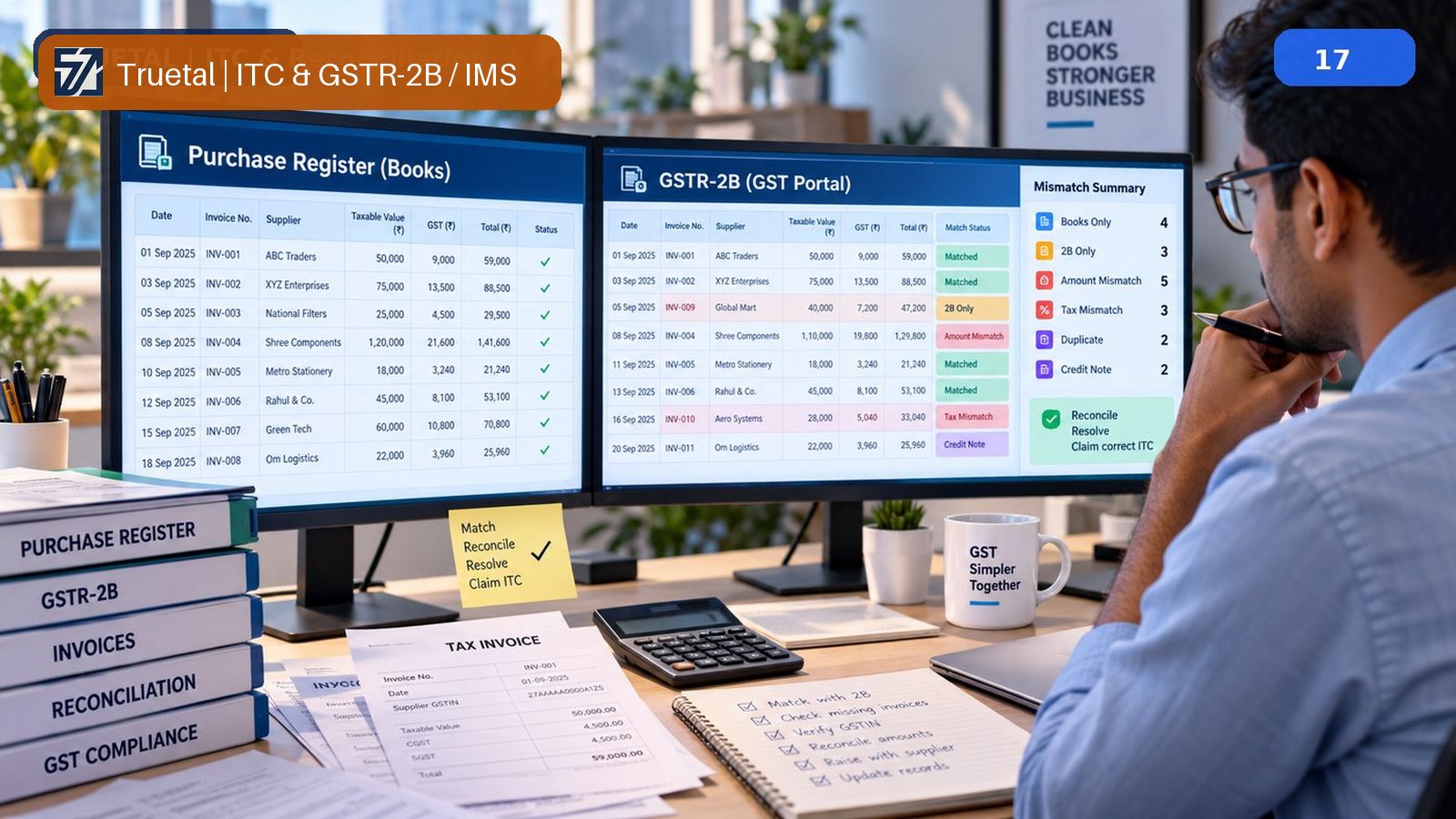
Reconcile GSTR-2B with your purchase register invoice by invoice: preserve both extracts, match GSTIN and document details, investigate exceptions, review permitted IMS actions and assess ITC separately. Close each difference with an owner and evidence, not a forced matching total. If credit was already availed but the supplier has not filed the corresponding GSTR-3B, maintain a separate Rule 37A control; marking an invoice Pending is not a substitute for reversal.
Reviewed against primary sources on 20 October 2026. This is a records-and-review workflow, not a direction to claim, reject or reverse every item in a category. Current law, document type and the actual return stage control the decision.
Keep three decisions separate
The purchase register records the business transaction. GSTR-2B communicates GST-system information. IMS lets the recipient take permitted actions on applicable records. None should silently overwrite the others.
A genuine purchase may need recording even while its ITC claim waits for the required evidence. Conversely, an unfamiliar GSTR-2B line is not permission to create an expense. Obtain the invoice and establish that the supply belongs to your business.
An exact match is therefore a review result, not a tax approval. Section 16 conditions and other restrictions still apply. Acceptance or deemed acceptance in IMS does not establish receipt of supply, business use or every legal condition.
Step 1: Freeze the inputs and identify the period
Save the purchase-register extract, relevant GSTR-2B, supplier documents and current IMS export with the GSTIN, tax period, extraction date and version. Keep later corrections as new versions rather than replacing the original evidence.
Include supplier GSTIN, document type, invoice number and date, taxable value, each tax head and linked credit notes. Also record the supplier reporting period, IMS status, claim period, reviewer and next action. Keep imports, RCM and ISD records in their appropriate review lanes; the ordinary domestic invoice matrix below is not a universal rule for them.
Step 2: Match documents, then classify differences
Match exact records first. Review harmless invoice-number formatting differences as probable matches, checking GSTIN, date and amounts before linking them. Never rewrite the supplier’s actual number or create another purchase just to satisfy matching software.
Give each exception one working reason: books only, statement only, value difference, tax-head difference, amendment, duplicate, credit note or eligibility review. Separate a book-entry mistake from incorrect supplier reporting. A net difference can conceal both.
Step 3: Use the issue matrix before choosing an IMS action
This matrix covers ordinary domestic forward-charge B2B invoices and debit notes. It describes the investigation and evidence needed, not an automatic claim or rejection instruction.
Review controls for ordinary domestic forward-charge B2B invoices and debit notes. IMS actions depend on the actual document, permitted portal options and filing stage.
| Discrepancy found | What to verify first | IMS review, where applicable | Tax working and evidence |
|---|---|---|---|
| Value difference | Compare the source invoice, book entry and supplier-filed taxable value and each tax head. | Do not choose Reject or Pending merely to clear a variance. Determine whether the record is yours, which details are wrong and which actions the portal permits. | Correct the wrong source through the appropriate route. Do not treat the smaller of books and GSTR-2B as automatically eligible ITC; document the supported claim and reviewer decision. |
| Tax-head mismatch | Check recipient GSTIN, place of supply and whether the source invoice or supplier reporting is wrong. | Request the appropriate supplier correction. Reject only where the record should not be accepted after document-level review; do not apply one action to every tax-head difference. | Do not convert reported IGST into CGST/SGST in the claim merely to match books. Retain the correction request, amended record and eligibility assessment. |
| Invoice missing from GSTR-2B | Check the correct GSTIN, document details, supplier filing status, applicable statement period and IMS status. | If absent from IMS, there is no record to act on there. A saved supplier record visible in IMS is not the same as a filed record flowing into GSTR-2B. | For invoices covered by Rule 36(4), check supplier furnishing and communication in GSTR-2B before claiming, together with the other conditions and time limits. Keep genuine purchase accounting separate. |
| Supplier corresponding GSTR-3B not filed | Identify ITC actually availed, its financial year and the supplier return period corresponding to the reported invoice or debit note. | A supplier filing default is not an instruction to mark the invoice Pending. Track Rule 37A separately from recipient IMS actions. | Apply the Rule 37A September check and November reversal deadline where its conditions are met. Keep the reversal working and later supplier-filing evidence before re-availing; avoid duplicate claims. |
GSTN cautions that rejecting an invoice or debit note removes its ITC from the recipient’s flow. Use Reject carefully, not as a shortcut for cleaning a reconciliation report. Where supplier reporting is wrong, agree the appropriate amendment route and monitor the resulting record and period.
Worked example: four lines need four different decisions
Assume an illustrative review has these items:
- INV-101: books and GSTR-2B each show ₹18,000 tax. Mark an exact match, then review eligibility and evidence.
- INV-102: books show ₹9,000 tax but the relevant GSTR-2B has no invoice. Check GSTIN, supplier filing and period; do not delete a genuine purchase or assume ITC is available.
- INV-103: books show ₹13,500 tax and GSTR-2B shows ₹12,600. Compare the source invoice and reporting. The ₹900 difference does not establish which source is correct, and ₹12,600 is not automatically the lawful claim.
- INV-104: one source shows ₹7,200 IGST and the other ₹3,600 CGST plus ₹3,600 SGST. Equal total tax does not cure the wrong head. Check place of supply and the document before obtaining the appropriate correction.
The reviewer should be able to explain each outcome independently. Do not offset an unsupported claim on one invoice against an omitted claim on another.
Step 4: Maintain the separate Rule 37A calendar
Rule 37A concerns ITC already availed on an invoice or debit note reported by the supplier in GSTR-1, as amended in GSTR-1A if any, or IFF. It checks whether the supplier furnished the corresponding GSTR-3B by 30 September following the financial year in which that ITC was availed. Where its conditions are met, reversal is required through GSTR-3B on or before 30 November following that financial year.
The year of availment matters: do not mechanically use the invoice’s financial year. Store both the document date and actual claim period. For example, credit availed in March 2026 belongs to FY 2025–26 for this check: the dates are 30 September 2026 and 30 November 2026. This example does not establish that the original claim was eligible.
The rule provides payment with interest under Section 50 if the reversal deadline is missed. It also permits re-availment after the supplier subsequently furnishes that corresponding return. Preserve the filing evidence and link the later claim to the earlier reversal; do not claim the original and amended records twice.
Rule 37 is different: it concerns the recipient’s non-payment of consideration and tax to the supplier within the applicable 180-day period, with its own conditions and exceptions. A supplier default review does not replace the creditor-payment review.
Step 5: Reconcile reversal and re-availment evidence
GSTN’s Electronic Credit Reversal and Re-claimed Statement guidance tracks temporary reversals in Table 4(B)(2). Reclaimable credit is subsequently reported in Table 4(A)(5) and explicitly in Table 4(D)(1), once the necessary conditions are fulfilled. Use the appropriate current return instructions for the actual case; these are not three separate credits.
Keep an invoice-level bridge: original claim, reason for reversal, reversal period and amount by tax head, supplier filing evidence, reviewer approval and later reclaim. Reconcile that bridge with the portal statement. A software status reading “resolved” is not proof that the required return action occurred.
Check current IMS restrictions and filing stage
“No Action” can be deemed acceptance when GSTR-2B is generated. Do not mistake silence for a protected hold. After relevant action changes, recompute GSTR-2B where the portal requires it before filing the corresponding GSTR-3B, and retain the final statement used.
GSTN’s 2026 IMS Offline Tool guidance retains the dashboard’s business rules and validations. Bulk processing is not a bypass: review upload errors and final portal results rather than treating creation of an upload file as proof that an action was accepted.
Specified credit-note and amendment Pending options changed from October 2025 and have document-specific limits. Older blanket advice can be wrong. GSTN also introduced the Import of Goods section for Bills of Entry from that period, with its own permitted actions; imports do not simply follow the domestic-invoice Reject rule.
Once the relevant return is filed, preserve its working and proof. Do not edit a locked book period to make today’s report look clean; route any correction through the authorised review and adjustment process, preserving the original audit trail.
What a completed review pack contains
Retain the original extracts, matched-record map, mismatch reason, source invoice, supplier correspondence, permitted IMS action evidence, final GSTR-2B, claim/reversal/reclaim working and filed-return evidence obtained through the official process. Every open item needs a named owner and next date. Close it only when the accounting decision and tax working are evidenced, not merely when the supplier replies.
How Truetal helps, and where human review remains
Truetal supports purchase records and GSTR-2B reconciliation on Pro, helping organise matching results and exceptions for review. Download the relevant portal data through the authorised route and use the supported upload workflow. For broader selection criteria, see our guide to best GST accounting software for small businesses.
Truetal does not automatically establish ITC eligibility, operate IMS for you, run a guaranteed Rule 37A compliance engine or directly file GST returns. Agree the record scope and review responsibility before starting; tax decisions and official portal actions remain with the authorised person.
The practical finish line is an explainable invoice-level review pack, with unresolved risks visible and every claimed, reversed or re-availed amount supported by evidence.
Frequently asked questions
Should I reject an invoice showing IGST instead of CGST and SGST?
First verify the place of supply, GSTIN and source invoice. Do not claim under the wrong tax head or mechanically convert it in your return working. Seek the appropriate supplier correction and determine the permitted IMS action from the document facts; a mismatch alone does not justify a blanket Reject instruction.
What are the Rule 37A reversal deadlines?
Where the rule applies to ITC already availed and the supplier has not furnished the corresponding GSTR-3B by 30 September following the financial year of availment, reverse that credit through GSTR-3B on or before 30 November following that year. The rule provides section 50 interest consequences for missing the reversal deadline and permits re-availment after the supplier subsequently furnishes that return.
Does marking an invoice Pending satisfy Rule 37A?
No. IMS Pending is a recipient action on a permitted record; Rule 37A concerns credit already availed and the supplier’s corresponding GSTR-3B filing. A pending status is not evidence that an earlier claim was reversed. Maintain a separate reversal and re-availment trail.
Can I claim ITC just because the purchase register matches GSTR-2B?
No. Matching establishes a relationship between records, not legal eligibility. Check the prescribed document, receipt of supply, supplier-furnished details, restrictions, business use and other applicable Section 16 and ITC conditions. Acceptance or deemed acceptance in IMS does not replace those checks.
Can a credit note be kept Pending in IMS?
The October 2025 changes allow Pending for specified credit notes and amendments, subject to their conditions. For those specified records, the permitted period is one tax period: one month for monthly recipients or one quarter for quarterly recipients, linked to the applicable GSTR-2B period and subsequent GSTR-3B due date. Do not apply an old blanket prohibition or assume all IMS documents share one deadline.
Sources
- CBIC — current Section 16: ITC eligibility and conditions
- CBIC — current Rule 36: documents and GSTR-2B communication
- CBIC — current Rule 37A: supplier GSTR-3B default and re-availment
- CBIC — current Rule 37: non-payment to supplier, a separate control
- GSTN — additional IMS FAQs, including careful use of Reject (17 October 2024)
- GSTN — changes to specified credit notes and amendments from October 2025
- GSTN — Import of Goods section in IMS (30 October 2025)
- GSTN — reversal/reclaim statement advisory (29 December 2025; State-hosted copy)
- GSTN — IMS Offline Tool guidance, 2026