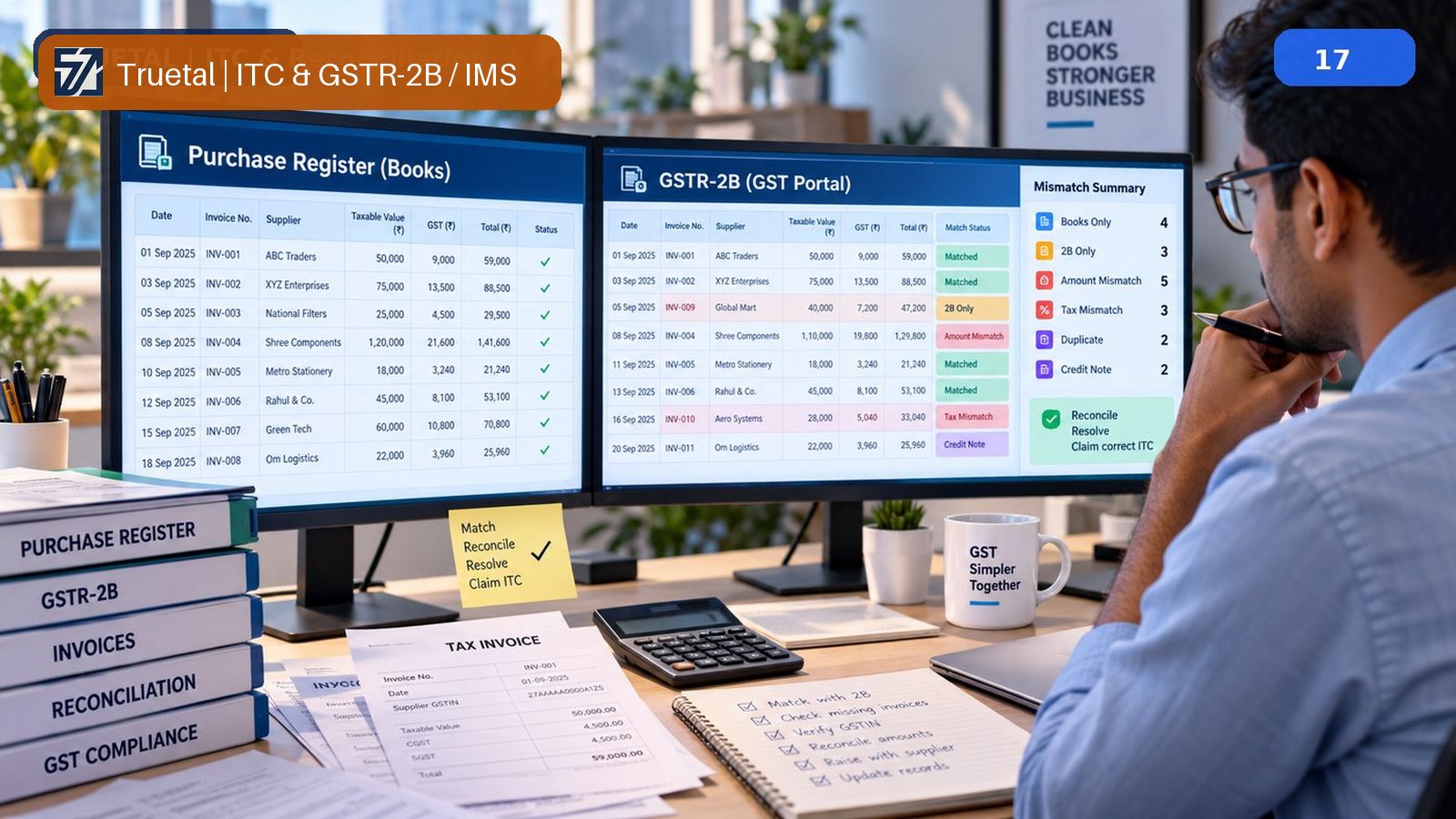

A GST reconciliation service should give you a line-level exception file, named actions and a closing control total—not merely a message saying “GSTR-2B matched.” The official GST sources cited here do not publish a standard tariff for a private reconciliation engagement. A defensible quote depends on the number of GSTINs and periods, document volume, data quality, exception rate, evidence required and whether the provider is matching records only or also helping resolve them.
The direct answer
Ask every provider to quote against the same written scope: GSTINs, periods, approximate books and GSTR-2B document counts, source formats, matching fields, legal-review boundary, exception-resolution work, outputs, turnaround, data handling and sign-off. Compare the cost per completed deliverable, not only the headline fee.
A low quote can be adequate for a clean, single-GSTIN monthly match. It becomes a false economy if the provider excludes credit notes, amendments, imports, reverse-charge records, duplicate checks, prior-period carry-forward, vendor follow-up or a usable exception file. Conversely, a business with clean records should not pay for historical cleanup it does not need.
Current-status caution, reviewed 17 October 2026: GSTR-2B is a read-only, auto-drafted ITC statement. The GST Portal advises taxpayers to reconcile it with their own books, while the taxpayer still has to self-assess eligibility under the CGST Act. IMS actions can affect what flows into GSTR-2B. This guide explains how to scope a service; it is not a legal opinion or a substitute for transaction-specific review.
What should a GST reconciliation service actually cover?
The phrase “GST reconciliation” is used for several different jobs. A quote should identify which of these layers are included:
| Layer | Minimum work | Output you should expect |
| Data readiness | Validate GSTIN, period, file version, columns and opening exception list | Input-control sheet and rejected-file log |
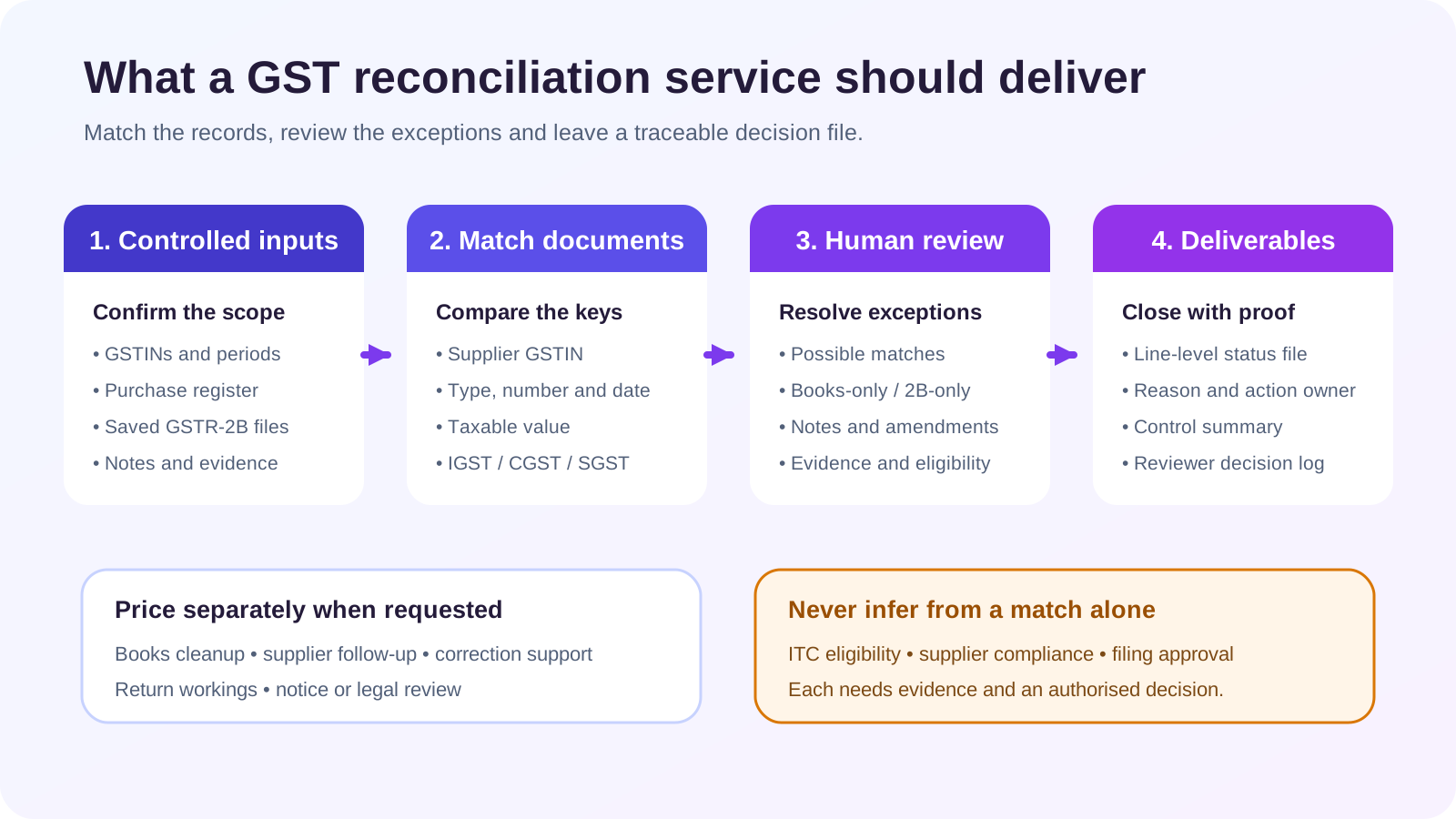
| Document matching | Compare supplier GSTIN, document type/number/date, taxable value and tax heads | Line-level matched, possible-match and unmatched statuses |
| Exception classification | Separate books-only, GSTR-2B-only, value/tax differences, duplicates, credit notes and amendments | Reason code, amount, owner and next action for every exception |
| Eligibility review | Apply the agreed Section 16/17 and business-use checks with supporting evidence | Reviewed eligibility/reversal decision log—not an unexplained “eligible” tick |
| Resolution support | Track supplier, accounts-team or tax-reviewer action and later-period appearance | Ageing/follow-up list and closure evidence |
| Period close | Reconcile opening exceptions, current movements and closing unresolved totals | GSTIN-wise control summary and reviewer sign-off |
Imports, ISD credits, reverse-charge entries and unregistered-supplier purchases should not be forced into the ordinary supplier-invoice bucket. Ask how each will be reported even if your provider is not engaged to decide the final tax treatment.
What deliverables should you receive?
A useful reconciliation pack is reviewable by someone who did not perform the matching. At minimum, request:
- A GSTIN- and period-wise control summary showing books documents, GSTR-2B documents, clean matches, possible matches and each unmatched class.
- A line-level workbook or export with the original source identifiers, match status, reason, tax difference, action owner and evidence link.
- Separate lists for books-only records, GSTR-2B-only records, value or tax mismatches, credit/debit notes, amendments, possible duplicates and records needing legal review.
- A carry-forward schedule showing which earlier exceptions appeared in a later saved GSTR-2B and which remain open.
- A decision log for every manual override, including who approved it and why.
- A closing memo stating what was covered, what was excluded and what remains unresolved.
The GST rules require registered persons to retain true and correct inward-supply and input-tax records. A reconciliation output should strengthen that trail, not replace the underlying invoices, books or portal downloads.
What drives GST reconciliation cost?
Government sources prescribe tax conditions and record responsibilities; they do not prescribe what a private reconciliation provider must charge. The most reliable quote therefore exposes its assumptions instead of presenting one unexplained monthly price.
| Cost driver | Why it changes the work |
| GSTINs and registrations | Each GSTIN needs its own source set, period controls and sign-off |
| Number of periods | A backlog needs opening exceptions and later-period tracking, not isolated monthly files |
| Books and GSTR-2B document volume | More rows increase validation, matching and evidence work |
| Source quality | Clean exports cost less to normalise than PDFs, inconsistent spreadsheets or missing fields |
| Exception rate | Human review is concentrated in possible matches and unresolved records, not clean matches |
| Scope boundary | Matching, eligibility review, corrections, supplier follow-up and return workings are different tasks |
| Turnaround and cadence | A compressed deadline or repeated rework needs more reviewer capacity |
| Audit and security requirements | Evidence links, approval logs, retention controls and restricted access add real work |
Ask for separate pricing for initial cleanup, recurring monthly review and out-of-scope remediation. That makes a low recurring quote comparable with a provider that has hidden the cleanup charge elsewhere.
Worked example: quote the 270 exceptions, not only the turnover
An Indian distributor asks for a three-month review across two GSTINs. Its purchase books contain 1,240 documents; the corresponding saved GSTR-2B files contain 1,210.
| Result | Documents | Required judgement |
| Clean matches | 1,020 | Retain source and control totals |
| Possible matches | 140 | Confirm numbering, date or amount differences before linking |
| Books-only | 80 | Check timing, supplier reporting, GSTIN, amendments and IMS status; absence alone does not prove non-filing |
| GSTR-2B-only | 50 | Obtain the invoice and receipt/business-use evidence; portal presence alone does not establish eligibility |
The two source sets create 270 exception records (140 + 80 + 50), even though most documents matched cleanly. A quote based only on turnover or 1,240 book rows misses the work. A better proposal states whether those 270 exceptions are merely listed, manually reviewed, sent for supplier follow-up, carried into later periods and closed with evidence.
This example is illustrative. Real scope depends on document types, tax heads, registrations, periods and the agreed legal-review boundary.
Red flags in a GST reconciliation quote
- “100% ITC guaranteed.” GSTR-2B appearance is not the only eligibility condition, and a service provider cannot guarantee facts it has not verified.
- Only a total difference is delivered. A net number can hide equal and opposite document-level errors.
- GSTR-2B is treated as the books. GSTR-2B-only entries still need invoice, receipt, business-use and other eligibility evidence.
- Books-only entries are labelled supplier non-filing immediately. Timing, GSTIN, document-number, amendment and IMS explanations must be checked first.
- No treatment for credit notes, amendments, imports, ISD or reverse charge. These can distort a simple B2B-invoice comparison.
- Manual overrides have no reviewer or reason. A changed status without evidence weakens the audit trail.
- Portal passwords or OTPs are requested by email or chat. Agree an approved access method and never share authentication secrets casually.
- Matching, GST return work and filing are described as one vague task. Each has a different responsibility and must be priced and authorised separately.
- There is no data-retention or deletion commitment. Supplier invoices and GST data deserve controlled access, storage and disposal.
How to compare providers on one page
Send the same short scoping sheet to every provider and require a written response:
- List legal entity, GSTINs, filing frequency and periods in scope.
- State approximate document counts in books and GSTR-2B for each period.
- Name every source format and whether documents/evidence are available.
- Ask which document types and tax heads are included or excluded.
- Ask for a sample line-level exception output before sharing the full data set.
- Separate automated matching from human exception review and tax judgement.
- Define who corrects books, contacts suppliers and records closure evidence.
- Fix turnaround, review meetings, revision rounds and acceptance criteria.
- Record access control, retention period, deletion and breach-escalation terms.
- Compare one-time cleanup, recurring work and out-of-scope rates separately.
The winning proposal is not automatically the cheapest. It is the one whose deliverables, boundaries and unresolved-item ownership you can verify.
When to do it yourself and when to seek help
A controlled in-house review may be enough when you have one GSTIN, clean monthly exports, low document volume, few exceptions and an experienced reviewer who can distinguish matching from legal eligibility.
Software plus human review usually fits when volume is higher but records are structured. Let the system identify exact and possible matches; have a responsible person decide ambiguous links, evidence and tax treatment.
Consider scoped outside help for multi-GSTIN backlogs, inconsistent books, high exception rates, staff changes, repeated supplier issues or a close deadline. If a notice, material historical claim or disputed legal position is involved, engage a suitably qualified GST professional for that case rather than buying only a data-matching service.
Documents to prepare before requesting a quote
- GSTIN list, filing frequency and periods required.
- Purchase register exports with supplier GSTIN, document identity, taxable value and tax heads.
- Saved GSTR-2B Excel or JSON files for the same and relevant later periods.
- Credit/debit-note and amendment records.
- Import, ISD and reverse-charge schedules where applicable.
- Supporting invoices and receipt/business-use evidence for a sample of exceptions.
- Prior reconciliation and unresolved carry-forward list, if one exists.
- A clear statement of whether the request is matching only, review support, cleanup or ongoing monthly control.
Do not send GST Portal passwords or OTPs in the quote pack. Start with bounded summaries or a representative sample, then use an agreed secure transfer method for the full engagement.
How Truetal helps
Truetal can keep purchase-register records and saved GSTR-2B snapshots in one workspace, compare documents, classify exact and review-needed matches, retain unresolved items across periods and produce GST working data for human review. This can reduce the mechanical part of the service and make exception ownership visible.
Truetal does not establish legal ITC eligibility, contact suppliers automatically, prepare GST returns or file them on the GST Portal. The authorised taxpayer and adviser remain responsible for evidence, adjustments and filing decisions.
FAQ
How much does a GST reconciliation service cost in India?
The official GST sources cited here do not publish a standard tariff for a private reconciliation engagement. Price should be scoped by GSTINs, periods, document volume, data quality, exception rate, human-review depth, deliverables, turnaround and whether cleanup or resolution work is included.
Is GSTR-2B matching the same as a complete GST reconciliation?
No. Matching compares document data. A complete scoped review may also classify exceptions, assess evidence and eligibility conditions, track supplier or books actions, carry items across periods and close with a control summary. The quote should state which layers are included.
Can a provider guarantee that every item appearing in GSTR-2B is eligible ITC?
No responsible provider should guarantee that from GSTR-2B alone. The GST Portal says taxpayers must self-assess because other statutory conditions and restrictions can still make a credit unavailable.
What should I share before asking for a quote?
Share GSTINs, periods, approximate book and GSTR-2B document counts, source formats, exception history and the service layer you need. Use a small anonymised sample first where possible, and do not share portal passwords or OTPs.
The takeaway
Buy an exception-resolution and evidence outcome, not a vague promise to “match 2B.” Define the inputs, service layer, outputs, boundaries, reviewer and closure standard before comparing price. That is how a GST reconciliation quote becomes measurable—and how an organic enquiry becomes a useful business review rather than another spreadsheet exchange.
Sources
- CBIC Tax Information — CGST Act section 16: eligibility and conditions for ITC (accessed 17 Oct 2026)
- GST Portal — Form GSTR-2B FAQs and reconciliation guidance (accessed 17 Oct 2026)
- GST Portal — Revised advisory on Invoice Management System (accessed 17 Oct 2026)
- CBIC — Accounts and Records Rules (accessed 17 Oct 2026)