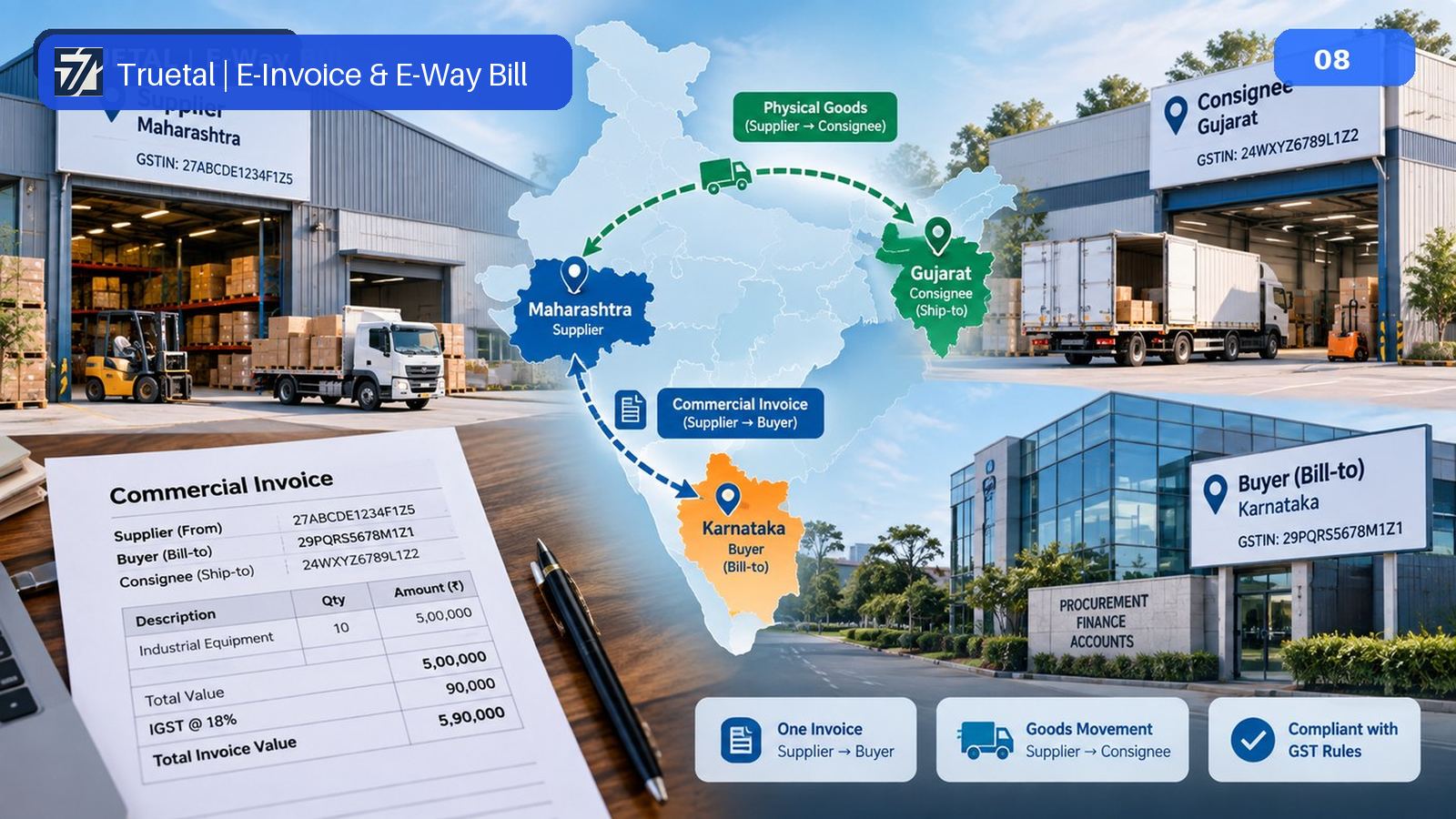

A GST invoice is not compliant merely because it has a logo, a GSTIN and a tax total. The document must identify the supply, parties, values and tax treatment clearly enough for the customer, the books and the GST records to agree.
The short answer
Rule 46 of the CGST Rules lists the particulars normally required on a tax invoice. For a small business, the safest workflow is to capture those fields from structured customer, product and company records, calculate the tax from the place-of-supply decision, and retain one final numbered document.
There is no single compulsory visual design for every business. A clean A4 invoice, a compact service invoice and another readable layout can all work if the required particulars are present and the tax treatment is correct.
GST invoice field checklist
| Area | What to include | Control question |
| Supplier | Legal/trade name, address and GSTIN | Is this the active registration making the supply? |
| Invoice identity | Unique financial-year serial number and issue date | Can the number be duplicated or silently reused? |
| Recipient | Name, billing address and GSTIN/UIN when registered | Was the GSTIN validated against the customer record? |
| Delivery/place details | Delivery address and State/code where applicable | Does ship-to differ from bill-to? |
| Item/service | Description, HSN/SAC, quantity/unit for goods | Does the master match what was actually supplied? |
| Values | Gross value, discount, taxable value and other charges | Are taxable additional charges included consistently? |
| Tax | Rate and CGST/SGST/IGST/cess amounts | Does place of supply support the tax type? |
| Other declarations | Reverse-charge indication and prescribed signatures/QR details where applicable | Does a special GST rule apply? |
Use the current CBIC rules and notifications for your facts. Thresholds, HSN-digit requirements, e-invoice applicability and special document rules can change; a template copied from an old article is not a permanent legal control.
Worked example: local B2B sale
Maharashtra Tools, registered in Maharashtra, sells 10 drill bits at ₹500 each to a registered Maharashtra customer. It gives a ₹200 line discount. Freight of ₹300 is charged by the supplier as part of the supply. Assume the applicable GST rate is 18% and the freight follows the same taxable treatment for this illustration.
| Calculation | Amount |
| Goods value: 10 × ₹500 | ₹5,000.00 |
| Less discount | (₹200.00) |
| Add taxable freight | ₹300.00 |
| Taxable value | ₹5,100.00 |
| CGST at 9% | ₹459.00 |
| SGST at 9% | ₹459.00 |
| Invoice total | ₹6,018.00 |
Because supplier location and place of supply are both Maharashtra in this simplified example, the invoice uses CGST and SGST. If the place of supply were another State, the tax decision could change to IGST. Do not choose CGST/SGST or IGST merely from the customer's mailing address; establish the place of supply under the rules relevant to the transaction.
The invoice should also show the supplier GSTIN, recipient GSTIN, unique invoice number and date, item description, HSN, quantity and unit, taxable value, rates and tax amounts. If bill-to and ship-to parties differ, apply the specific bill-to/ship-to analysis instead of copying this simple example.
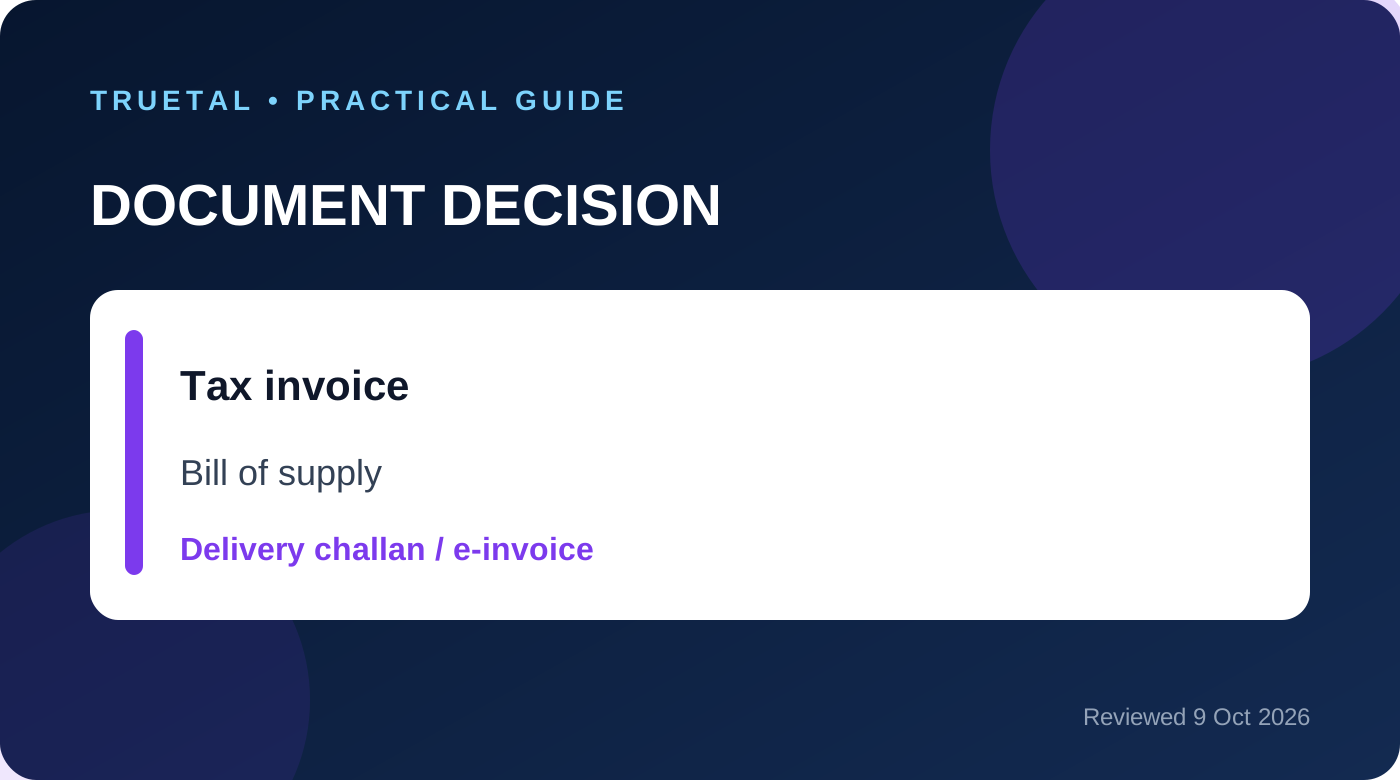
Tax invoice, bill of supply or another document?
| Situation | Typical document question |
| Registered person making a taxable supply | Is a tax invoice required under section 31 and Rule 46? |
| Composition taxpayer or exempt supply | Is a bill of supply appropriate instead? |
| Advance for services | Is a receipt voucher required before the invoice? |
| Goods moving without a sale invoice | Is a delivery challan permitted for that reason? |
| Credit/debit adjustment after invoice | Should a credit or debit note link to the original supply? |
| Taxpayer covered by e-invoicing | Must invoice data be reported to IRP and carry confirmed IRN/QR evidence? |
These are legal classifications, not layout preferences. When uncertain, confirm the current rule with your tax adviser.
Invoice-number controls
A good invoice number is unique for the financial year, sequential under the business's documented series, and never recycled after a customer has received it. Separate series may be used where legitimately designed—for example, by registration or branch—but every series needs control.
If an invoice is wrong, do not delete and replace it without history. The correct action depends on whether it is still a draft, already issued, reported through e-invoicing, or included in returns. Cancellation, credit/debit notes and amendments have different consequences.
Before sending the invoice
- Confirm the seller GST registration and legal identity.
- Validate the customer's GSTIN and billing/ship-to details.
- Confirm the invoice date and controlled serial number.
- Review HSN/SAC, description, quantity and unit.
- Establish place of supply and tax type.
- Check discounts and every additional charge.
- Recalculate taxable value and GST using compliant rounding.
- Confirm reverse-charge or special declarations where relevant.
- Complete e-invoice requirements if the supplier/document is covered.
- Save the final PDF and delivery/sending evidence.
Common mistakes
- Using an inactive or wrong GST registration on the seller header.
- Entering the customer GSTIN correctly but choosing tax type from the wrong State field.
- Omitting the delivery address in a bill-to/ship-to supply.
- Treating freight or packing as outside taxable value without a supported basis.
- Reusing a cancelled or deleted invoice number.
- Confusing a normal GST invoice with a confirmed e-invoice carrying an IRN.
- Calling a pro-forma invoice a tax invoice before the supply/document trigger.
- Copying an old HSN or e-invoice threshold from a static template.
How Truetal helps
Truetal can create and track invoices and related documents from configured company, customer and item records. The workflow supports GST calculations and keeps the invoice connected to payment and accounting records. E-invoice preparation is available where configured; direct GST return filing and live e-way bill generation must not be assumed from the invoice screen.
FAQ
Is there one government-prescribed GST invoice design?
The rules prescribe particulars, not one universal visual theme for every taxpayer. Your invoice can follow a readable business layout if it contains the applicable required information.
Is a GSTIN required for every customer?
No. Registered-recipient and unregistered-recipient requirements differ. Rule 46 also specifies additional recipient and delivery details in certain unregistered supplies. Capture the customer's actual status rather than inserting a dummy GSTIN.
Does an invoice above ₹50,000 always need an e-way bill?
Not solely because the invoice exists. E-way bill requirements concern movement of goods and include exceptions and State-specific rules. Review the separate e-way bill guidance for the movement.
Is a GST invoice automatically an e-invoice?
No. E-invoicing is a reporting process for covered taxpayers and documents. A regular invoice becomes a confirmed e-invoice only through the applicable IRP process and evidence.
Can I correct an issued invoice by editing the PDF?
No. The saved record, customer copy, accounting and GST reporting must remain aligned. Use the permitted cancellation, amendment or credit/debit-note route for the facts.
The takeaway
Build the invoice from reliable masters and a tax decision, not from a pretty template. A well-controlled GST invoice makes the same seller, customer, supply, value and tax story visible everywhere it is used.