One company raises the invoice, another company receives the bill, and the goods physically go somewhere else. Bill-to/Ship-to transactions look simple on paper but create frequent GSTIN, place-of-supply and e-way bill errors when the commercial and physical flows are mixed together.
The Short Answer
In a Bill-to / Ship-to structure, commercial billing and physical delivery are separated. The tax treatment is determined by the legal supply / place-of-supply rules, while the e-way bill must accurately capture the billing party and destination movement.
In Plain Words
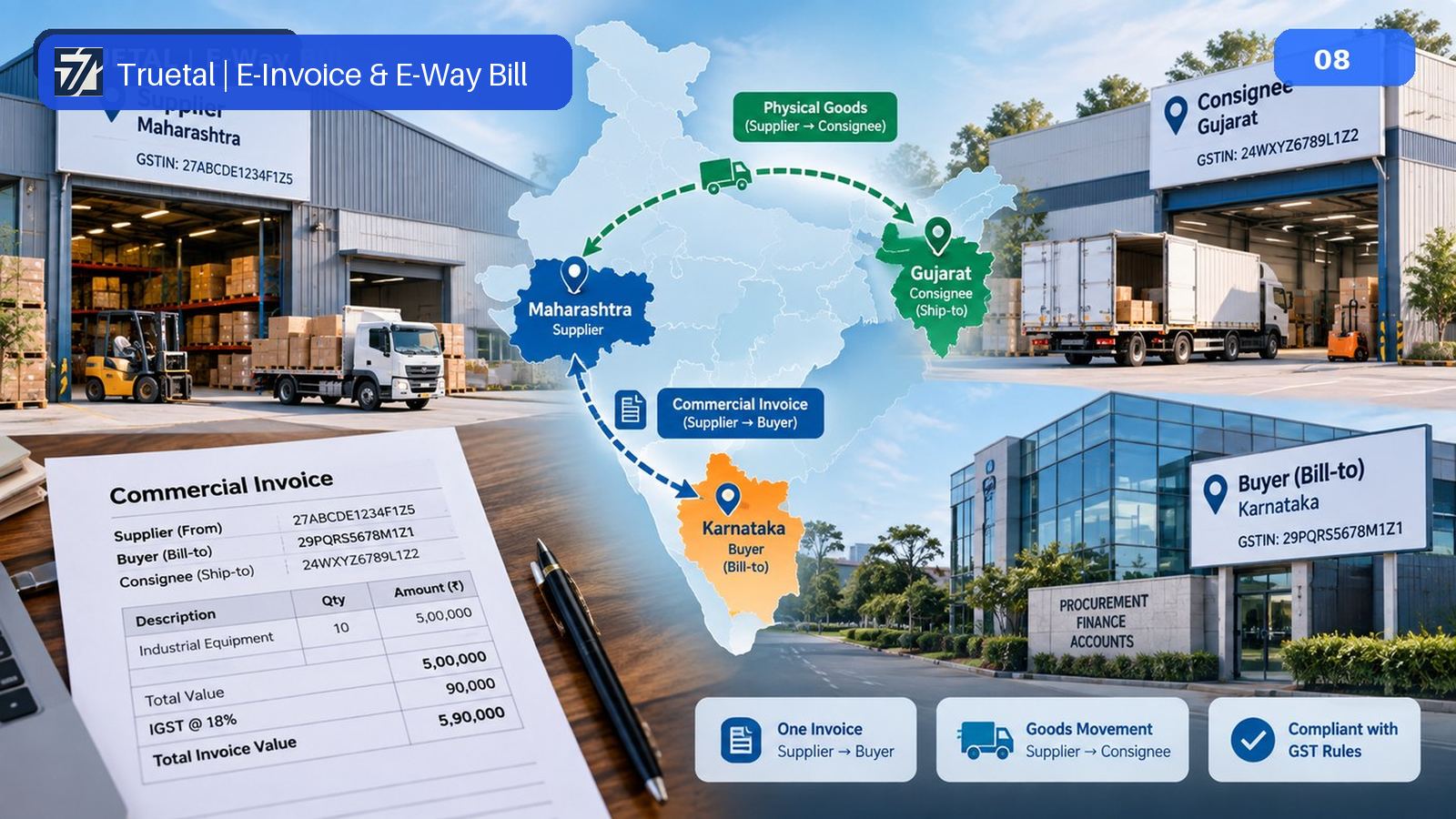
Separate the commercial relationship from the movement of goods. The invoice may be between Supplier A and Buyer B while the truck moves from Supplier A to Consignee C. Your ERP should store both flows rather than trying to derive one from the other.
The three parties in a Bill-to / Ship-to transaction
- Supplier (A) — issues the tax invoice and is responsible for the movement documentation.
- Buyer (B) — the party being billed; B's GSTIN and state generally drive the invoice's tax type.
- Consignee (C) — the physical recipient of the goods, who never appears as a billed party on the tax invoice.
Invoice fields vs movement fields
Your invoice should reflect the commercial relationship between A and B — B's GSTIN, billing address, and the CGST/SGST or IGST split determined by that relationship. Your e-way bill's "Ship-to" section should independently reflect where the goods are actually going — C's address and state — which can be a completely different state from B's.
Why physical destination alone does not decide CGST/SGST vs IGST
A common ERP mistake is deriving the tax type from the delivery address instead of the billing party's GSTIN. The physical destination affects logistics and the e-way bill; it does not, by itself, determine whether a transaction is intra-state or inter-state for GST purposes — that depends on the place-of-supply rules applied to the actual billing relationship.
Worked example
Supplier A (Maharashtra) sells to Buyer B (Karnataka), who instructs A to deliver directly to Consignee C (Gujarat). The invoice is issued to B in Karnataka, with the tax type determined by the place-of-supply rule applicable to that sale — commonly resulting in IGST given the inter-state billing relationship. The e-way bill separately shows the physical movement from A's location in Maharashtra to C's location in Gujarat. Two different states appear on the e-way bill's route; only B's relationship with A matters for the invoice's tax treatment.
Illustrative example. Actual treatment may depend on the facts and rules applicable on the transaction date.
Common ERP mapping mistakes
- Auto-populating the invoice's tax type from the Ship-to state instead of the Bill-to (buyer) GSTIN.
- Allowing the Ship-to party's GSTIN to accidentally overwrite the Bill-to party's GSTIN on the tax invoice.
- Failing to capture a genuinely different Ship-to address at all, defaulting every e-way bill to the buyer's address even when delivery goes elsewhere.
Validation checklist before IRN / EWB API call
- Confirm the invoice's GSTIN/state fields reflect the Buyer (B), not the Consignee (C).
- Confirm the e-way bill's transportation details reflect the actual physical route to C.
- Confirm your ERP allows Bill-to and Ship-to to differ without forcing a mismatch error.
The Key Steps at a Glance
Read the four steps in order — each one depends on the one before it.
- 1The three parties in a Bill-to / Ship-to transaction
- 2Invoice fields vs movement fields
- 3Why physical destination alone does not decide CGST/SGST vs IGST
- 4Worked Maharashtra -> Karnataka -> Gujarat example
What to do now
- Audit your ERP's invoice-generation logic to confirm tax type is derived from the Bill-to GSTIN, not the delivery address.
- Test at least one real three-state Bill-to/Ship-to/consignee combination before relying on the automated flow.
Common mistakes
- Confusing "where the goods go" with "who determines the tax type."
- Letting a single address field serve both billing and shipping purposes when they genuinely differ.
The Takeaway
Bill-to/Ship-to becomes much easier when the ERP stores invoice ownership and physical movement as two explicit flows.
How Truetal Helps
Truetal's invoice and e-way bill modules keep Bill-to and Ship-to as genuinely independent fields, so a three-party sale never silently collapses into a single, wrong address.
Questions People Search For
- Bill to ship to GST e way bill example
- Bill to ship to IGST or CGST
- Three party transaction GST
E-Way Bill system FAQ; CBIC GST invoice rules. Verify the exact place-of-supply outcome for your specific transaction against current law.