

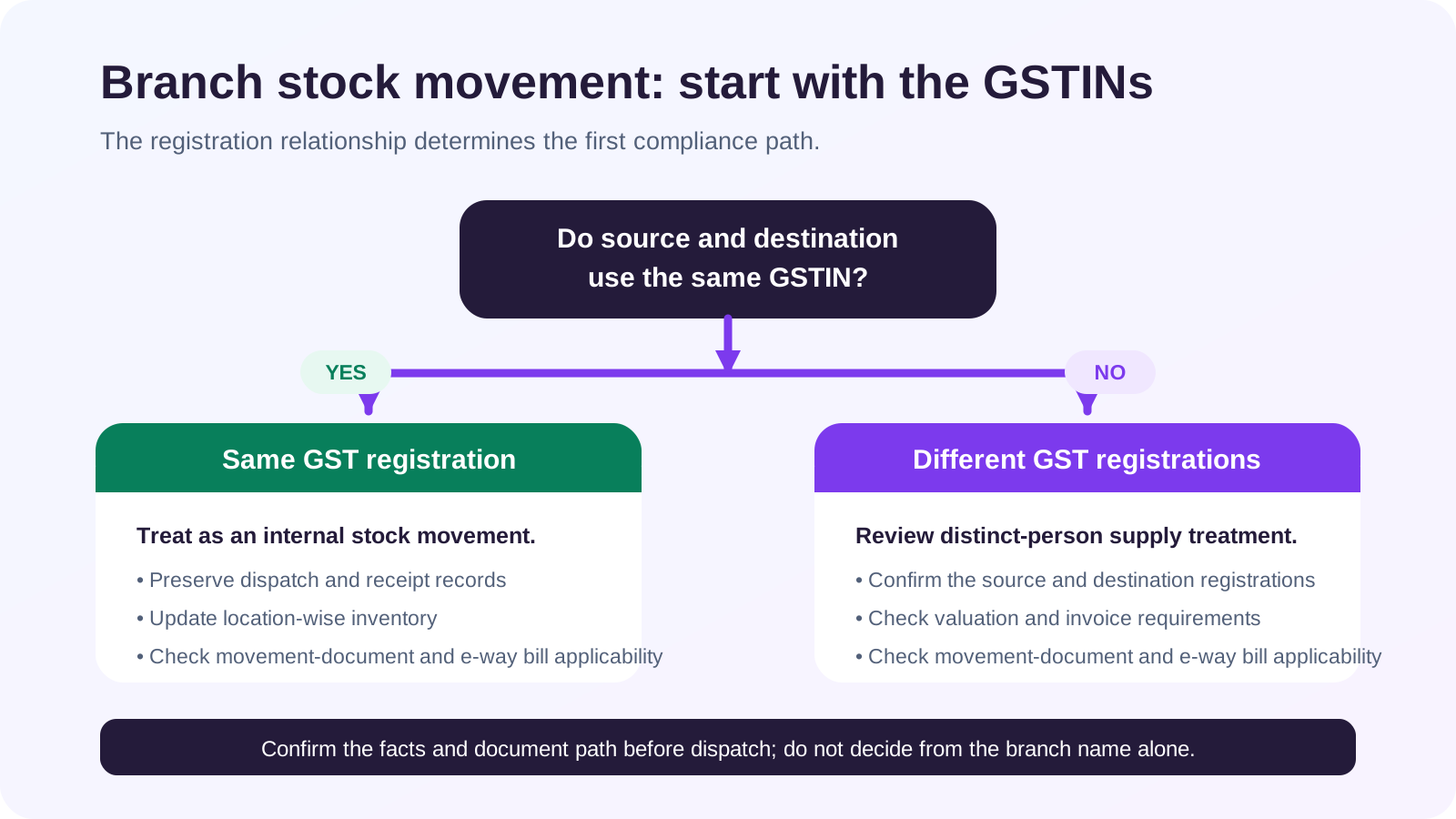
For a stock movement between locations covered by the same GST registration, the move is not a supply between distinct persons merely because two branches are involved; it is generally tracked through stock and movement records, with a delivery challan where goods move for reasons other than supply. A transfer between different GSTINs of the same legal entity is between distinct persons and can be a taxable supply even without consideration.
Current-law caution, reviewed 15 October 2026: separate GST registrations within the same State can also be distinct persons. E-way-bill requirements, State exemptions, valuation, blocked credit, exempt supplies, job work and special facts need their own review before dispatch.
The direct answer
Start with the GSTIN—not the branch name.
- Same GSTIN: preserve a delivery challan/movement document and warehouse-to-warehouse stock trail. Do not create sales revenue merely to move your own stock within the same registration.
- Different GSTINs: treat the registrations as distinct persons. Schedule I can treat the transfer as supply without consideration, so issue the applicable GST document—normally a tax invoice for a taxable transfer, or a bill of supply where Section 31(3)(c) applies—then determine value, report the supply and let the receiving registration test ITC separately.
Decision table
| Question | Same GSTIN / same registration | Different GSTINs / distinct persons |
| Is the move automatically a supply between distinct persons? | No, not merely because the warehouse or branch changes | Schedule I treats business supplies between distinct persons as supply even without consideration |
| Primary movement document | Delivery challan or other valid movement evidence, as applicable | Tax invoice for a taxable distinct-person supply, or bill of supply where applicable, plus transport documents |
| Tax pattern | No output tax merely for the internal location move | IGST commonly applies across States; intra-State tax can apply between separate registrations in one State, subject to the facts |
| Valuation | Maintain quantity and carrying-cost trail | Apply the distinct-person valuation rule; where the recipient is eligible for full ITC, the declared invoice value receives the rule’s stated treatment |
| Stock accounting | Reduce source warehouse and increase destination warehouse; account-wide quantity/value should not change | Record outward supply at one GSTIN and inward purchase/stock at the other without inventing group revenue in consolidated management reporting |
| E-way bill | Check Rule 138 because movement for reasons other than supply is within its scope, subject to threshold and exemptions | Check Rule 138 and applicable State rules for the supply movement |
Worked example: Pune warehouse and Bengaluru branch
An Indian company keeps goods in a Mumbai warehouse and a Pune warehouse, both declared under one Maharashtra GSTIN. It moves 50 units from Mumbai to Pune. The business records one source-warehouse issue and one destination-warehouse receipt. It carries the appropriate delivery challan and checks e-way-bill applicability for the consignment. There is no customer sale and no group revenue merely because the storage location changed.
Assume the goods are taxable and no special exemption applies. The same company also has a separately registered branch in Bengaluru. A movement from the Maharashtra GSTIN to the Karnataka GSTIN is between distinct persons. Even if no cash changes hands, Schedule I brings the business supply between those registrations into the GST supply framework. The Maharashtra registration issues the applicable tax invoice, applies the place-of-supply and valuation rules, and reports the transaction. The Karnataka registration records the inward supply and tests ITC under the normal conditions.
The example changes again if the “Pune branch” holds its own separate GST registration. Same State does not always mean same GSTIN. The GSTIN printed in the source and destination records decides which branch of the analysis applies.
Valuation for a different-GSTIN transfer
The distinct-person valuation rule starts with open market value, then the value of like kind and quality, followed by the prescribed cost/residual methods where earlier methods do not determine value. The rule also says that where the recipient is eligible for full ITC, the value declared in the invoice is deemed to be open market value.
Do not turn that proviso into a universal “any value is safe” rule. Confirm full ITC eligibility, product facts and documentation for the receiving GSTIN. Exempt/blocked-credit operations and mixed-use businesses may require a different analysis.
Dispatch and accounting checklist
- Confirm the exact source and destination GSTINs.
- Verify that both storage locations are correctly declared where required.
- Identify whether the movement is an internal location transfer, distinct-person supply, job work, return or another reason.
- Choose the correct tax invoice, bill of supply or delivery challan before dispatch.
- Record item, HSN, quantity, value basis, source warehouse and destination warehouse.
- Check the central Rule 138 trigger and the applicable State notification or exemption.
- Preserve transporter, vehicle and delivery acknowledgement details.
- For different GSTINs, document the valuation method and tax treatment.
- Reconcile the outward record of one registration with the inward record of the other.
- Confirm that consolidated management reports eliminate internal group effects where appropriate without altering GST registration-level records.
Evidence to retain
- registration certificates and declared-place details;
- approved stock-transfer request;
- delivery challan, tax invoice or bill of supply, as applicable;
- valuation working for a distinct-person supply;
- e-way bill or documented exemption analysis;
- transporter and proof-of-delivery records;
- source/destination warehouse movement entries;
- receiving branch acknowledgement;
- GSTR-1/GSTR-3B working records and GSTR-2B comparison, where applicable; and
- damaged, short or rejected-transfer evidence.
Common mistakes
Using branch names instead of GSTINs. Two locations with one name can have separate registrations; two warehouses with different names can share one GSTIN.
Issuing no document for a same-GSTIN move. “No sale” does not mean “no movement evidence.” GST records rules require stock and storage details, and transport rules still need review.
Treating every branch move as tax-free. Different registrations are distinct persons, including separately registered places in one State.
Posting internal warehouse movement as external revenue. Under one GSTIN, the total stock should not rise or fall merely because its location changed.
Assuming full ITC without checking. The valuation proviso depends on the recipient’s full-credit eligibility.
Forgetting State e-way-bill rules. The central threshold is not the end of the analysis for every intra-State movement.
How Truetal helps
Truetal can track stock by warehouse and record a warehouse-to-warehouse transfer through an audit trail. The warehouse transfer and delivery challan are separate manual workflows; a challan can be prepared for a branch/stock-transfer reason, but the two records are not automatically linked. Warehouses are not mapped to GSTINs, and Truetal does not provide an integrated multi-GSTIN transfer, select the valuation/tax treatment, create the inter-branch tax invoice automatically or generate the e-way bill today. The authorised user must complete those decisions and actions.
FAQ
Is stock transfer between branches taxable under GST?
It depends on the registrations. A business supply between distinct persons under different GST registrations can be taxable even without consideration. A location move within the same GST registration is not a distinct-person supply merely because two branches are involved.
Do branches in the same State always share one GSTIN?
No. A person can hold separate registrations in permitted cases. Check the actual GSTIN of each location; separately registered places are treated as distinct persons.
Can I use a delivery challan for a same-GSTIN warehouse transfer?
GST invoice rules provide for a delivery challan when goods are transported for reasons other than supply. Ensure the challan contains the required details and check e-way-bill and State-specific requirements.
Is an e-way bill needed when there is no sale?
It can be. Rule 138 covers movement for reasons other than supply as well as movement in relation to supply, subject to value triggers, special cases and exemptions.
The takeaway
The decisive field is the GSTIN. Use a movement-and-stock trail within one registration; use the distinct-person supply, applicable GST document, valuation and registration-level reporting trail when the GSTIN changes.
Sources
- India Code — Consolidated Central Goods and Services Tax Act, including section 25 and Schedule I
- CBIC Tax Information — CGST Act section 31 on tax invoices and bills of supply
- CBIC Tax Information — CGST Rule 28 valuation for distinct or related persons
- CBIC Tax Information — CGST Rule 55 delivery challan
- CBIC Tax Information — CGST Rule 138 e-way bill framework
- CBIC — Accounts and Records Rules for stock and storage locations