
The direct answer
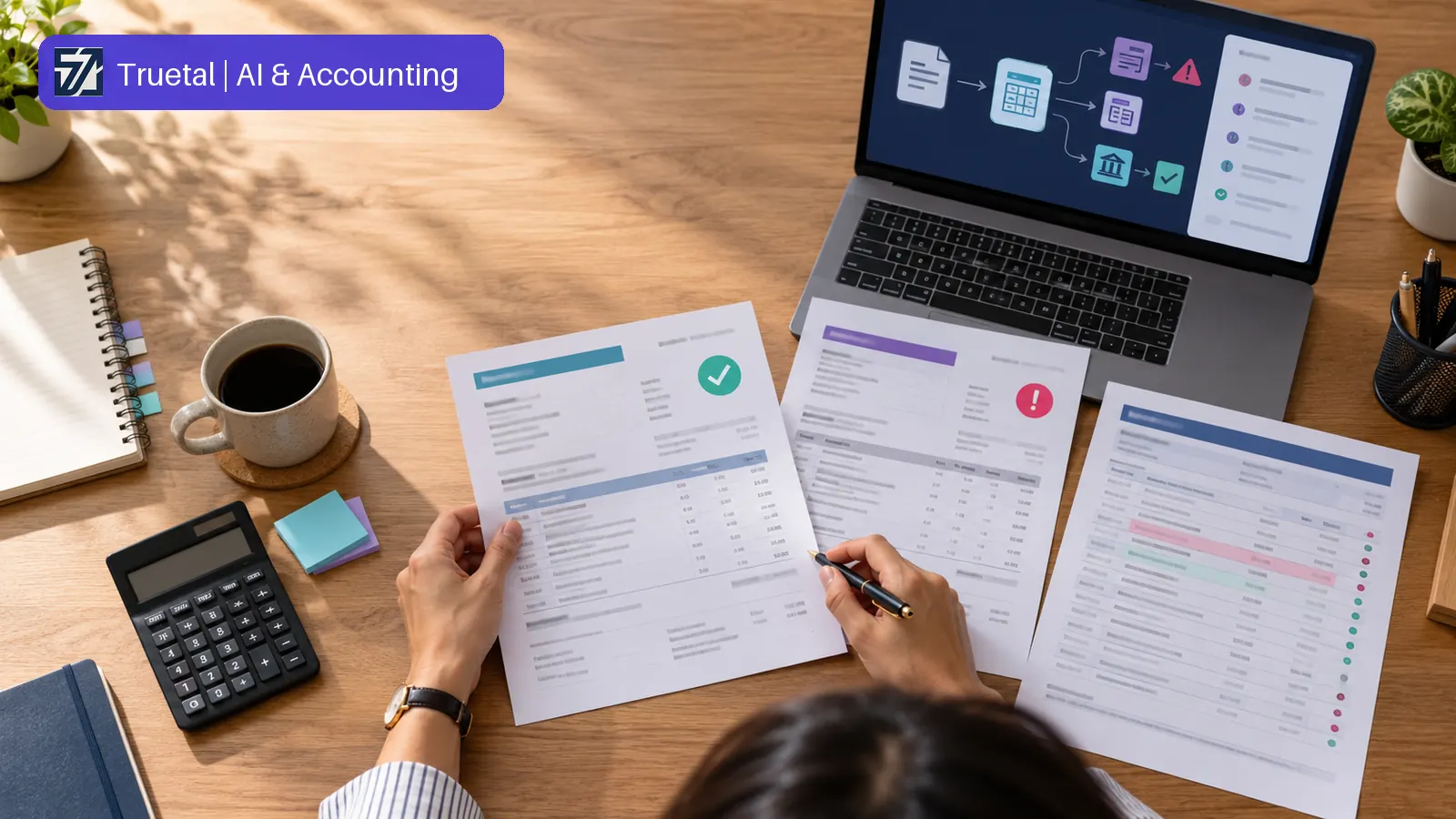
AI in accounting works best as a controlled assistant, not an invisible decision-maker. It can extract purchase-invoice fields, suggest categories, detect likely duplicates, propose bank matches and group GST reconciliation exceptions. The control line is simple: retain the source evidence, restrict access, route uncertainty to a person, require approval for material or tax-sensitive outcomes, and record what the system suggested and what the reviewer finally decided.
That approach can remove a great deal of repetitive work without surrendering responsibility for the books. The objective is not to make every entry touch-free. It is to make routine work faster and make unusual work easier to see, explain and approve.
Last reviewed: 17 October 2026.
What AI in accounting should mean
The phrase covers several different technologies. Optical character recognition can read an invoice image. Rules can standardise a vendor name. Statistical or language models can suggest a ledger or explain an unusual movement. Matching logic can rank a bank receipt or GSTR-2B record against a book entry. None of those tools understands every commercial fact behind a transaction.
A useful system therefore separates four states: captured, suggested, reviewed and posted. Captured data came from a source. A suggestion is a proposed interpretation. Reviewed means a named person checked the relevant evidence and exceptions. Posted means the approved result changed the books. When software collapses those states into one silent action, speed can hide errors. When it keeps them distinct, automation becomes easier to supervise.
Nine accounting workflows worth automating
1. Invoice capture and field extraction
AI-assisted invoice capture can read a supplier name, GSTIN, invoice number, date, taxable value and tax breakup from a PDF or photograph. That removes retyping, but extraction is not validation. The workflow should test field formats, arithmetic and duplicate risk, then show the original document beside the extracted fields. Low-quality scans, handwritten changes, mixed tax rates and unusual layouts belong in an exception queue.
Control to keep: do not create a final purchase entry merely because every field was populated. A person should verify the source document and material tax fields before approval.
2. Expense categorisation and ledger suggestions
A model can learn that recurring payments to a software vendor usually belong to a software or subscription ledger. It can also suggest cost centres or projects from vendor, narration and prior treatment. The suggestion becomes less reliable when a supplier provides multiple kinds of goods or services, the business purpose changes, or the same description has different tax treatment.
Control to keep: display the proposed ledger, supporting signals and prior examples. Require human review for a new vendor, a low-confidence result, a material amount or a category that affects tax treatment.
3. Duplicate invoice and payment detection
Duplicate detection can compare GSTIN, invoice number, date, amount and document image, while allowing for spaces, prefixes and common typing differences. It can also identify a payment that may have been initiated twice. A similarity flag is not proof: recurring rent, instalments and legitimate replacement invoices can look alike.
Control to keep: hold the probable duplicate, link both candidate records and let a reviewer mark it duplicate, legitimate or unresolved. Never delete source evidence automatically.
4. Bank reconciliation suggestions
AI can rank likely matches between bank lines, customer invoices, supplier payments and internal transfers. This is especially useful for partial receipts, combined settlements, bank fees and narrations that do not contain a clean invoice number. The model should propose a match rather than manufacture one.
Control to keep: show the amount, date, counterparty and allocation behind each proposed bank reconciliation. A person should confirm split matches, write-offs, unidentified receipts and period-closing differences.
5. Vendor and customer master checks
Automation can spot near-duplicate vendor names, incomplete GSTINs, changed bank details or an invoice whose supplier data differs from the approved master. This can improve data quality and surface fraud risk, but it should not overwrite a master record from one incoming document.
Control to keep: require a maker-checker process for bank-detail and identity changes. Retain the previous value, evidence for the change, requester and approver.
6. GST and GSTR-2B reconciliation
Software can compare purchase records with GSTR-2B using GSTIN, document type, normalised invoice number, date and tax values. It can group exact matches, probable matches, books-only items, 2B-only items, value differences, credit notes and amendments. The GST Portal describes GSTR-2B as a static statement and advises taxpayers to reconcile it with their own records and avoid duplicate credit.
This is a strong use of automation, but it does not convert a match into an ITC decision. GST reconciliation identifies where attention is needed. A human must still examine the invoice, receipt of supply, business use, restrictions and other applicable conditions. Truetal can organise and match purchase and saved GSTR-2B records for review; it does not decide ITC eligibility or file GST returns.
Control to keep: preserve both compared records, the matching basis, the exception category and the review decision. Do not treat a fuzzy match as an exact match.
7. Receivables prioritisation and follow-up drafts
AI can rank overdue invoices, identify repeated delays and draft a reminder using the invoice and payment history. It can reduce the effort of preparing routine follow-ups, but an automated message can damage a relationship when a payment is already in transit, a credit note is disputed or delivery is incomplete.
Control to keep: reconcile recent receipts and disputes before sending. Let a user approve material escalations and keep the sent message linked to the invoice history.
8. Variance and management-report explanations
Automation can point to the transactions behind an expense spike, margin movement or cash-flow variance and draft a plain-language explanation. That is useful for investigation, not a substitute for investigation. The model may identify correlation while missing a price change, stock adjustment or one-off commercial event.
Control to keep: every explanation should link back to the underlying ledger lines and source documents. Label generated commentary as a draft until the owner verifies the cause.
9. Month-end exception and close checklist
A system can collect unreconciled bank lines, unapproved journals, missing documents, unusual balances and open GST reconciliation items into one close queue. It can assign owners and show ageing so the team spends time on exceptions rather than rebuilding spreadsheets.
Control to keep: define who may clear each exception, lock a period or reopen it. A dashboard reaching zero should mean the named controls were completed, not that warnings were hidden.
Worked example: a GST purchase bill from email to reviewed books
Assume a business receives a supplier PDF showing a taxable value of Rs 50,000, CGST of Rs 4,500 and SGST of Rs 4,500.
- Capture: the system stores the original PDF and extracts the supplier GSTIN, invoice number, date and values.
- Validate: arithmetic and field-format checks pass, but the invoice number resembles an earlier document after punctuation is removed. The record is held as a probable duplicate.
- Review the exception: the accountant opens both source documents. One is the current month's service; the older one is a different valid billing period, so the reviewer marks the new invoice legitimate and records the reason.
- Suggest accounting: the system proposes the professional-fees ledger based on the approved vendor history. Because the amount is material, it remains unposted until the reviewer checks the service and tax breakup.
- Reconcile: when the saved GSTR-2B data becomes available, matching logic finds a probable record with the same GSTIN and values but a differently formatted invoice number. The reviewer confirms the document-level match. That confirmation still does not decide whether ITC is legally eligible.
- Approve and retain: an authorised user approves the accounting entry. The audit trail keeps the source PDF, extracted values, duplicate check, coding suggestion, GSTR-2B comparison, reviewer notes and approval time.
The automation saved data entry and search time. The human handled the two judgements that mattered: whether the apparent duplicate was genuine and whether the proposed treatment was supported.
Evidence and source retention
Every automated result should be traceable to source evidence. For an invoice, retain the file received, not only the extracted text. For a bank match, retain the statement line and allocations. For a reconciliation result, retain the book record, the external statement used and the matching explanation. If an entry changes later, do not erase the earlier state.
Retention also improves the system itself. Reviewers can see which suggestions frequently need correction and narrow the rule instead of accepting a misleading accuracy average. Evidence makes a control testable: another authorised person can reproduce why the final entry exists.
Access, privacy and data handling
Accounting data may contain personal information, bank details, commercial terms and tax identifiers. Before sending it to any AI service, identify what data leaves the accounting environment, where it is processed, how long it is retained and whether it is reused to train a shared model. The Digital Personal Data Protection Act, 2023 provides the statutory framework for digital personal data in India; businesses should obtain advice for their specific obligations and implementation dates.
Use role-based access, least privilege and separate production data from experimentation. Mask unnecessary bank or identity fields in prompts. Revoke access when a user changes role. Review vendors for encryption, retention, deletion, incident handling and subcontractors. A convenient public chatbot is not an approved place for confidential books unless the business has deliberately assessed and configured it for that use.
Human approval and audit trail
"Human in the loop" is meaningful only when the reviewer has enough context and authority to disagree. A button labelled Approve is weak if the source is hidden or every exception is preselected. Good review shows the document, proposed change, reason, confidence or rule, relevant history and downstream effect.
The audit trail should record the original suggestion, reviewer identity, decision time, changes and final posting reference. High-risk actions such as vendor bank changes, manual journals, period reopenings and tax-sensitive overrides can require a second approver. Access logs and edit history should be exportable for internal review rather than locked inside a black box.
Decision checklist: automate, suggest or keep manual
Before automating an accounting step, ask:
- Is the input supported by a retained source document or reliable system record?
- Is the rule stable, or does the outcome depend on facts the software cannot see?
- What amount, novelty, confidence or tax impact sends the item to human review?
- Can the reviewer see why the result was suggested and change it easily?
- Who may approve, post, reverse or reopen the result?
- Does the audit trail preserve the suggestion, evidence, approval and later edits?
- Are access, retention and data-sharing settings appropriate for the information?
- What metric will reveal failure: correction rate, false matches, unresolved exceptions or close delay?
- Is there a tested fallback when the model, integration or source system is unavailable?
Automate deterministic preparation when evidence is strong and consequences are reversible. Use suggestions when judgement remains. Keep the final decision manual when the transaction is unusual, material, legally sensitive or poorly evidenced.
Red flags in an AI accounting proposal
Be cautious when a vendor promises fully autonomous books but cannot show source links, exception handling or edit history. Other warning signs include one accuracy percentage with no definition, shared administrator accounts, no approval thresholds, silent model changes, no data-deletion terms, automatic overwriting of vendor masters and claims that a GSTR-2B match proves ITC eligibility.
A credible proposal describes the workflow and its limits: which fields are extracted, how uncertainty is shown, what becomes an exception, who approves, what is logged and how the business can retrieve its evidence.
How Truetal helps
Truetal is designed around source-linked records and reviewed outcomes. It can help organise invoices, accounting suggestions, bank-matching candidates and purchase-versus-GSTR-2B exceptions so a responsible user can inspect the evidence and decide. The product does not claim that AI silently posts every entry, determines ITC eligibility or files GST returns on the user's behalf.
The useful first step is not buying "AI" as a label. Map one real workflow, mark where evidence enters, define exception rules and name the person who approves the result. Then measure whether automation reduces preparation time without increasing correction risk.
FAQ
Can AI post accounting entries without human approval?
A business may automate low-risk steps, but a safer design keeps material or tax-sensitive entries in a review queue until an authorised person checks the source, coding and tax treatment. Truetal does not silently post AI suggestions as final entries.
Which accounting workflow is usually the best place to start?
Start with a repetitive, evidence-rich workflow such as invoice capture or bank-match suggestions. Measure extraction accuracy, exception volume, review time and corrections before extending automation to more judgement-heavy work.
Can AI decide whether input tax credit is eligible from GSTR-2B?
No. Software can compare purchase records with GSTR-2B and group mismatches, but appearance in GSTR-2B does not by itself establish ITC eligibility. A responsible person must review the invoice, business purpose and applicable GST conditions.
What should an AI accounting audit trail record?
Keep the source document, extracted values, suggested action, rule or confidence signal, exception reason, reviewer, approval time, final entry and later edits. The trail should explain both what changed and who accepted it.
The takeaway
AI in accounting is most valuable between source and decision: it captures, compares, ranks and explains. Strong controls then make the outcome dependable. Preserve evidence, protect access, surface uncertainty, require human approval where judgement matters and retain a readable audit trail. That combination delivers faster accounting without turning the books into an unexplained model output.