When a destination country changes import duties, Indian exporters immediately ask whether Indian GST also changes. These are separate systems. The real business impact usually appears in price, margin, contract terms, landed cost and customer negotiation.
The Short Answer
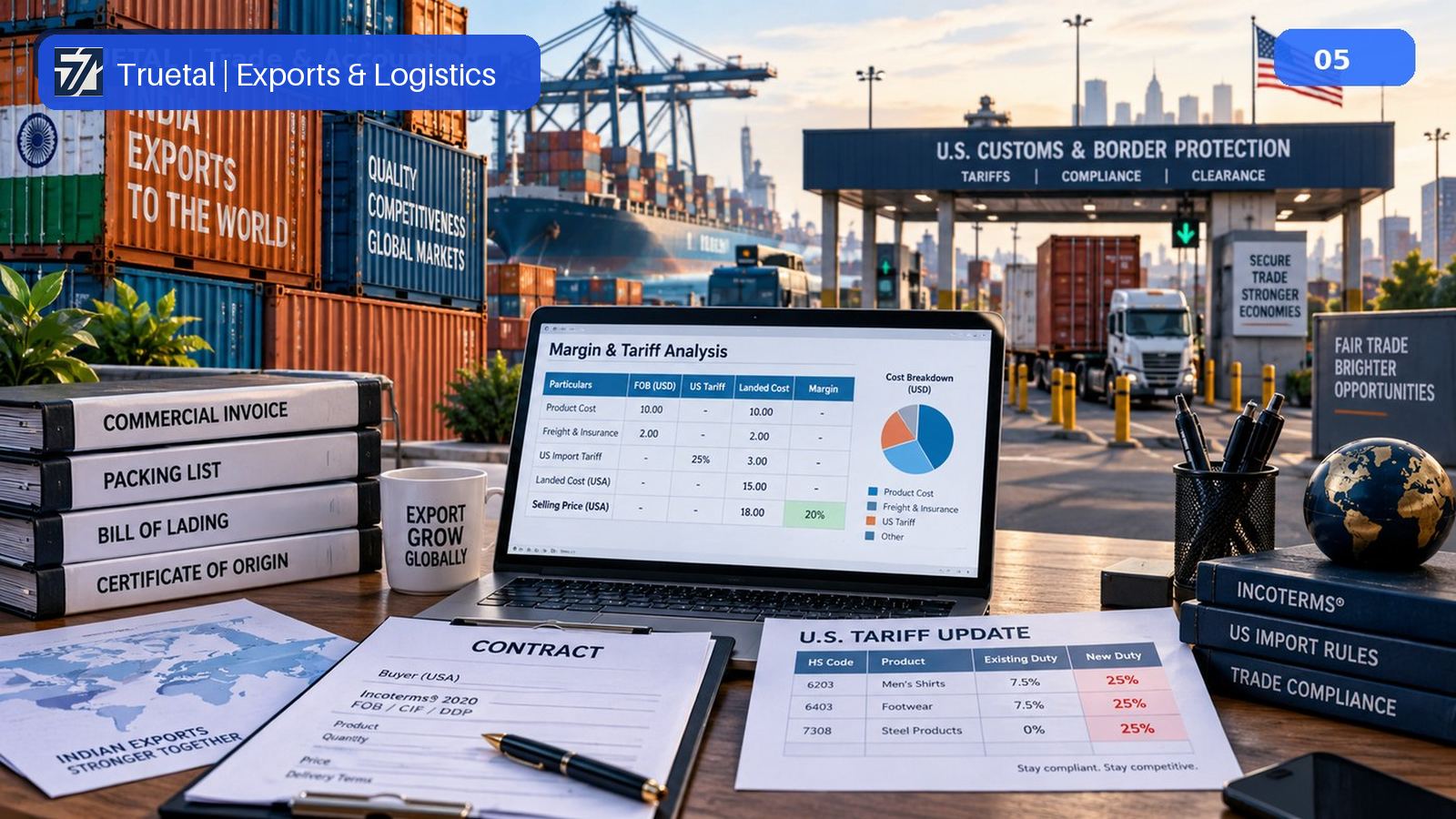
A US import tariff is a border levy in the destination market; it is not Indian GST. Indian export GST treatment can remain zero-rated subject to the normal conditions, while the commercial effect may show up in selling price, Incoterms, margins, customer negotiations, inventory planning and receivable risk.
In Plain Words
A destination tariff changes the commercial economics of the deal; it does not by itself rewrite Indian GST law. Your contract or Incoterms determine who bears the extra landed cost, while the finance team tracks any resulting discount, margin squeeze, receivable risk or inventory change.
What the current US tariff proposal means — status and uncertainty
Tariff proposals linked to broader trade and geopolitical tensions have been discussed in current reporting, with real uncertainty about final scope, rate and timing for any specific product category. Do not build pricing or contracts around an assumed rate — check the current US Customs and Border Protection position for your specific HS classification before quoting a landed cost to a US customer.
US import duty vs Indian GST: different tax points, different governments
These are two entirely separate tax events, collected by two different governments at two different points:
- Indian GST (or zero-rating under LUT) applies at the point of supply from India — governed entirely by Indian GST law, unaffected by anything the US does at its own border.
- US import tariff applies when the goods enter the US — governed entirely by US customs law, and has zero bearing on your Indian GST return.
Who bears the tariff depends on contract / Incoterms
Whether you or your US customer effectively absorbs a tariff is a commercial and contractual question, not a tax one. Under DDP-style terms where you're responsible for landed cost, a new or increased tariff falls on your margin unless renegotiated. Under FOB/CIF-style terms where the buyer handles import formalities, the tariff is the customer's cost directly. Review your existing contracts' Incoterms before assuming who's affected.
Accounting impact: margin, price concessions, inventory and FX
The real accounting-relevant effects of a tariff change are commercial, not statutory:
- Margin compression if you absorb some or all of a new tariff to stay price-competitive.
- Price renegotiation with customers, which may need contract amendments and revised invoicing terms going forward.
- Inventory planning if US-bound orders slow down while customers and exporters assess the tariff situation.
- Receivable/FX risk if payment terms get renegotiated alongside pricing.
None of these require any change to how you treat the export under Indian GST/LUT.
GST refunds / LUT remain a separate Indian compliance track
Your ITC refund claims and LUT compliance continue exactly as before — a US tariff does not create any new Indian GST condition, exemption or documentation requirement. Keep pursuing refunds and LUT renewal on their normal timeline regardless of tariff developments.
Scenario table: DDP vs FOB/CIF-style commercial responsibility
For an illustrative ₹1,00,000 export sale, three commercial outcomes are possible once a tariff applies at the US border (using an illustrative tariff impact, not a real notified rate):
| Scenario | Who bears the tariff cost | What changes in your books |
| Customer bears it (FOB/CIF-style) | Your US customer, at their import formalities | Nothing — your invoice and margin are unaffected |
| You discount to stay competitive | You, via a lower quoted price | Lower revenue per unit — a pricing decision, not a GST one |
| Contract shifts landed-cost responsibility to you (DDP-style) | You, built into your quoted price | Margin absorbs the tariff — track this as a cost of sale, not a tax adjustment |
The Key Steps at a Glance
Read the four steps in order — each one depends on the one before it.
- 1What the current US tariff proposal means – status and uncertainty
- 2US import duty vs Indian GST: different tax points
- 3Who bears the tariff depends on contract / Incoterms
- 4Accounting impact: margin, price concessions, inventory and FX
What to do now
- Check your Incoterms on existing US contracts before assuming who bears a tariff.
- Confirm the current, specific tariff position for your HS code directly with US customs guidance — don't rely on a general news headline.
- Keep your LUT/refund compliance exactly as it is; nothing about a US tariff requires any change there.
Common mistakes
- Treating a US tariff announcement as if it changes your Indian GST rate or LUT eligibility.
- Assuming a specific tariff percentage without checking the current position for your exact product classification.
- Not reviewing Incoterms before assuming the customer will simply absorb a new cost.
The Takeaway
Keep Indian GST and destination-country tariff analysis on separate tracks, then connect them through price, margin and contract responsibility.
How Truetal Helps
Truetal keeps your export GST/LUT compliance completely separate from commercial pricing tracking, so a change in one never gets mistakenly applied to the other.
Questions People Search For
- US tariffs India exporters GST impact
- Trump tariff India accounting impact
- US import tariff who pays
Sources
Reuters reporting on US-India tariff discussions (September 2026); GST Council press release archive. Tariff specifics are a live, evolving situation — verify the current position for your product before relying on any figure.