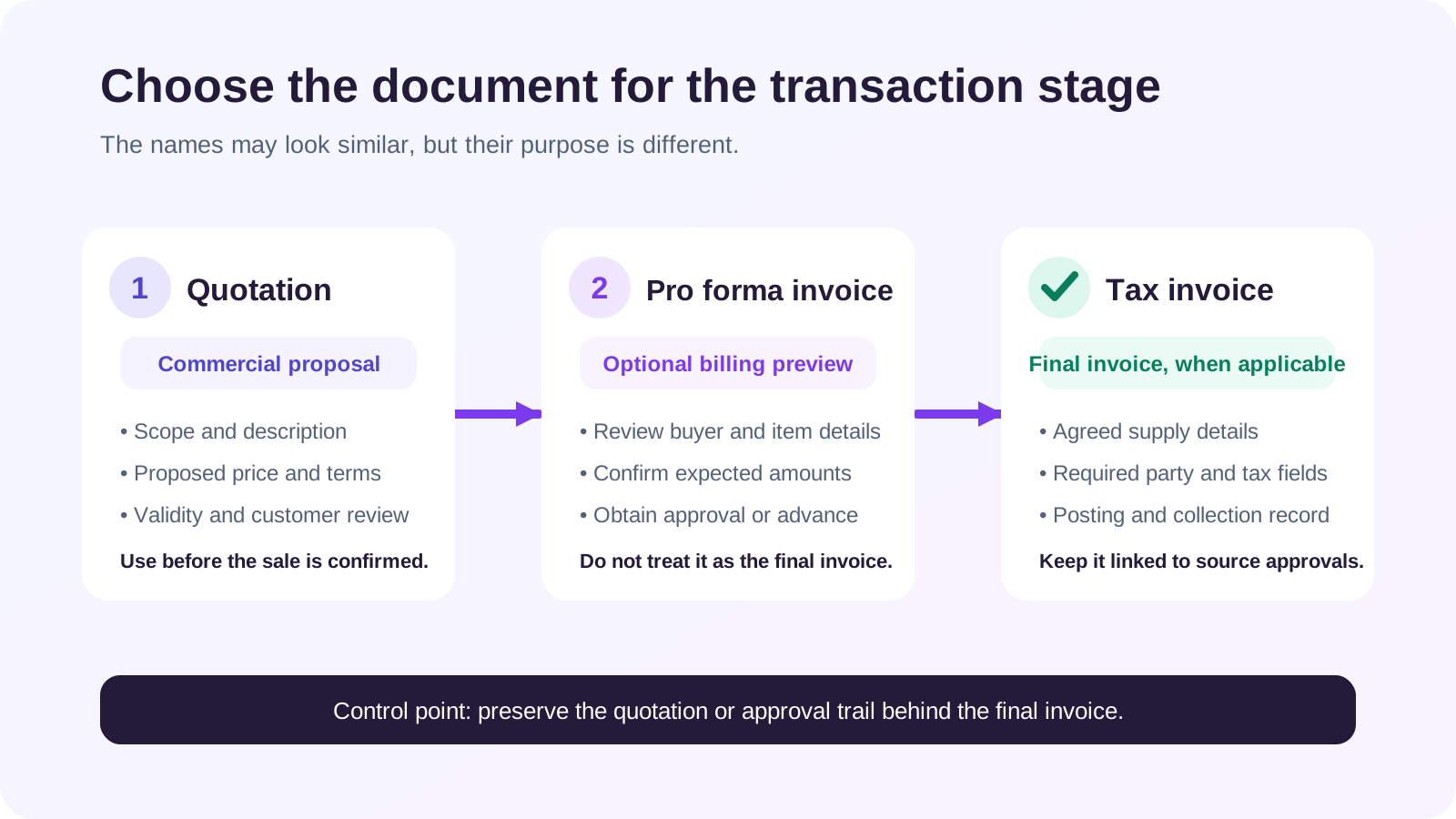
A quotation proposes price and terms, a proforma invoice presents a preliminary invoice-like summary, and a GST tax invoice is the prescribed document for a taxable supply. A quotation or proforma should not be posted as final sales merely because it looks like an invoice. Issue the tax invoice at the legally correct stage, with the particulars required by GST law, and preserve the earlier documents as commercial evidence.
Current-status caution, reviewed 15 October 2026: document names do not override the facts. An advance, a change in time of supply, an export/SEZ transaction, reverse charge, e-invoicing applicability or a bill-of-supply case can alter the required workflow. Verify the live rule for the actual supply.
The direct answer
Use a quotation while the customer is deciding. Use a proforma when the customer needs a more invoice-shaped preliminary document for approval, budgeting or arranging payment. Use a GST tax invoice only when the taxable-supply invoicing requirement has arisen.
A customer accepting a quotation does not transform the same PDF into a tax invoice. A proforma number should not be reported as the final invoice number. The final tax invoice needs its own controlled, consecutive serial number for the financial year and the applicable Rule 46 particulars.
What each document does
| Document | Main purpose | Accounting treatment | GST role |
| Quotation | Offer scope, quantity, price, validity and terms | Normally no sale or customer receivable yet | Not a GST tax invoice |
| Proforma invoice | Preliminary invoice-style request or confirmation before the final document | Normally not final revenue or output tax by itself | Does not replace the prescribed tax invoice or any required receipt voucher |
| GST tax invoice | Records the taxable supply at the required invoicing point | Supports the final sale, customer receivable and output-tax entry | Must contain applicable statutory particulars; e-invoice rules may also apply to notified taxpayers |
The commercial sequence may be quotation → customer approval → proforma or advance request → supply → tax invoice → payment. Not every business needs every middle step. The control is to know which document is still negotiable and which one has become the final accounting and GST source.
Worked example
An engineering supplier in Pune quotes a machine at ₹1,00,000 plus applicable GST. The quotation is valid for 15 days and states delivery and payment terms. The customer accepts it and asks for a proforma to complete an internal purchase approval.
At this point, the supplier keeps both documents outside the final sales register. The proforma can show the expected value and tax calculation for planning, but it is clearly marked as preliminary and uses a separate sequence from tax invoices.
When the invoicing requirement for the actual supply arises, the supplier issues the final GST tax invoice. It carries the controlled invoice number, issue date, supplier and recipient details, description, HSN/SAC as applicable, value, tax rate and amount, place-of-supply details where required, and the other relevant Rule 46 fields. The books then record the final receivable, revenue and output tax from that tax invoice—not from the earlier quotation and proforma.
If the customer pays an advance before supply, the supplier separately checks the current advance, receipt-voucher and time-of-supply rules. Renaming the proforma as a “tax invoice” is not a safe substitute for that review.
Before you issue the document
- Identify whether the customer is considering, approving, paying in advance or receiving the supply.
- Confirm the supplier GSTIN and the customer GSTIN, legal name and place of supply where applicable.
- Keep quotation/proforma numbering separate from the final tax-invoice series.
- State validity, delivery, payment, cancellation and tax assumptions on the quotation.
- Mark a proforma prominently as preliminary and not the final tax invoice.
- Check whether a receipt voucher, bill of supply, delivery challan, export endorsement or reverse-charge wording is required instead.
- Check e-invoice applicability before treating a locally generated invoice as the completed GST document.
- Link the accepted quotation and any proforma to the final invoice without overwriting the source documents.
Evidence to retain
- the version of the quotation the customer accepted;
- approval email, purchase order or signed contract;
- the proforma, if one was issued;
- advance receipt and receipt voucher evidence, where applicable;
- dispatch, delivery or service-completion evidence;
- final tax invoice and IRN details where e-invoicing applies;
- credit/debit note or cancellation trail for later changes; and
- bank receipt matched to the final customer receivable.
Common mistakes and edge cases
Booking the proforma as revenue. This creates a receivable and output-tax trail before the final source document exists, then risks duplication when the tax invoice is issued.
Reusing the proforma number as the tax-invoice number without a controlled series. The final invoice series must satisfy the applicable GST numbering requirements.
Calling every preliminary request a tax invoice. A title is not enough; document timing, purpose and statutory contents matter.
Ignoring advances. A payment before supply needs its own current-law review. The correct treatment can differ for goods, services and special transactions.
Editing an issued tax invoice to match a revised commercial deal. Once the final document has entered the accounting/GST trail, use the lawful cancellation or credit/debit-note route rather than silently replacing history.
Assuming a proforma permits ITC. The recipient should test ITC using the final tax invoice, receipt of supply, GSTR-2B and every other applicable statutory condition—not the proforma alone.
How Truetal helps
Truetal can create quotations and proforma documents, share their PDFs, and convert a quotation only after it is explicitly marked ACCEPTED into a linked DRAFT tax invoice for review. Proformas stay outside GSTR-1 working data. Truetal does not decide when GST liability arises or whether a special document is legally sufficient; the authorised user must review the transaction facts before finalising the invoice.
FAQ
Is a proforma invoice a GST tax invoice?
No. A proforma is a preliminary commercial document. It does not replace the prescribed GST tax invoice and should not be treated as the final source for revenue, output tax or recipient ITC.
Can a quotation show GST separately?
It can show an estimated tax calculation so the customer understands the expected price, but it remains a quotation. The final rate, place of supply and tax treatment must be checked when the prescribed document is issued.
When should I convert a quotation into an invoice?
Convert it when the deal and transaction facts reach the correct invoicing point. Customer acceptance is important commercial evidence, but the GST timing depends on the nature of the supply and applicable rules.
What if the customer pays against a proforma?
Record the receipt accurately and check the current advance, receipt-voucher and time-of-supply treatment. Do not post the proforma itself as the final tax invoice merely because money arrived.
The takeaway
Let the document follow the event: quotation for negotiation, proforma for a preliminary confirmation, and tax invoice for the taxable supply. Separate numbering and a linked evidence trail prevent duplicate sales, premature tax entries and customer disputes.