The direct answer
When gold prices fall, a jeweller does not revalue stock every day. At the year-end valuation date (31 March), compare each stock line's cost with its net realisable value (NRV): the price you expect to get for it in normal business, less the costs needed to sell it. Carry the lower figure. If NRV is below cost, the difference is a write-down that reduces this year's profit. If NRV is above cost, stay at cost; you never write stock up to market. Use one cost formula consistently: FIFO or weighted average, or the specific cost of distinctive pieces.
As of 19 November 2026: gold prices in India have fallen from their January 2026 peak. Market reports put 24-carat gold at about ₹1.29–1.35 lakh per 10 grams in mid-November. A price on any day before 31 March does not by itself change your closing stock value; the comparison is made at the valuation date. This guide explains accounting and income-tax valuation principles. Your accountant decides the figures for your entity.
Why the date matters more than the headline
A fall in November matters for the books only if the stock is still worth less than its cost on 31 March. If prices recover by then, there may be nothing to write down. If they fall further, the write-down grows.
AS 2, the ICAI accounting standard on inventories, says NRV estimates use the most reliable evidence available when the estimates are made. Price changes after the year-end are considered only to the extent they confirm conditions that existed at the year-end. So keep the evidence for the rate you used on 31 March: the day's buying and selling rates, and how you priced your own stock.
You can also run the same comparison at each month-end for internal reports. It tells you early how much profit is sitting at risk in stock bought at higher prices.
Step 1: Use one cost formula and keep it
Cost is what it took to bring the stock to its present location and condition. For jewellery this is usually the metal plus purchase making or labour charges and other direct costs. It excludes the costs of selling.
Assign cost with one of these:
- Weighted average cost per gram, kept separately for each purity (24K bullion, 22K, 18K). Every purchase changes the average.
- FIFO, where the oldest stock is treated as sold first.
- Specific identification for distinctive pieces that are not interchangeable, such as a studded set made to order. AS 2 requires their individual cost.
Two points that many older articles miss:
- LIFO is not allowed. AS 2 permits only FIFO or weighted average for interchangeable items, and ICDS II, the income-tax standard on inventories, also limits the formula to FIFO or weighted average. Tribunal cases that accepted LIFO for jewellers relate to earlier years.
- Consistency matters. Switching formulas in a year when prices fall, to move profit, invites questions. Change only for a genuine reason, and disclose it.
Step 2: Estimate NRV for each stock line
For a jeweller, NRV is what each line would realistically sell for after the fall, less the costs to complete and sell it:
- Bullion and plain gold: the current rate for that purity, less selling costs.
- Finished jewellery: the expected selling price, which includes the gold value at the current rate and the making charges customers actually pay you. Subtract selling costs such as card or platform charges and sales commission.
- Slow-moving or damaged pieces: NRV may be closer to melt value. Base the estimate on evidence, not hope.
AS 2 says stock is normally written down item by item. Similar items can be grouped, for example plain 22K chains of one design, but do not set a gain on bullion against a loss on jewellery. Comparing only the totals hides losses.
See which stock lines are priced below cost
Truetal keeps a weighted-average cost for every product and its Stock Valuation report flags products whose cost is above the sale price you saved for them. Update each purity’s sale price to today’s rate and review the suggested write-down with your accountant. Inventory is a Pro feature, included in the free trial.
Try Truetal free for 7 daysWorked example: three stock lines on 31 March
A jeweller's closing stock on 31 March looks like this. All figures are illustrative, not today's rates.
| Stock line | Cost | Net realisable value | Carry at |
| 22K jewellery, 400 g at ₹12,300/g | ₹49,20,000 | ₹47,40,000 (₹12,000/g − ₹150/g selling cost) | ₹47,40,000 |
| 18K studded pieces, specific cost | ₹6,00,000 | ₹6,50,000 | ₹6,00,000 |
| 24K bullion, 100 g at ₹12,600/g | ₹12,60,000 | ₹12,85,000 (₹12,950/g − ₹100/g) | ₹12,60,000 |
| Total | ₹67,80,000 | ₹66,75,000 | ₹66,00,000 |
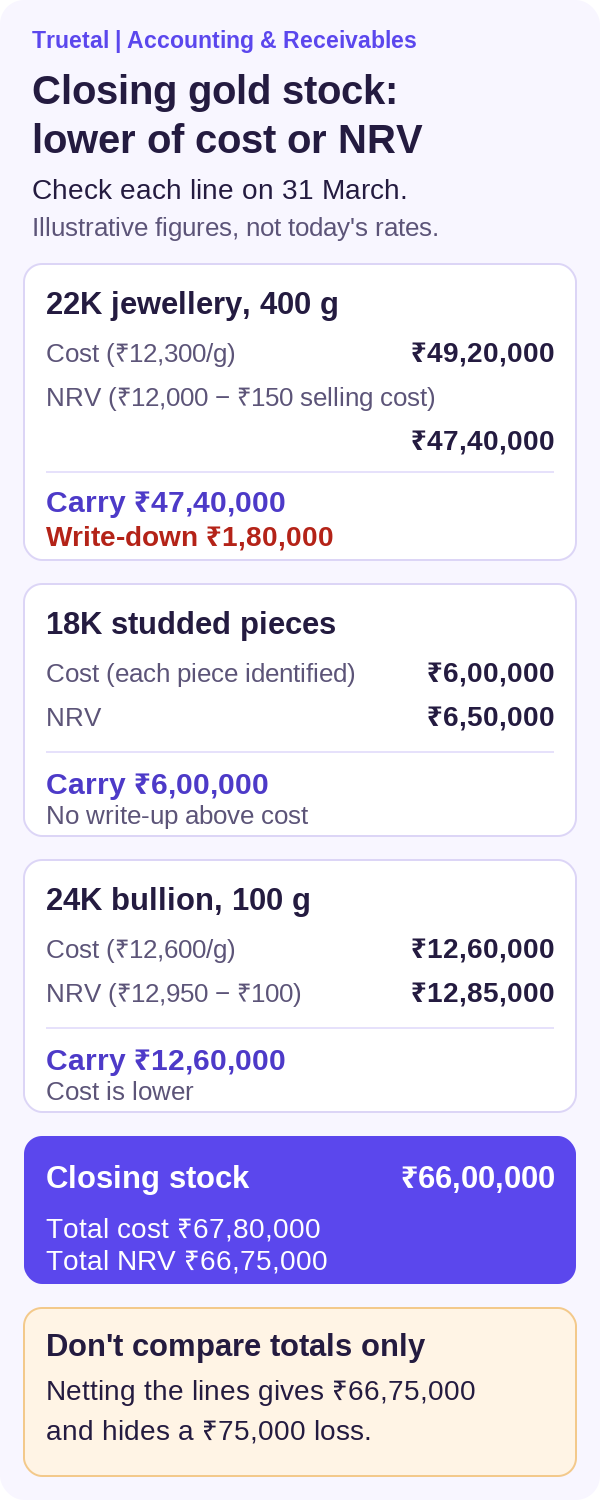
Closing stock is ₹66,00,000. The 22K line needs a write-down of ₹1,80,000, which increases cost of goods sold and reduces this year's profit.
Notice the trap in the totals. Total NRV (₹66,75,000) is lower than total cost (₹67,80,000), so a quick check might carry ₹66,75,000. That would let the 18K and bullion margins absorb part of the 22K loss and overstate stock by ₹75,000. Check line by line.
If gold rises again next year, any 22K stock still unsold is compared with its original cost again at that year's valuation date. Its carrying value can move back up towards cost, but never above it. Ask your accountant how that recovery is treated for income tax.
Books and income tax: the same rule, two records
In the books. Businesses that do not follow Ind AS generally apply ICAI's AS 2. Companies covered by Ind AS apply Ind AS 2 instead, which uses the same lower-of-cost-and-NRV principle.
For income tax. From tax year 2026-27, section 277 of the Income-tax Act, 2025 replaces section 145A of the 1961 Act. It requires inventory to be valued at the lower of actual cost or NRV, computed under the Income Computation and Disclosure Standards (ICDS) notified under section 276(2). Section 277 also requires purchases, sales and inventory to include any tax, duty or cess actually paid or incurred. Ask your accountant how this adjustment affects your figures.
ICDS were notified by CBDT Notification 87/2016. They do not apply to an individual or HUF whose accounts do not need a tax audit, so check whether your business is covered. Where they apply, ICDS II follows the same lower-of-cost-and-NRV rule and allows only FIFO or weighted average.
If your accounts are audited, the tax audit report asks for the valuation method and any deviation from the prescribed method. Keep the year-end working ready for your auditor.
GST: the rate does not change, and a write-down is not a write-off
A fall in the gold rate does not change the GST rate. Gold and jewellery under Chapter 71 carry 3% GST: 1.5% CGST and 1.5% SGST, or 3% IGST. GST is charged on the price at which you actually sell. A lower year-end stock value in your books does not change the GST on earlier purchases or later sales.
Section 17(5)(h) of the CGST Act blocks input tax credit on goods that are lost, stolen, destroyed, written off, or given away as gifts or free samples. A year-end NRV write-down keeps the goods in stock for sale, so it is a valuation entry. If you physically scrap, lose or give away stock, that is a different event. Ask your accountant about reversing the input credit.
This guide does not cover the GST treatment of old-gold exchange or making-charge job work. Those depend on how each transaction is structured.
Year-end checklist for jewellers
- Count the physical stock and agree weights and purity with the stock register.
- Split stock into lines: bullion by purity, plain jewellery by purity and design group, distinctive pieces individually.
- Confirm the cost of each line using the same formula as last year.
- Record the evidence for NRV on the valuation date: rates used, expected selling prices, selling costs and any slow-moving lines.
- Compare cost with NRV line by line and carry the lower figure.
- Post one write-down entry with the working attached, approved by the owner or accountant.
- Keep the working for the tax audit, and do not reverse input credit unless goods were actually lost, destroyed, written off or given away.
Common mistakes
- Valuing all stock at today's rate. Stock bought below the current rate stays at cost; writing it up overstates profit.
- Netting gains and losses across lines. Compare each line, or a genuine group of similar items, not the shop total.
- Using LIFO because an old ruling allowed it. Current standards allow FIFO or weighted average for interchangeable items.
- Ignoring making charges. Exclude selling costs from cost, but include purchase making or labour charges that brought the jewellery to its present condition.
- Treating a write-down as a GST write-off. A valuation entry is not the same as goods lost, destroyed or given away.
- No evidence for the rate used. A figure without its date and source is hard to defend in an audit.
How Truetal helps
On the Pro plan, Truetal's inventory tracks stock by warehouse and keeps a weighted-average cost for each product from every stock receipt. The Stock Valuation report shows opening, received, issued and closing quantity and value for any date range. It also flags products whose cost is above the current sale price saved for that product, with a suggested write-down for review.
Limits to know:
- The flag compares cost with the sale price you keep in the product master. Update that price to the rate you will actually sell at before you rely on the flag. It does not deduct selling costs, so it is a review prompt, not a computed NRV.
- Truetal does not post the write-down for you. Your accountant decides the figure and posts the entry.
- Keep each purity as a separate product. For distinctive pieces, use a separate product for each piece so its own cost stays visible.
Frequently asked questions
Do I have to revalue gold stock every time the price falls?
No. Stock is compared with NRV at the valuation date, normally 31 March for annual accounts. A fall in November affects the books only if the stock is still worth less than cost on that date. You can run the same check monthly for internal reports.
Can I value my closing gold stock at the current market rate?
Only where the market-based NRV is lower than cost. If the current value is above cost, the stock stays at cost; writing stock up to market is not allowed.
Is LIFO allowed for jewellery stock?
For interchangeable stock, AS 2 and ICDS II allow FIFO or weighted average. Older tribunal decisions accepting LIFO relate to earlier years. Distinctive pieces use their specific individual cost.
Does a write-down of stock value reduce my GST or require ITC reversal?
A write-down does not change the GST rate or the GST on your sales. Section 17(5)(h) blocks credit on goods lost, stolen, destroyed, written off or given away. A year-end NRV write-down keeps the goods in stock for sale. Ask your accountant about specific losses or scrapping.
What GST rate applies to gold jewellery in 2026?
Gold and jewellery under Chapter 71 carry 3% GST (1.5% CGST plus 1.5% SGST, or 3% IGST). A fall in the gold price does not change the rate.
Sources
- ICAI — Accounting Standard (AS) 2, Valuation of Inventories: cost formulas, specific identification and item-by-item NRV, checked 19 November 2026
- Income Tax Department — Income-tax Act, 2025 as amended by the Finance Act, 2026: section 277 valuation of inventory, checked 19 November 2026
- Income Tax Department — Income Computation and Disclosure Standards (ICDS), including ICDS II on inventories, checked 19 November 2026
- CBIC — Central Goods and Services Tax Act, 2017, section 17(5)(h), checked 19 November 2026
- GST Council — Sectoral FAQ on gems and jewellery: 3% rate on Chapter 71 goods, checked 19 November 2026
- Value Research — Why gold prices are falling in India, November 2026 (market context only)