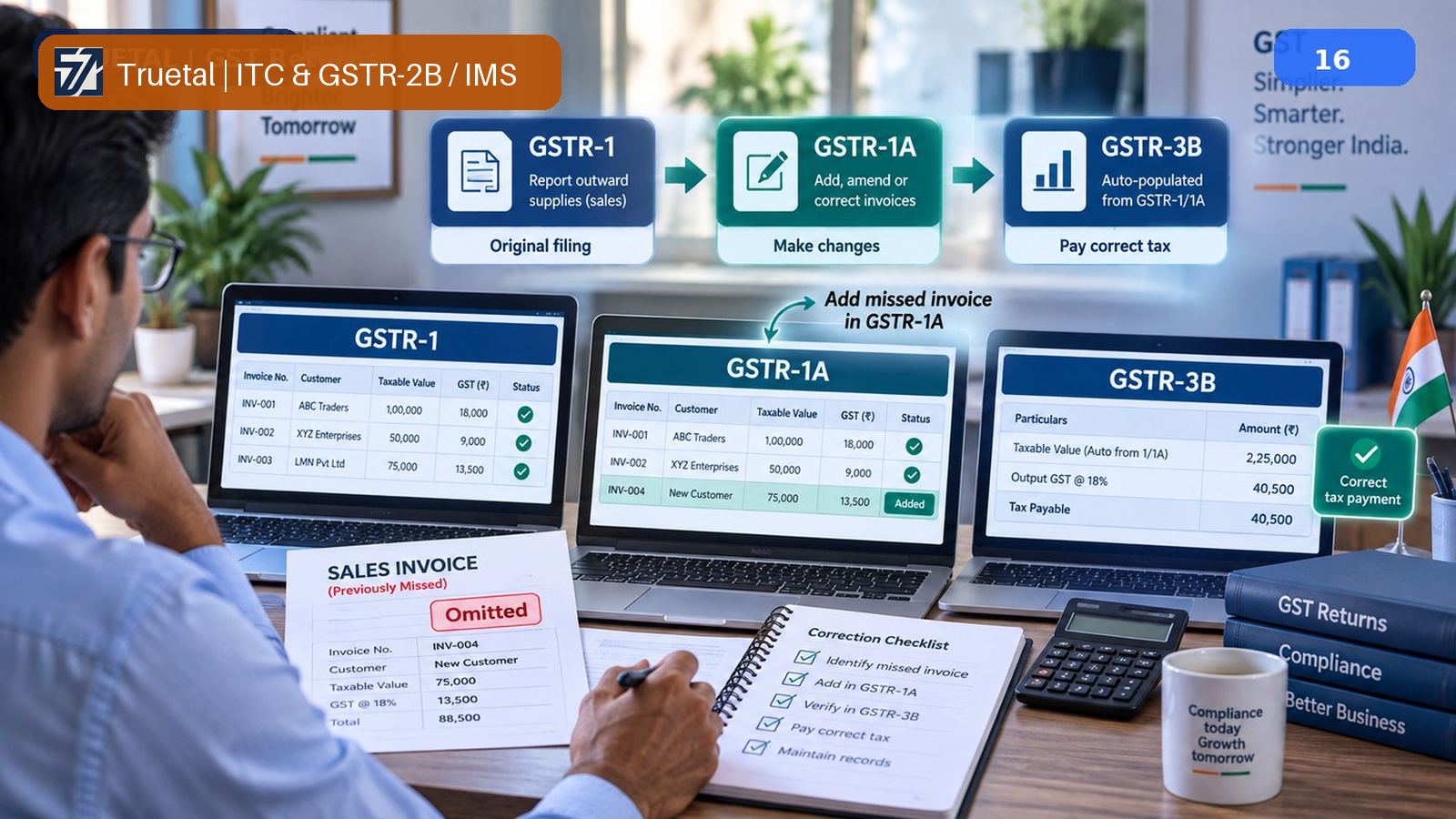

The direct answer
If DRC-01B Part A appears, download it immediately and reconcile the GSTR-1, GSTR-1A or IFF liability against GSTR-3B separately for each tax head. Rule 88C gives seven days to pay the accepted difference with applicable interest through DRC-03, explain the difference in Part B, or use both routes for a mixed result. Do not ignore it: Rule 59(6)(d) can restrict a subsequent GSTR-1 or IFF until the required payment or reply is furnished.
Reviewed against primary sources on 20 October 2026. Verify the actual intimation, current portal instructions and facts with the authorised filer. This is a records-and-response workflow, not legal advice.
What DRC-01B compares
DRC-01B is the Rule 88C intimation for a difference where tax payable according to GSTR-1, as amended in GSTR-1A if any, or IFF exceeds tax payable according to GSTR-3B by the amount and percentage contemplated by the rule.
This guide deliberately does not state a universal rupee or percentage trigger. The rule refers to the prescribed comparison criteria, and the GST system applies configured parameters. An unofficial threshold copied from another website or an old case should not replace the figures in the taxpayer's Part A.
Legal fact: Part A communicates a system-identified difference and directs payment with applicable Section 50 interest through DRC-03 or an explanation on the portal within seven days.
Practical interpretation: A system difference is the start of a reconciliation. It does not reveal whether the cause is a genuine short payment, timing, an amendment, duplication, classification or another reporting issue.
Decide the response only after reconciliation
Use this only after reconciling the actual Part A figures. It is a review aid, not an automatic legal conclusion.
| Review finding | Part B route | Evidence to retain |
|---|---|---|
| The full difference is an unpaid liability | Pay the accepted differential tax and applicable interest through DRC-03, then report the validated ARN in Part B. | Part A, reconciliation, calculation approval, DRC-03, ledger debit, ARN and filed Part B. |
| The full difference has a supported explanation | Enter the reason and details for the unpaid amount in Part B. Do not create a payment reference that does not exist. | Filed returns, period bridge, invoice or amendment schedule, tax-head working and reviewer approval. |
| Part is payable and part is explainable | Use DRC-03 for the accepted amount and explain the remaining amount in the same Part B response. | A tax-head bridge showing that the Part A difference equals the DRC-03 amount plus the explained balance, with evidence for both. |
| The cause is unresolved before the internal deadline | Escalate immediately to the authorised filer, GST practitioner or legal adviser. Do not select a convenient portal reason without evidence. | Open-item log, unresolved records, escalation note and the portal response deadline. |
Do not force the total to zero by offsetting unrelated periods or tax heads. A plausible explanation for CGST does not explain an IGST shortfall. Every part of the Part A difference should end in one of two evidenced buckets: amount paid through the correct route or amount explained in Part B.
The seven-day response workflow
1. Save the intimation and freeze the evidence
Download Part A and note the GSTIN, tax period, issue date and figures for IGST, CGST, SGST or UTGST and cess. Save the filed GSTR-1, any GSTR-1A, IFF where relevant, filed GSTR-3B, electronic-liability and cash-ledger evidence, and the GST Portal comparison report.
Work from copies. Do not overwrite original return extracts or alter closed books merely to make a current worksheet agree.
2. Rebuild the difference by tax head
Create one worksheet with these columns:
- Tax head and return period.
- Liability considered from GSTR-1, GSTR-1A or IFF.
- Corresponding GSTR-3B liability.
- Part A difference.
- Prior-period tax already discharged, if relevant.
- Amendments, debit or credit notes and advance adjustments.
- Accepted amount payable.
- DRC-03 amount and ARN.
- Amount remaining for explanation.
- Evidence reference, owner and reviewer.
The control total for each tax head should show how the Part A amount divides between payment and explanation. Keep IGST, CGST, SGST or UTGST and cess visible even when the overall total appears correct.
3. Find the document-level cause
Test common causes such as:
- Tax paid in an earlier period while the related invoices were reported later in GSTR-1.
- An amendment, debit note, credit note or advance adjustment appearing in a different period.
- Duplicate invoice data after an ERP, e-invoice or spreadsheet import.
- An invoice omitted from the GSTR-3B liability working.
- A wrong period, tax head or return row.
- Export, SEZ or another classification handled differently between the two workings.
- A genuine liability reported in outward supplies but not discharged in GSTR-3B.
Do not select a portal reason first and then search for evidence to fit it. Reconcile first; select the reason that accurately describes the evidenced result.
4. Choose payment, explanation or both
Where the full difference is accepted, calculate the liability and applicable interest through the authorised review process and use DRC-03.
Where the full difference is explainable, prepare a concise reason that identifies the period, tax head, amount and exact supporting return or schedule. Avoid vague text such as “difference due to reconciliation”.
Where only part is payable, use DRC-03 for that part and explain the remainder. Rule 88C expressly accommodates full or partial payment and reasons for the balance left unpaid.
5. Complete DRC-03 where payment is due
Use the official portal route and correct cause of payment for the liability mismatch. Follow the current on-screen validations rather than reusing an unrelated ARN.
Retain DRC-03, its ARN, payment and ledger evidence, and the approved calculation. Do not enter an ARN merely to pass a field check.
6. File Part B on the GST Portal
Use Services > Returns > Return Compliance, then open the liability-mismatch record. Review Part A and enter the validated DRC-03 information, the supported explanation, or both in Part B. Preview the response, check its period and tax-head amounts, file with the authorised DSC or EVC, then download the filed response and retain its acknowledgement and status.
The authorised signatory should review the final preview because a complete-looking form can still contain an incorrect period, explanation or allocation.
Worked example: partial payment plus explanation
Assume a fictional Part A shows ₹18,000 IGST, ₹9,000 CGST and ₹9,000 SGST, totalling ₹36,000. This is only an illustration; it is not a portal trigger threshold.
The review finds that the ₹18,000 IGST was reported in outward supplies but omitted from the relevant GSTR-3B working. The CGST and SGST relate to invoices reported later in GSTR-1, while evidence shows the corresponding liability was already discharged in an earlier GSTR-3B.
After authorised review, the taxpayer pays the accepted IGST difference and applicable interest through DRC-03. Part B reports that ARN and explains the ₹18,000 CGST and SGST balance with the earlier-period return and invoice schedule. The worksheet proves that ₹36,000 equals the paid part plus the explained part; it does not assume that portal acceptance is guaranteed.
Why the response matters for the next filing
Rule 59(6)(d) restricts furnishing a subsequent GSTR-1 or IFF where a taxpayer issued the Rule 88C intimation has neither deposited the specified amount nor furnished the required reply explaining the unpaid amount.
That makes an unanswered Part A an operational filing risk, not merely an inbox item. A reply may satisfy the response condition in Rule 59, but it does not establish that the underlying explanation has been accepted. Monitor the portal and registered communications after filing.
DRC-01C is a different comparison
DRC-01C is the Rule 88D process for cases where ITC availed in GSTR-3B exceeds ITC available in GSTR-2B by the relevant comparison criteria. It also uses Part A and Part B, with payment through DRC-03, an explanation, or a combination where applicable.
Do not copy an outward-liability explanation from DRC-01B into DRC-01C. For DRC-01C, reconcile the comparison scope, reversals and reclaims, amendments, and the appropriate import, RCM, ISD or other ITC lanes before deciding the response. A GSTR-2B difference is a review trigger; it does not decide every legal eligibility question.
Prevent the next mismatch
Before filing, compare draft GSTR-3B liability with GSTR-1, GSTR-1A or IFF by period and tax head. Review amendments, credit and debit notes, advances, exports and SEZ supplies, and preserve the sign-off worksheet. Download the GST Portal comparison report after filing and investigate flagged differences while source records remain available.
A sound control has four owners: the preparer who builds the bridge, the reviewer who checks evidence, the authorised filer who approves the return or response, and the person who retains proof. One person silently editing totals is not a control.
Common mistakes
- Quoting an unofficial trigger threshold as a universal rule.
- Netting different periods or tax heads without a document bridge.
- Selecting a portal reason before investigating the source records.
- Reusing an unrelated DRC-03 ARN.
- Treating submission as proof that the explanation was accepted.
- Copying a DRC-01B explanation into the separate DRC-01C comparison.
How Truetal helps—and where it stops
Truetal helps keep accounting records, GST-ready working data and GSTR-2B purchase-side reconciliation evidence organised for review. That can make a source trail easier to assemble when an authorised professional investigates a mismatch.
Truetal does not determine the legal response, calculate a guaranteed liability outcome, prepare or file GSTR-1 or GSTR-3B, submit DRC-01B or DRC-01C, operate the GST Portal on the taxpayer's behalf or provide legal advice. The authorised taxpayer and professional reviewer remain responsible for return figures, payment, explanation and portal filing.
The finish line is a filed Part B supported by a tax-head bridge, source evidence, reviewer approval and retained portal proof—not merely a status marked complete in an internal checklist.
Frequently asked questions
How much time is allowed to respond to DRC-01B Part A?
Rule 88C directs the taxpayer to pay the differential liability with applicable interest or explain the difference on the common portal within seven days. Record the issue date and verify the actual Part A and current portal status immediately.
Can I reply to DRC-01B without making a payment?
Yes, where the difference has a supportable explanation, Rule 88C permits an electronic explanation for the unpaid amount in Part B. Filing an explanation does not by itself prove that the position has been accepted.
Can I make a partial payment and explain the remaining difference?
Yes. Rule 88C permits full or partial payment through DRC-03 and an explanation for the amount that remains unpaid. Reconcile both portions by tax head before filing Part B.
Can an unanswered DRC-01B affect the next GSTR-1 or IFF?
Yes. Rule 59(6)(d) restricts furnishing a subsequent GSTR-1 or IFF where the taxpayer has neither deposited the amount specified in the intimation nor furnished the required reply explaining the unpaid amount.
Is DRC-01C the same as DRC-01B?
No. DRC-01B under Rule 88C concerns outward-liability differences between GSTR-1, GSTR-1A or IFF and GSTR-3B. DRC-01C under Rule 88D concerns ITC availed in GSTR-3B compared with ITC available in GSTR-2B. Each needs its own reconciliation and evidence.
Does filing Part B automatically close the matter?
No. Submission proves that a response was filed; it does not establish that the explanation is accepted or that no further action is possible. Preserve the filed copy and monitor official portal status and communications.
Sources
- CBIC — Notification 26/2022: Rule 88C, Rule 59(6)(d) and Form GST DRC-01B
- CBIC — current Rule 59 restrictions on furnishing GSTR-1 or IFF
- GST Council — Notification 12/2024 adding GSTR-1A to the Rule 88C comparison
- GSTN — DRC-01B Return Compliance manual and Part B workflow
- GSTN — tax-liability and ITC comparison reports
- GST Council — Notification 38/2023 introducing Rule 88D and Form GST DRC-01C