
The direct answer
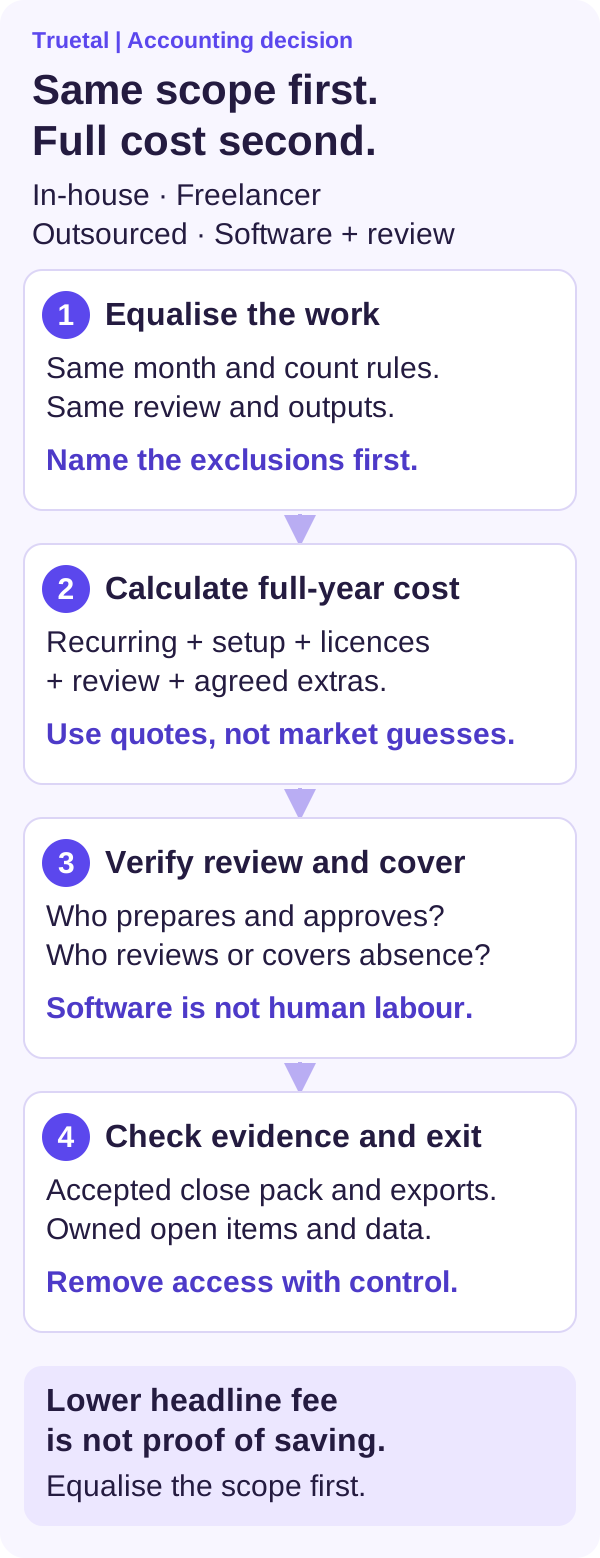
Compare an in-house accountant, freelancer, outsourced firm and software-plus-review arrangement using the same work, records, review level and deadlines. The cheapest monthly headline may exclude bank reconciliation, clean-up, cover, software, professional review or exit exports. Obtain written quotes and calculate the full first-year cost. Choose who can deliver an accepted close with controlled access—not a model that appears cheapest only because work has been omitted.
As of 20 October 2026: this is a buying framework, not an India salary survey or a published service tariff. Fees vary by place, experience, workload and engagement. No universal salary range, market fee, guaranteed saving or included professional service is assumed below.
Compare four models on one scope
“Freelancer” describes an engagement arrangement, not a qualification or promised service level. An outsourced firm may offer several people, but cover and review exist only if agreed. Software is a tool; entering records, reviewing exceptions, approving accounts and submitting statutory returns remain assigned human responsibilities.
Compare written terms for in-house employment, a freelancer, an outsourced firm and software with separately engaged review. No market prices or included professional services are assumed.
| Cost or control factor | In-house accountant | Freelance accountant | Outsourced accounting firm | Software + separately engaged review |
|---|---|---|---|---|
| Recurring cost | Actual compensation and applicable employer costs; obtain a role-specific budget. | Written recurring quote for the same defined work and records. | Written quote identifying processing, review and any minimum commitment. | Software subscription plus separately quoted human work; record owner time. |
| Setup and backlog | Budget onboarding, earlier-period review and any specialist help. | Confirm whether historic clean-up is a separate project. | Confirm migration, opening review and backlog exclusions. | Licence does not include reconstruction; assess migration and clean-up separately. |
| Software and access | Identify licence, equipment, account ownership and access needs. | Agree whose licence is used and whether its cost is included. | State the platform, licence owner, secure access and export rights. | Check the plan features; professional review is not included unless separately contracted. |
| Review and acceptance | Name the reviewer and define the month-end evidence pack. | Name the reviewer; distinguish entry from professional review. | Confirm the actual review level and named escalation owner. | Name who enters, reviews and approves; a suggestion is not approval. |
| Cover and turnaround | Agree absence cover, supervision and the close timetable. | Agree availability, response times and backup arrangements. | Verify staffing, cover and any contractual service levels. | Tool availability does not provide human cover; arrange it separately. |
| Tax work and responsibility | Separate record processing from qualified advice and authorised filing. | List included and excluded tax tasks and who can perform them. | Specify professional scope; do not infer liability transfer. | Software is not a tax opinion or direct filing engagement. |
| Exit and continuity | Retain business-controlled data, backups and a replacement handover. | Agree notice, usable exports, open-item handover and access removal. | Agree data ownership, export formats, support and exit charges. | Check continued access/export terms and the separate reviewer handover. |
Do not read the final column as “software does everything”. If the owner performs entry, record that time. If a separate accountant reviews the month, record the fee, evidence expected and availability. A plan subscription does not automatically buy bookkeeping labour, tax advice, an SLA or professional responsibility.
The existing guide on what a small business should outsource helps divide tasks. This article answers the narrower cost decision: how to compare four proposed delivery models without removing work or accountability from the calculation.
Define the workload before asking for a price
Give each candidate the same sample month and a written description of the output. Use redacted samples or an agreed secure exchange rather than sending financial files to multiple public contact forms.
| Scope question | What to put in the comparison brief |
| Period and entities | Current monthly work or historical clean-up; entity, branches and registrations in scope |
| Record-count basis | Whether invoices, invoice lines, bank rows, payments, journals and settlements count separately |
| Channels and complexity | Bank/card accounts, payment platforms, currencies, inventory, payroll and missing documents |
| Processing | Who collects evidence, enters records, searches duplicates and answers business-purpose queries |
| Review | Bank reconciliation, ageing, exceptions, closing schedules and the named reviewer |
| Statutory work | What records are supplied to the tax professional; any separately contracted advice or filing |
| Delivery and acceptance | Document cut-off, review date, required reports, approval and open-item treatment |
| Continuity and exit | Absence cover, notice, export formats, handover help and removal of access |
For example, an illustrative month contains 180 sales invoices, 100 supplier invoices and 120 bank rows: 400 source rows. It does not necessarily contain 400 independent accounting events. A bank receipt may settle an invoice already counted; one platform settlement may cover many invoices. This is a workload example, not a recommended plan limit or a national transaction benchmark.
Ask every provider to apply its counting rule to that same sample. A quote for “300 transactions” is not comparable until both sides define the word. Ask what happens when one missing document causes repeated queries, or when a current-month task reveals an older error.
Calculate first-year cost without inventing a market rate
Use this worksheet with actual written terms:
First-year cash cost = 12 × recurring monthly charges + setup/migration + annual licences + separately billed review + agreed extras.
Keep applicable taxes and their treatment visible. Compare both options on the same basis; do not mix a tax-inclusive figure with an exclusive one or assume every tax charged is recoverable. Get case-specific tax treatment from the responsible adviser.
Record owner time separately: monthly hours × the business's own chosen planning value. This is an opportunity-cost estimate, not a wage quote or a cash payment. Do not add it once inside a provider's charge and again as the same outsourced hours.
The following numbers are entirely hypothetical worksheet inputs, not market quotations, Truetal prices or salary guidance. Suppose two proposals cover the same agreed monthly close and reports. Both exclude statutory advice and filing. An owner enters these figures solely to test the formula:
| Hypothetical first-year input | Proposal A | Proposal B |
| Recurring processing charge | ₹8,000 × 12 = ₹96,000 | ₹10,000 × 12 = ₹1,20,000 |
| One-time setup | ₹6,000 | ₹3,000 |
| Separate annual software licence | ₹3,600 | Included in the recurring charge |
| Separate annual review charge | ₹12,000 | Included in the recurring charge |
| First-year cash cost before applicable taxes | ₹1,17,600 | ₹1,23,000 |
The hypothetical difference is ₹5,400 in the first year, not the ₹24,000 suggested by comparing monthly charges alone. It is not a promised saving. If A excludes the review depth, secure handover or absence cover provided by B, the scopes are not equal and this calculation cannot decide the engagement. Replace every input with a real quote before making a decision.
For an employee comparison, use the business's actual proposed compensation and applicable employer-cost advice. Include recruitment/onboarding, required equipment, software, supervision and leave/absence arrangements where relevant. Do not apply an unsupported fixed salary multiplier or assume statutory employer obligations are identical for every business.
Who owns preparation, review and approval?
List a named owner for each stage. One person may perform several tasks, but that does not make the control points disappear:
- Business owner: supplies business explanations, controls payment approval and accepts the agreed outputs.
- Preparer: collects and records evidence, links documents and maintains the exceptions register.
- Reviewer: checks material classifications, reconciliations and closing schedules at the agreed level.
- Tax professional or authorised person: handles the separately agreed tax decisions and statutory actions.
- System administrator: manages access, exports and removal of users without sharing personal OTPs.
These are proposed engagement responsibilities, not a statement that hiring a provider transfers statutory liability. Actual legal obligations and contractual remedies depend on the entity, role and agreement. “Automated validation” does not remove errors or make software liable for a return.
ICAI's cash-and-bank guidance identifies authorisation and separation of incompatible functions as control considerations. In a small team, where a separate preparer and reviewer are not practical, agree a compensating owner review and keep its evidence. Do not give one outside person unrestricted authority to change vendors, approve payments and conceal the resulting entries.
Choose a model for its actual operating fit
An in-house arrangement may fit work that needs frequent physical coordination and business context. Ask whether the workload justifies the availability, whether review expertise is separately needed and who covers an absence. Being in the office does not by itself prove the books are reconciled.
A freelancer can fit a defined recurring scope with clear evidence and review times. Confirm the particular person's availability, relevant experience, conflict/backup arrangements and exit obligations. Do not assume a lower commitment automatically means lower risk or that a freelancer cannot support a disciplined close.
An outsourced firm can fit a defined processing-and-review workflow, particularly where several skills or cover are needed. Check the actual assigned team, escalation route, access controls and whether a senior review is included. A sales proposal describing a team is not proof that every month receives that team's attention.
Software plus separately engaged review can fit a business that can reliably collect and enter its own records. It is not a substitute for missing capacity. Include the owner's work, the review engagement and any clean-up in the comparison. A mixed model can also be sensible: internal daily capture, external monthly review and a separate qualified tax engagement.
Test one close and agree how you can leave
Ask what a completed sample-month pack would contain: source-linked records, bank reconciliation, customer/supplier ageing, relevant closing schedules, dated exceptions and reviewer sign-off at the agreed level. A dashboard screenshot or zero unmatched-bank rows is not enough.
Before the engagement starts, agree who owns the data, which native and readable exports will be provided, how much handover support is included and what happens to unresolved items. Confirm software access after the service ends and any licence dependency. Retain backups and filed evidence; revoke only the identified person's access through the proper process.
Avoid comparing an all-inclusive claim with an itemised proposal until the first has a written exclusions list. Other warning signs include no named reviewer, no response route for a missed deadline, a fee that ignores an existing backlog, mandatory password/OTP sharing, no usable export and a claim that tax penalties have simply moved away from the business.
Where Truetal fits—and where it does not
Truetal provides software for invoices, accounting records, reviewed bank-reconciliation suggestions and traceable reports on the applicable plan. The solutions for finance teams describe the workflow; Truetal flexible business pricing describes software plans. Confirm current inclusions, taxes and any separate implementation or migration quote there.
Neither a software plan nor this comparison promises an employed accountant, outsourced processing hours, a professional reviewer, an SLA or a savings calculator. Accounting support, catch-up work, tax advice, certification and statutory filing require their own agreed scope. Direct GST/ITR filing is not represented here as a live Truetal capability.
The useful next step is a scoped discussion of the sample month and required delivery pack. Share approximate volumes, accounts, current tools and the problem—not confidential statements, client files, passwords or OTPs through the public form. Choose the arrangement after comparing evidence, responsibilities and full cost, not after reading an invented industry fee range.
Frequently asked questions
Is a freelance accountant always cheaper than a full-time employee?
No universal conclusion is reliable. Compare actual written terms for the same workload, review depth, tools, cover and outputs. Include setup, separate review, software, agreed extras and owner time without counting the same work twice.
What should an outsourced accounting quote include?
It should define the covered period, counting basis, source requirements, processing and review scope, outputs, timing, exclusions, named responsibilities, access, data ownership and exit terms. Confirm historical clean-up and statutory work separately.
Does accounting software include an accountant or tax filing?
Not merely because it is accounting software. Check the actual plan and separate engagement. Truetal software does not include professional labour, tax opinions, an SLA or direct GST/ITR filing by default.
Does outsourcing transfer the business tax liability?
Do not assume that. Legal obligations and contractual remedies depend on the entity, role and agreement. Assign preparation, review, approval and authorised filing explicitly, and obtain case-specific professional advice where needed.
How should I compare a per-transaction fee with a monthly retainer?
Apply both providers counting rules to the same sample month. Clarify whether invoices, lines, bank rows, payments, journals and settlement batches count separately, then compare the same required outputs and expected volume.