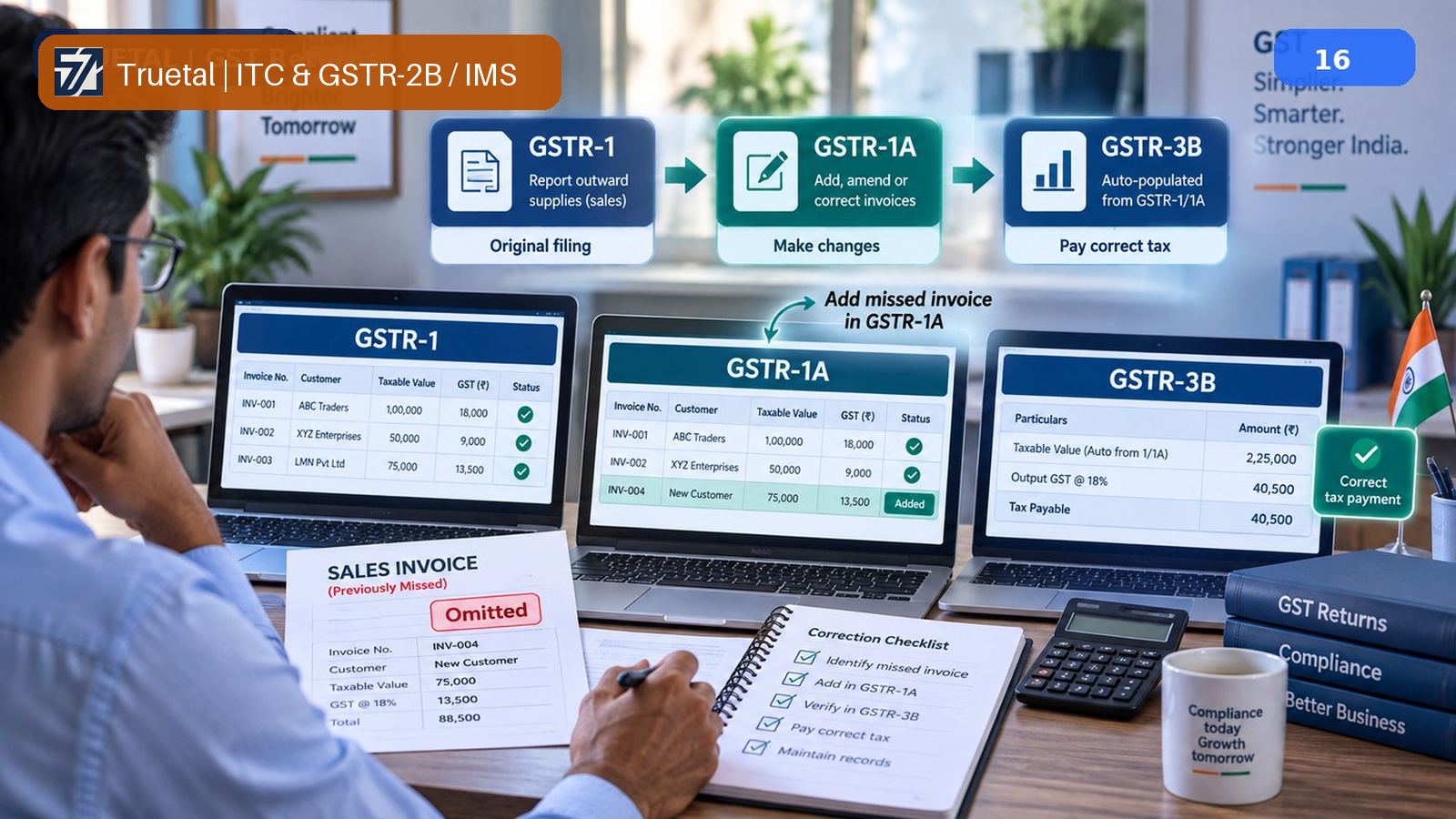

The direct answer
The 57th GST Council has recommended a structured way to correct or align liability and input tax credit information in GST returns. The package includes proposed changes to GSTR-1/1A/IFF and GSTR-3B, an Electronic Credit Reversal and Reclaim Statement under proposed Rule 86C, and an RCM tax-paid and ITC-claimed statement under proposed Rule 86D.
It is not live merely because the Council announced it. A taxpayer cannot treat the press release as permission to revise a filed GSTR-3B today. Use the process available under the law and portal for the relevant return period, and verify the final rules before changing a filing workflow.
Status as of 9 October 2026: This is a GST Council recommendation. The Council said the alternate correction mechanism may be brought into force from the return for April 2027, after consultation. Implementing rules, forms, circulars and portal functionality are awaited. Current law and current portal procedures continue meanwhile.
What has been recommended
The official release describes a connected return architecture rather than one new edit button:
- enhanced comparison of GSTR-1/1A/IFF liability with GSTR-3B;
- a mechanism under Rule 61 for correct reporting and correction of liability;
- a proposed Rule 86C statement for ITC reversal and reclaim;
- a proposed Rule 86D statement linking RCM tax paid with ITC claimed;
- invoice details in DRC-03 where a payment relates to an underlying invoice;
- IMS rules for accepting, rejecting or keeping documents pending; and
- a mechanism aligning ITC in GSTR-3B with GSTR-2B.
The practical direction is clear: liability, ITC, RCM and corrective payments are expected to become more traceable to their source records. The final legal wording and portal validations will decide exactly how that works.
Current decision table
| Situation | What to do now | What the proposal may change |
| GSTR-1 liability exceeds GSTR-3B | Reconcile the invoice-level cause and use the currently permitted correction/payment route | A more direct alignment mechanism is proposed |
| ITC was reversed temporarily | Maintain a period, reason and document-level reclaim register | Proposed Rule 86C may formalise the electronic trail |
| RCM tax was paid but ITC timing differs | Keep the self-invoice, payment and eligibility evidence linked | Proposed Rule 86D may connect tax paid and credit claimed |
| A DRC-03 payment corrects an invoice error | Record the affected invoice and calculation internally | DRC-03 is proposed to capture the underlying invoice |
Worked example
A business reports taxable sales of ₹12,00,000 in GSTR-1 but carries only ₹11,00,000 into GSTR-3B because one invoice was omitted from its return working. Separately, it reversed ₹18,000 of ITC while waiting for evidence and later became eligible to reclaim it.
The correct control is two separate bridges:
- a liability bridge that identifies the omitted sales invoice, tax impact and correction/payment route; and
- an ITC bridge showing the original credit, reversal period, reason, supporting evidence and permitted reclaim period.
Do not net the two errors together simply because one increases tax and the other may increase credit. The proposed statements reinforce that separation, but the same discipline is useful today.
Preparation checklist
- Reconcile GSTR-1/1A/IFF with GSTR-3B before every filing.
- Reconcile purchase records and eligibility decisions with GSTR-2B and IMS.
- Maintain an invoice-level ITC reversal and reclaim register.
- Separate RCM liability, payment and later ITC eligibility.
- Link every voluntary payment to its reason and source invoice.
- Preserve reviewer approval and the version of the working used for filing.
- Do not rebuild software validations until final schemas and effective dates are published.
Common mistakes
- Calling April 2027 a confirmed launch date when the release says the mechanism may start then.
- Treating GSTR-2B appearance as automatic ITC eligibility.
- Netting unrelated liability and ITC errors in an offline worksheet.
- Reclaiming a reversed credit without preserving why it became eligible.
- Claiming that Truetal can revise or file the return when that facility is not live.
The takeaway
The recommendation points toward a better audit trail, not a present right to reopen any filed GSTR-3B. Build clean liability, ITC, RCM and payment bridges now. When the final rules and portal release arrive, those records will make migration safer and corrections easier to explain.