

The direct answer
The 57th GST Council recommended a more automated refund system. In the proposed first phase, acknowledgement or a deficiency memo would be due within 10 days; silence would lead to system-generated deemed acknowledgement. For acknowledged, low-risk zero-rated or inverted-duty claims, the system would provisionally sanction 90% without officer intervention. Later phases would add more automated validation and final sanction in specified cases.
This does not mean every RFD-01 will now produce an automatic payment. Risk classification, statutory restrictions, exclusions, validation and final scrutiny still matter.
Status as of 9 October 2026: The two-phase framework is a Council recommendation and the official FAQ describes several steps as proposed. Confirm the relevant amendments, notification and portal rollout before relying on the 10-day or three-working-day timelines. Current refund law and live portal behaviour continue until implementation.
Proposed process at a glance
| Stage | Proposed treatment | Important limit |
| RFD-01 filed | Structured, system-readable information | Incorrect data can fail validation |
| Completeness check | Acknowledgement or deficiency memo within 10 days | A deficiency requires a fresh application |
| No response within 10 days | Deemed acknowledgement | This is not refund approval |
| Low-risk zero-rated or IDS claim | 90% provisional system sanction | Exclusions and statutory restrictions apply |
| Final processing | Officer review in Phase I; more automation in Phase II for specified claims | Pending dues and proceedings may affect release |
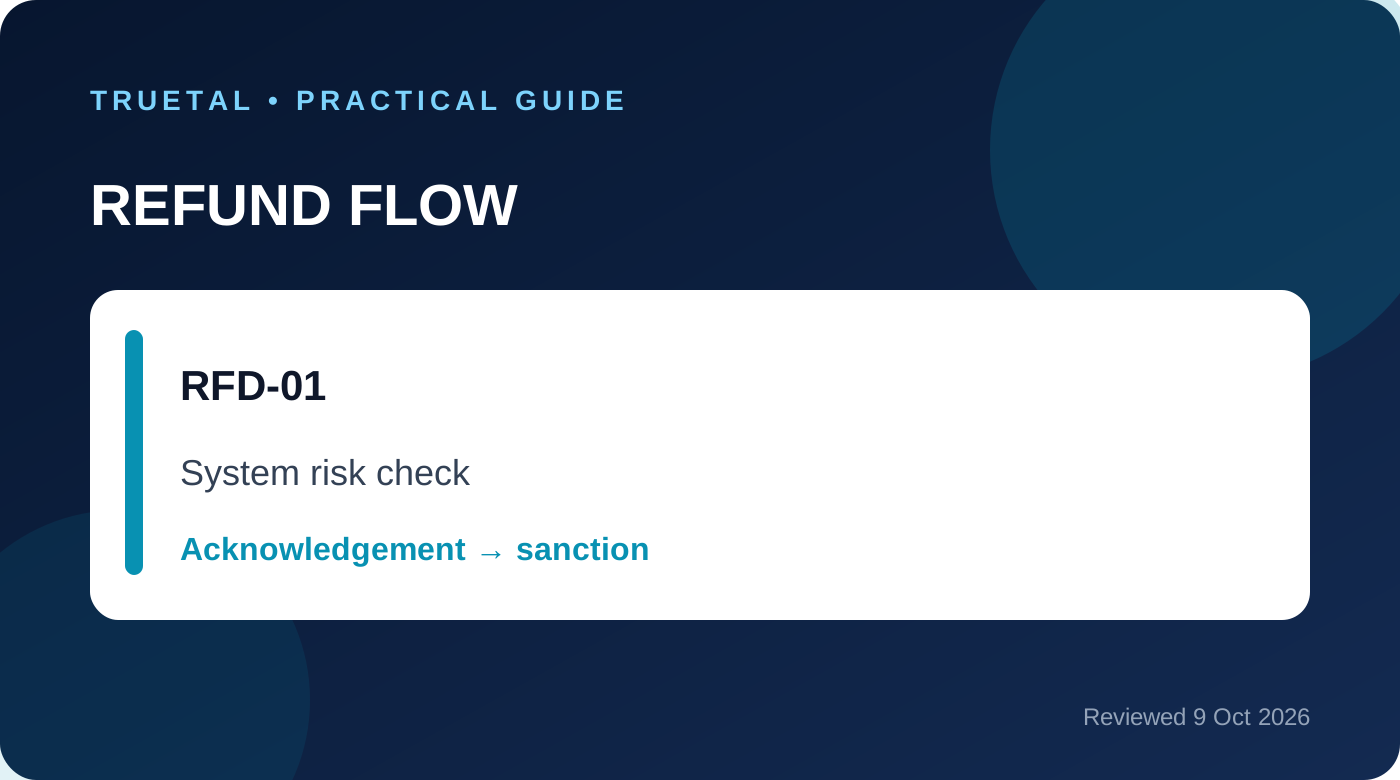
The FAQ also refers to a proposed system-issued RFD-04 within three working days of acknowledgement for qualifying low-risk claims. Treat that as a proposed service design until the operative rules and system release are verified.
Worked example
An exporter files a ₹10,00,000 refund claim for unutilised eligible ITC. Its books, returns, shipping data and bank-realisation evidence agree, Aadhaar authentication is complete, and no stated exclusion applies.
Under the proposed low-risk path, the system could provisionally sanction ₹9,00,000 after acknowledgement. That is not a promise that the claim will receive that treatment: risk selection and legal conditions decide the route, and final scrutiny can still test the claim.
If the shipping-bill value differs from the return, or the claim includes blocked ITC, faster automation may simply surface the mismatch sooner. Automation rewards clean evidence; it does not cure an ineligible claim.
Refund-readiness checklist
- Match RFD-01 figures with GSTR-1, GSTR-3B and the electronic credit ledger.
- Reconcile eligible ITC with purchase records and GSTR-2B.
- Exclude blocked or otherwise ineligible credit.
- Complete required Rule 42 or Rule 43 reversals.
- Match export details with shipping-bill, ICEGATE or SEZ records as applicable.
- Keep foreign-remittance evidence for export of services where required.
- Confirm Aadhaar authentication and any notified-person exclusions.
- Review pending demand, appeal and withholding conditions.
- Preserve the exact data and calculation version submitted.
Common mistakes
- Equating deemed acknowledgement with sanction.
- Promising a 90% refund to every applicant.
- Filing the same defective data again after a deficiency memo.
- Including all GSTR-2B credit without an eligibility review.
- Mixing the 2025 risk-based measures with every feature in the newly proposed two-phase system.
The takeaway
Faster refund processing makes data quality more important, not less. Build a claim that can be validated across books, returns and external evidence. Until the new framework is legally and technically implemented, follow the process actually available on the GST Portal.