A supplier credit note appears in your GSTR-2B, but commercially you disagree with the deduction. The GST document and the commercial dispute now move together, but they are not the same issue. Ignoring either side can cause a second mismatch later.
The Short Answer
Do not ignore the credit note. Match it to the commercial dispute, inspect the supplier document, use Invoice Management System (IMS) options available for the tax period, and document whether input tax credit (ITC) was previously availed / reversed so the tax impact is not duplicated.
In Plain Words
Keep two linked statuses: 'commercial dispute' and 'GST/IMS status'. A buyer may disagree with a quality deduction while still needing to deal with the credit note appearing in the GST system. The control should prevent the same ITC reduction from being recorded twice.
Step 1: verify it actually appears in your GSTR-2B
Before anything else, confirm the disputed credit note has actually shown up in your GSTR-2B — this is what determines whether it affects your ITC calculation at all.
Step 2: reject it in IMS if you don't accept it
Reject where the record is not yours, names the wrong recipient or otherwise should not be accepted. If the note belongs to you but the amount, tax effect or underlying commercial adjustment is disputed, document the disagreement and obtain case-specific advice before selecting the IMS action; a commercial dispute alone does not automatically determine the tax treatment.
Step 3: raise the dispute with the supplier directly
Rejecting in IMS handles the GST-return side. The underlying commercial disagreement — why the credit note was issued, whether it's justified — still needs to be resolved directly with the supplier, through your normal commercial channels.
Step 4: document the resolution before filing
Once the dispute is resolved one way or another, keep a clear record of the outcome and the reasoning, so the treatment in your return is defensible if it's ever questioned later.
Why silence is the risky path
Silence is still a decision because IMS can apply a default treatment when GSTR-2B is generated. Review the note before the relevant return workflow, keep the supplier correspondence and ensure the IMS action matches the document facts rather than using Reject as a blanket response.
Worked example: a credit note you disagree with
Scenario: A supplier issues a credit note of ₹50,000 (₹9,000 GST) against an earlier invoice. You believe the goods were never returned and the credit note is wrong. It appears in your GSTR-2B.
- Confirm it is in 2B for the period, since that is what affects your ITC calculation.
- Reject it in IMS, with a note. A silent credit note would otherwise reduce your available ITC by ₹9,000.
- Raise the dispute with the supplier through your normal commercial channel and attach the delivery records.
- Record the outcome. If the supplier withdraws the note, nothing changes in your books. If the dispute is resolved in the supplier's favour, book the credit note and reverse the ITC in the period the resolution is agreed.
- File the paper trail so the treatment in your return is defensible.
Result: The disputed credit note does not silently reduce your ITC while the commercial argument is still open.
Key takeaway: Treat the commercial disagreement and the GST consequence as two connected lanes, and do not let either lane silently overwrite the other.
Illustrative example. Actual treatment may depend on the facts and rules applicable on the transaction date.
The Key Steps at a Glance
Read the four steps in order — each one depends on the one before it.
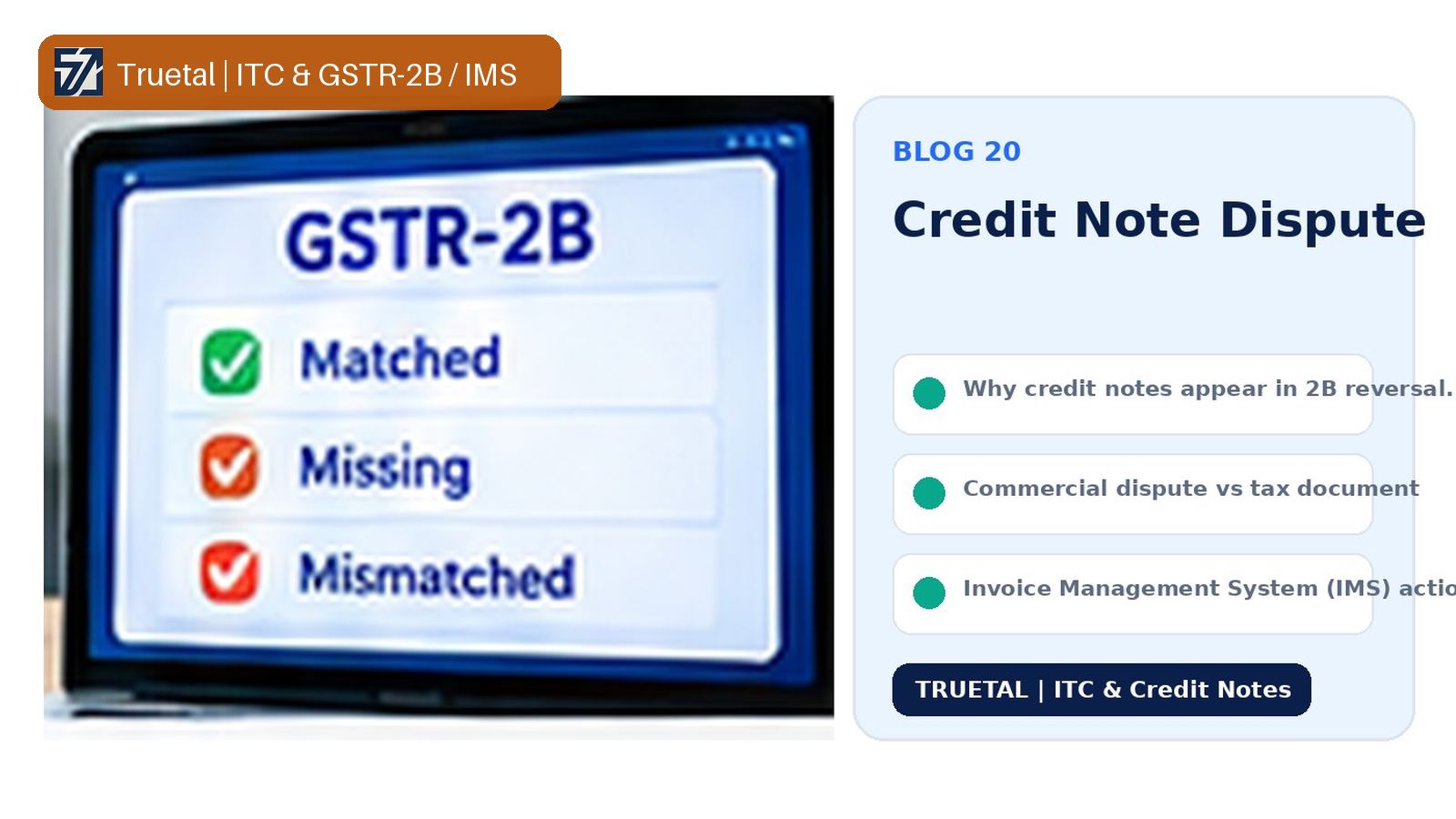
- 1Why credit notes appear in 2B reversal section
- 2Commercial dispute vs tax document
- 3IMS action options and current-period rules
- 4Avoid double ITC reduction
What to do now
- Check your GSTR-2B for the disputed credit note before doing anything else.
- Reject it in IMS if you don't accept it — don't just ignore it.
- Resolve the underlying commercial dispute separately, and document the outcome.
Common mistakes
- Assuming disagreement alone is enough, without taking the actual IMS rejection action.
- Letting a disputed note sit unaddressed until return-filing deadline pressure forces a rushed decision.
- Not documenting the resolution, leaving the treatment unexplained if questioned later.
The Takeaway
Treat the commercial disagreement and GST consequence as two connected lanes, and do not let either lane silently overwrite the other.
How Truetal Helps
Truetal can place credit-note exceptions in a review queue with the supporting invoice and supplier records; the authorised user remains responsible for the IMS and return action.
Questions People Search For
- Credit note in GSTR 2B what to do buyer
- Wrong supplier credit note IMS
- GSTR 2B credit note ITC reversal
GST Portal Invoice Management System documentation.