
A profitable business can still struggle to pay salaries. A business with a healthy bank balance can still be losing money. Profit, cash balance and cash flow are connected, but they are not interchangeable.
The short answer
A cash flow statement explains how cash and cash equivalents changed during a period by grouping movements into operating, investing and financing activities. For a business owner, it answers: did normal operations generate cash, what long-term assets were bought or sold, and how did borrowings or owner/company funding change the position?
The core control is simple:
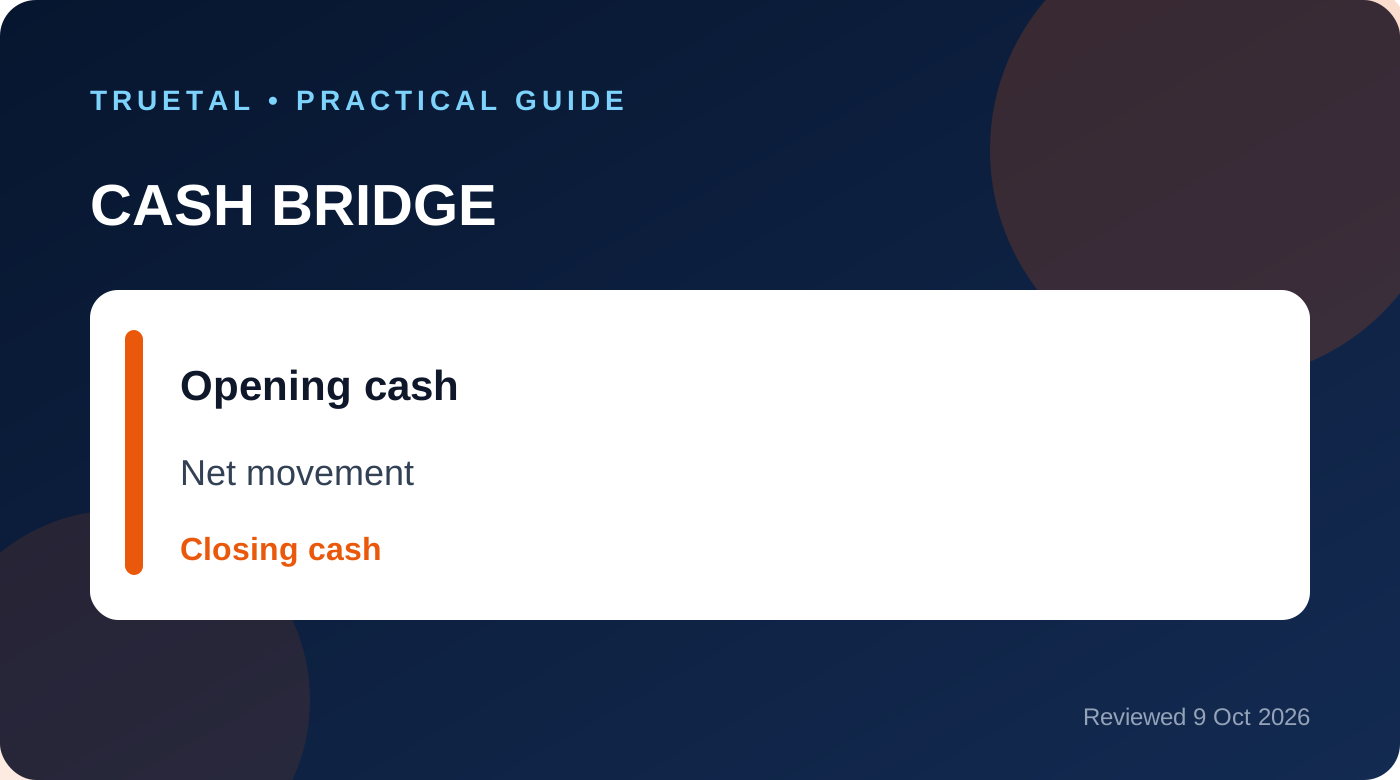
Opening cash and cash equivalents + net cash movement = closing cash and cash equivalents.
The classification and statutory presentation require the applicable accounting framework. ICAI AS 3 provides the formal principles. Small businesses can also use the same structure as a management view, even where a statutory cash flow statement is not required.
The three sections
| Section | What it explains | Common examples |
| Operating activities | Cash generated or used by normal business | Customer receipts, supplier/employee payments, operating expenses |
| Investing activities | Cash used for or received from longer-term assets/investments | Machinery purchase, asset sale, qualifying investments |
| Financing activities | Changes in borrowings and owners' financing | Loan proceeds/repayment, capital introduced, dividends/drawings as applicable |
Classification can depend on the applicable standard and facts. Interest, taxes and owner-related flows need consistent treatment under the relevant framework. Do not classify a line by its bank narration alone.
Worked example: profit but tight cash
Consider a small distributor for September:
- Sales invoices raised: ₹8,00,000.
- Cost and operating expenses recognised: ₹6,20,000.
- Accounting profit before other items: ₹1,80,000.
- Customers actually paid only ₹5,20,000 during the month.
- The business paid suppliers and operating expenses of ₹5,60,000.
- It bought equipment for ₹1,00,000 in cash.
- It received a new term loan of ₹2,00,000.
- It repaid ₹40,000 of loan principal.
- Opening cash and bank balance was ₹90,000.
A simplified management cash flow is:
| Cash flow | Amount |
| Customer receipts | ₹5,20,000 |
| Supplier and operating payments | (₹5,60,000) |
| Net operating cash flow | (₹40,000) |
| Equipment purchase | (₹1,00,000) |
| Net investing cash flow | (₹1,00,000) |
| Loan received | ₹2,00,000 |
| Principal repaid | (₹40,000) |
| Net financing cash flow | ₹1,60,000 |
| Net increase in cash | ₹20,000 |
| Opening cash and bank | ₹90,000 |
| Closing cash and bank | ₹1,10,000 |
The business reports profit but generated negative operating cash because customers had not yet paid enough. Its closing cash increased only because new borrowing more than funded the equipment purchase and operating shortfall. That is a very different story from “bank balance increased by ₹20,000”.
Why profit does not equal cash
An invoice can create revenue and receivable before cash arrives. A purchase bill can create an expense or inventory and payable before it is paid. Depreciation reduces accounting profit without a current cash payment. Loan proceeds increase cash but are not sales. Buying equipment reduces cash but is not normally the full period expense.
This is why the cash flow statement must connect with the Profit & Loss account, Balance Sheet, receivables, payables, fixed assets, borrowings and bank records.
Direct and indirect methods
Under the direct method, operating cash flows show major classes of actual receipts and payments. Under the indirect method, the operating section starts from profit and adjusts for non-cash items and working-capital changes.
The worked example above is a simplified direct-style management view. A statutory statement must follow the applicable AS 3/Ind AS requirements, accounting policies and disclosures. Do not mix methods halfway through or use a cashbook total without classifying non-operating flows.
Monthly preparation checklist
- Set the exact period and entity.
- Reconcile each bank account and cash ledger.
- Confirm opening balances equal the prior closing balances.
- Review customer receipts separately from sales invoices.
- Review supplier/expense payments separately from purchase recognition.
- Identify asset purchases and proceeds from asset sales.
- Separate loan principal from interest and fees.
- Identify capital, drawings, dividends or other owner/company financing correctly.
- Check transfers between your own bank accounts cancel out in the combined statement.
- Reconcile the calculated closing cash with the Balance Sheet and underlying ledgers.
- Investigate unclassified and suspense items rather than forcing them into operations.
- Compare operating cash with profit and explain the largest working-capital movements.
Decisions the statement should trigger
| Finding | Question for the owner |
| Profit positive, operating cash negative | Are receivables or inventory consuming cash? |
| Cash positive mainly from new debt | Can operations service future repayments? |
| Large investing outflow | Was the asset planned and is working capital still adequate? |
| Supplier payments delayed | Is reported cash being preserved by stretching payables? |
| Customer receipts improving | Are old invoices actually closing, or are advances masking ageing? |
| Repeated unexplained bank lines | Is the reconciliation process complete? |
Common mistakes
- Calling every bank credit operating income.
- Treating a loan receipt as sales or profit.
- Treating transfers between own accounts as inflow and outflow for the combined business.
- Using invoice totals instead of actual cash receipts in a direct-method view.
- Mixing loan principal, interest and bank charges.
- Omitting cash-in-hand or including restricted/non-qualifying balances without review.
- Assuming a positive closing bank balance means operations are healthy.
- Preparing the statement from an unreconciled bank account.
- Presenting a management summary as a statutory AS 3 statement without professional review.
How Truetal helps
Truetal's accounting reports include a cash-flow view built from the same source-linked records used by the ledgers and other financial reports. Bank transactions, invoices, payments, bills, expenses, assets and journals remain separate source types so a reviewer can investigate the movement behind a figure.
The report depends on complete, reviewed books. Imported bank lines that have not been checked or posted do not become accounting truth merely because they appear in a statement upload. Classification and statutory presentation should be reviewed with your accountant.
FAQ
Is cash flow the same as bank balance?
No. Bank balance is a point-in-time amount for an account. Cash flow explains movements across the period and may include multiple bank accounts and qualifying cash equivalents.
Why can a profitable business have negative operating cash flow?
Revenue may be unpaid, inventory may have increased, suppliers may have been paid faster, or non-cash income/expenses may affect profit. Review working-capital changes and source records.
Should transfers between my own bank accounts appear as cash flow?
For a combined business cash flow, a transfer between two included cash accounts is not an external inflow or outflow. Both statement sides still need reconciliation.
Does every small business have to prepare a statutory cash flow statement?
Applicability depends on entity type and the relevant accounting framework, with exemptions in some cases. ICAI AS 3 notes the applicable framework; confirm your own obligation with your accountant.
How often should management review cash flow?
Monthly is a useful minimum for many small businesses, with weekly cash monitoring when collections, inventory buying or debt servicing are tight. The statutory reporting period may differ.
The takeaway
Profit tells you whether income exceeded expenses under accounting rules. Cash flow tells you how money moved. Use both, reconcile them to the same books, and investigate whether growth is producing cash or consuming it.