
The direct answer
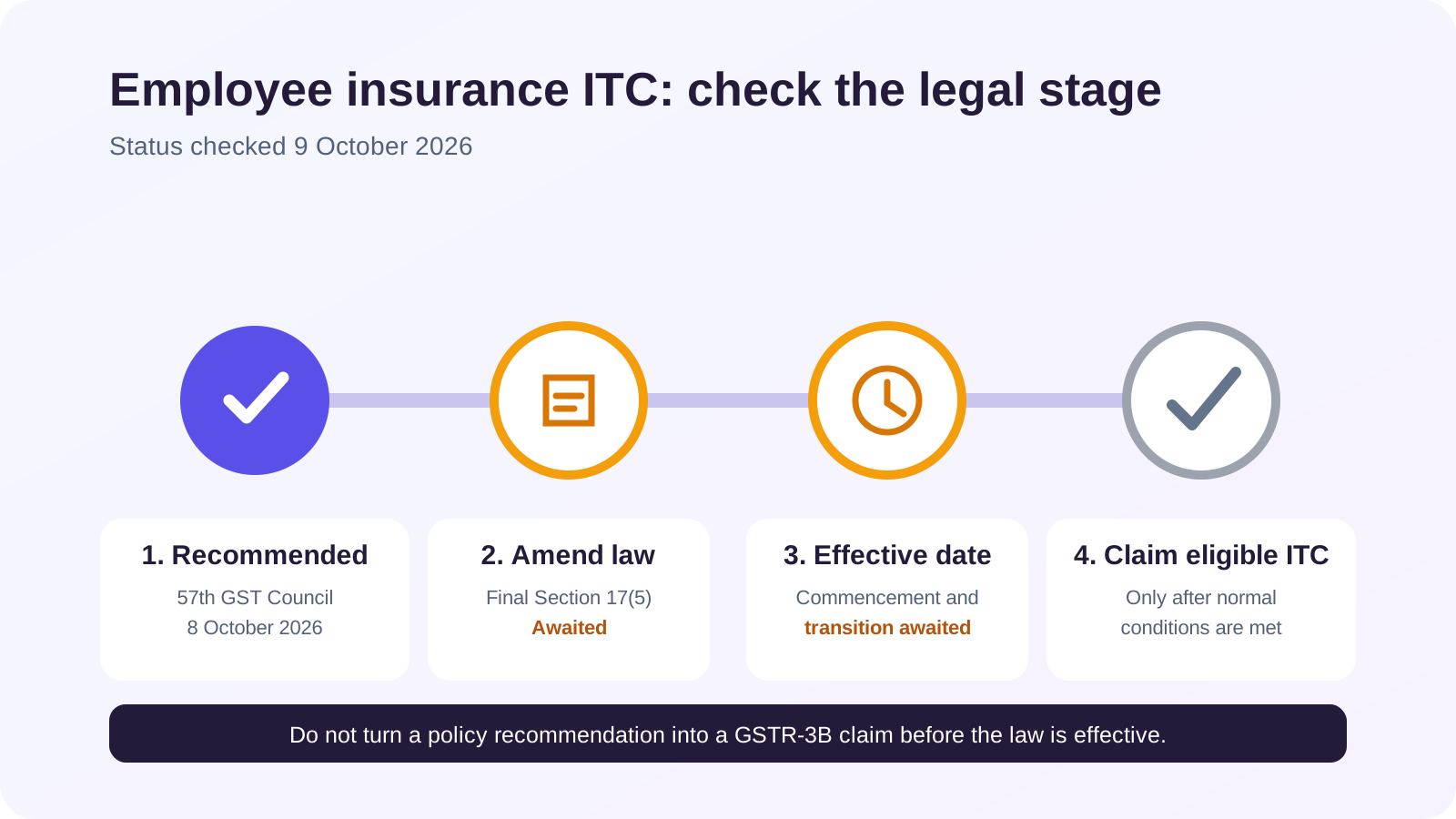
On 8 October 2026, the 57th GST Council recommended amending Section 17(5) of the CGST Act to remove restrictions on input tax credit (ITC) for several supplies, including health and life insurance. That is potentially valuable relief for employers paying GST on group policies.
But a Council recommendation is not, by itself, an operational amendment. As of 9 October 2026, employers should not assume that all GST on employee group health or life insurance can already be claimed. The implementing law and its effective date are still awaited.
Status as of 9 October 2026: Council recommendation announced. Implementing amendment and commencement date awaited. Continue applying the current Section 17(5) rule and its existing exceptions until the law changes.
What the GST Council recommended
The official Ministry of Finance release says the Council recommended amending Section 17(5) to remove blocked-credit restrictions, including those affecting health and life insurance. It describes the objective as reducing tax cascading and improving the flow of ITC.
This is broader than an insurance-rate announcement. It is about whether a registered business may use the GST charged on an eligible inward supply as credit against its output GST liability.
The official release does not state an effective date for this particular Section 17(5) proposal. That matters: other recommendations in the same release carry specific dates, but item 9 does not. The release also cautions that Council recommendations take legal effect through the relevant legislation, notification or circular.
What has not changed yet
Until the amendment is enacted and brought into force, the present blocked-credit framework continues.
Under the current Section 17(5)(b) position, ITC on life and health insurance is generally blocked, subject to specific exceptions. CBIC Circular 172/04/2022-GST clarifies that the proviso for benefits an employer is obliged to provide under a law in force applies across clause (b). Another exception can apply when the inward supply is used to make an outward taxable supply of the same category or as part of a taxable composite or mixed supply.
The exact eligibility of a policy therefore still depends on the employer, the applicable law, the policy structure and normal ITC conditions—not only on the words “employee health insurance” on an invoice.
Recommendation versus claimable credit
| Stage | What it means | Employer action |
| GST Council recommendation | Policy decision announced on 8 October 2026 | Understand the proposal; do not book a new claim solely from the announcement |
| CGST Act amendment | Parliament/state-law process gives the change legal form | Read the final wording; do not assume it matches every press summary |
| Effective-date notification or commencement | The operative date and possible transition rules become known | Map invoices and tax periods to the confirmed date |
| Eligible ITC claim | Section 16 conditions, document evidence, GSTR-2B and apportionment are satisfied | Claim only the supported amount and retain the review trail |
Do not confuse group-policy ITC with the individual-policy exemption
Individual and employer-sponsored group insurance now sit in different tax conversations.
The Department of Financial Services says GST on specified individual life and health insurance policies was exempted from 22 September 2025. It also says employer-sponsored group health and group life policies continue to attract GST at 18%.
The 2026 Council recommendation is therefore not a simple extension of the individual exemption. It concerns the employer's ability to take credit for GST charged on relevant business insurance inputs. A taxable group premium and a potentially available employer ITC can coexist.
Worked example: a ₹5 lakh group health premium
Assume an insurer charges a registered employer:
| Item | Amount |
| Group health insurance premium | ₹5,00,000 |
| GST at 18% | ₹90,000 |
| Total invoice | ₹5,90,000 |
Under the general current blocked-credit rule, the ₹90,000 is not automatically available merely because the policy covers employees or supports the business. An existing exception may apply—for example, where a law in force obliges that employer to provide the benefit—but that conclusion must be documented against the employer's facts.
If the recommended amendment later becomes effective with sufficiently broad wording, the employer may be able to claim some or all of the eligible GST, subject to the final law, Section 16 conditions, exempt/non-business-use apportionment and any transition rules. This would not necessarily create a cash refund or make the total premium “18% cheaper”; it would create usable credit only to the extent legally available.
What finance teams should do now
1. Build a policy-level evidence file
Keep the policy schedule, insurer's GST tax invoice, GSTIN, coverage period, employee class covered, premium payment evidence and any endorsements or employee recoveries together. If the existing legal-obligation exception is being considered, retain the exact statute, rule or licence condition relied on.
2. Reconcile the insurer invoice with GSTR-2B
GSTR-2B appearance is an evidence check, not the final eligibility decision. Match supplier GSTIN, invoice number/date and tax amount, then investigate missing or amended documents before taking credit.
3. Separate the proposed credit from today's return
Use a review status such as “awaiting legal commencement” instead of placing the whole GST amount into claimable ITC. This prevents a news headline from becoming an unsupported GSTR-3B figure.
4. Watch for the final wording and effective date
The amendment may define scope, conditions or transition treatment differently from early summaries. Recheck the article and your internal position when the Finance Act/amending Act and commencement notification are published.
5. Review business use and recoveries
Check whether coverage includes only employees or also family members, whether employees reimburse any premium, whether the business makes exempt supplies, and whether common-credit apportionment applies. These facts can affect the eligible amount even after a broader Section 17(5) change.
Common mistakes to avoid
- Claiming ITC from 8 October 2026 solely because a headline says employers “get ITC”.
- Treating the Council press release as a notification or retrospective amendment.
- Confusing GST exemption for qualifying individual policies with employer ITC on taxable group policies.
- Assuming every rupee of GST becomes cash savings without checking output liability and apportionment.
- Using GSTR-2B presence as proof of legal eligibility.
- Forgetting to revisit invoices once the operative amendment and effective date are published.
How Truetal can support the control
Truetal can compare uploaded GSTR-2B evidence with purchase records, surface mismatches for review and keep supplier follow-up connected to the underlying invoice. That helps the finance team answer “is the tax invoice present and matched?”
It does not replace the separate legal question “is this employee-insurance ITC eligible under the law in force for this period?” Keep that decision documented with your CA or GST adviser, especially while the 2026 recommendation is awaiting implementation.
The practical conclusion
The 57th GST Council recommendation is meaningful, but the safe action today is preparation—not premature claiming. Organise policy and invoice evidence, reconcile GSTR-2B, identify any existing statutory-obligation exception, and wait for the final amendment and commencement date before applying the wider relief.
For the broader blocked-credit framework, read Section 17(5) blocked ITC categories. If the insurer invoice is missing from your statement, use What to do when ITC is not showing in GSTR-2B.
Sources
- PIB — Recommendations of the 57th GST Council meeting (8 October 2026)
- CBIC Circular 172/04/2022-GST — Section 17(5)(b) and employer-obligation exception
- Department of Financial Services — GST treatment of individual and group insurance from 22 September 2025
- Economic Times — report on the Council recommendation (9 October 2026)