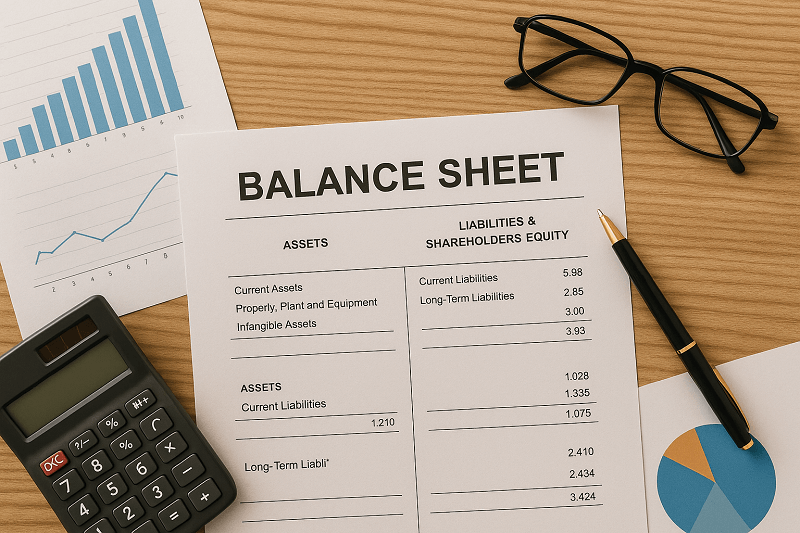
Let’s start with a truth no one told me when I began…
You don’t need to be a CA or MBA to understand your business numbers.
You just need to care — enough to open your balance sheet, breathe, and ask, “Is my business okay?”
This article isn’t one of those boring, over-technical write-ups you close after two lines.
This is me — Mahesh from Truetal.in — speaking to you directly as a business owner who’s been through sleepless nights, confused by financial jargon, and unsure if that big sale meant “profit” or another debt cycle.
So, let’s walk through your balance sheet — together.
What Is a Balance Sheet Really?
A balance sheet is like your business’s X-ray report.
It shows:
- What you own (Assets)
- What you owe (Liabilities)
- What’s left for you (Equity)
That’s it. No rocket science.
But what it reveals can either be your saving grace… or your silent killer.
Why This Guide is Different
You’ll find hundreds of “how to read a balance sheet” articles online. But most of them won’t tell you:
🔍 “A current ratio under 1.0 is like bleeding internally — you won’t see it immediately, but it can kill your business.”
🔍 “One big client paying late can break your monthly cash flow.”
🔍 “Profit doesn’t mean you’re safe. Liquidity does.”
These are the things no textbook, no free YouTube crash course tells you. But they should.
Let’s Break It Down (No Jargon, Just Real Talk)
1. Assets – What You Own
- Current Assets: Cash, receivables (clients who haven’t paid yet), inventory.
- Non-Current Assets: Office laptop, furniture, machinery.
👉 Cash is king. Receivables = hope. Inventory = cash stuck.
👉 Too much inventory? You’re buying without selling.
👉 Receivables ageing over 30 days? You’re funding clients’ businesses, not yours.
2025 insight: Most SMEs today sit on massive receivables. A recent report revealed 29% of businesses could collapse if just one client delays payment. You read that right — one client.
2. Liabilities – What You Owe
- Current Liabilities: Unpaid supplier bills, staff salaries, credit card dues.
- Long-Term Liabilities: Loans, EMIs, lease payables.
👉 You can be profitable and still crash if liabilities outweigh liquidity.
Hidden stat from 2024: SME credit card debt rose 16–20% vs. pre-Covid levels. Most people think: “Loans are bad.” But that’s not always true.
👉 If your debt grows but your assets and equity grow faster — you’re building something real.
3. Equity – What’s Yours
This is the leftover cake after you’ve paid off everyone else.
If equity is rising — you’re adding real value.
If equity is dropping — you’re eating your past profits just to survive.
Real Insights No One Tells You
Let me lay down some brutal truths that most guides miss:
| Insight | Why It Matters |
| Current Ratio < 1 | You’re spending more than you can repay monthly. Liquidity issue ahead. |
| Too much reliance on 1–2 clients | If 1 doesn’t pay, you might miss salary, rent, or EMI. |
| Inventory turnover low (<5x/year) | You’re piling up stock, not converting it to cash. |
| Profit ≠ Safe | You can be profitable and still default if cash doesn’t flow. |
Gravity Payments (2024) shared that companies with profits still went bankrupt — because they ignored liquidity ratios. The profit was on paper. The cash was missing
The Balance Sheet Reality Check (My Tool for You)
Every month, just sit for 30 minutes with these 5 questions:
- Is my cash better than last month?
- Are receivables below 30 days?
- Am I adding debt for survival or growth?
- Did my equity grow?
- Would I invest in this business if I weren’t the founder?
Bank of America’s 2025 checkpoint says most small businesses still survive — not because of big revenue — but because they watched their liquidity and equity every single month.
A Real-World Case You’ll Never Forget
An Australian SME had ₹75 lakh revenue but depended on two clients.
- One delayed payment.
- They defaulted on vendor bills.
- In just 21 days, they were at insolvency risk.
Had they monitored their balance sheet, especially receivables and current liabilities, they would’ve seen the storm coming.
Final Words: Your Balance Sheet Is Not a File — It’s a Mirror
You’ve worked too hard to not know where your business stands.
This guide isn’t just accounting advice — it’s a survival and growth tool.
It’s what I wish someone had told me 5 years ago.
And I want you to win faster than I did.